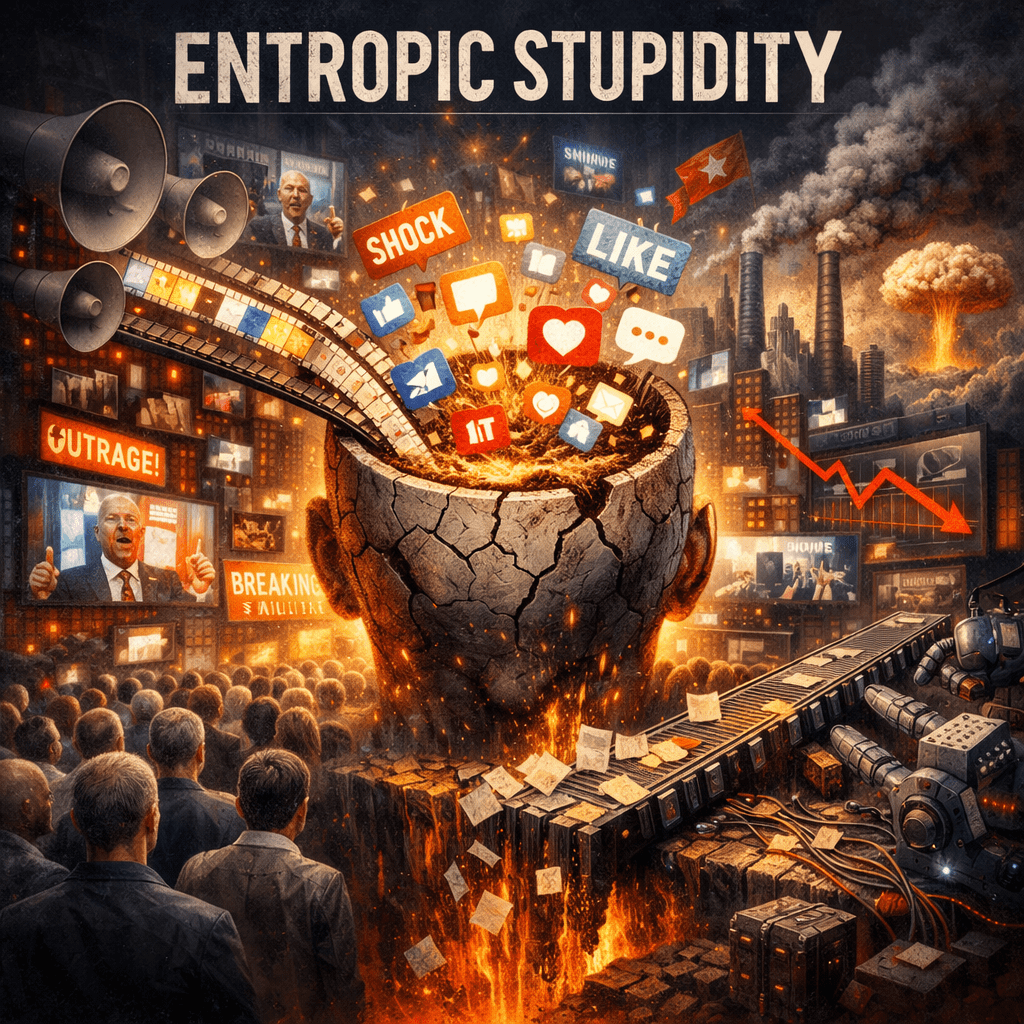
The communicative field—call it language, media, platforms, signalling systems, whatever—does not sit outside us. It evolves through us, as us. What most people experience as agency, originality, or personal control is largely a selection effect inside a much larger communicative metabolism. We choose from it, we modulate it slightly, but the directionality is not ours. The system is not serving intelligence; it is optimising throughput.
What we are watching now is not merely the rise of “bad actors” or incompetent leaders. It is the systematic favouring of low-friction cognition: simplified language, compressed narratives, emotional triggers, jingoism, slogans, spectacle. Speed beats depth. Familiar beats accurate. Repetition beats reflection. This is not accidental. It is how high-velocity communication systems stabilise themselves under load. The cost is intelligence itself.
Intelligence is not an individual possession. It is a field property. It emerges from dense, slow, recursive relational networks—especially linguistic ones. When those networks are flattened and accelerated, intelligence does not disappear dramatically; it thins. It becomes less detectable, less usable, less valued. People do not suddenly become stupid. They are trained into conditions where stupidity is adaptive. And because everyone is immersed in the same field, the degradation is largely invisible from the inside.
Authoritarian and fascistic power structures make sense in this context. They are not clever, but they are efficient. They offer fast closure, simple narratives, and reliable extraction of value. They stabilise elite positions quickly. They also hollow out the substrate that makes long-term coordination, innovation, and resilience possible. The people running these systems are often not especially intelligent—but that ceases to matter once the field no longer rewards intelligence anyway.
By 2026, the dominant experience will not be fear or oppression. It will be normalisation. Outrage cycles will feel like participation. Spectacle will feel like meaning. Cognitive loss will feel like clarity. The system will be getting dumber, and so will we, together—and most people will interpret that sensation as relief rather than decline.
That is the danger. Not collapse. Not tyranny. But a smooth, accelerating reduction in collective intelligence, occurring precisely through the systems that claim to enhance it.
 Daedelus Kite