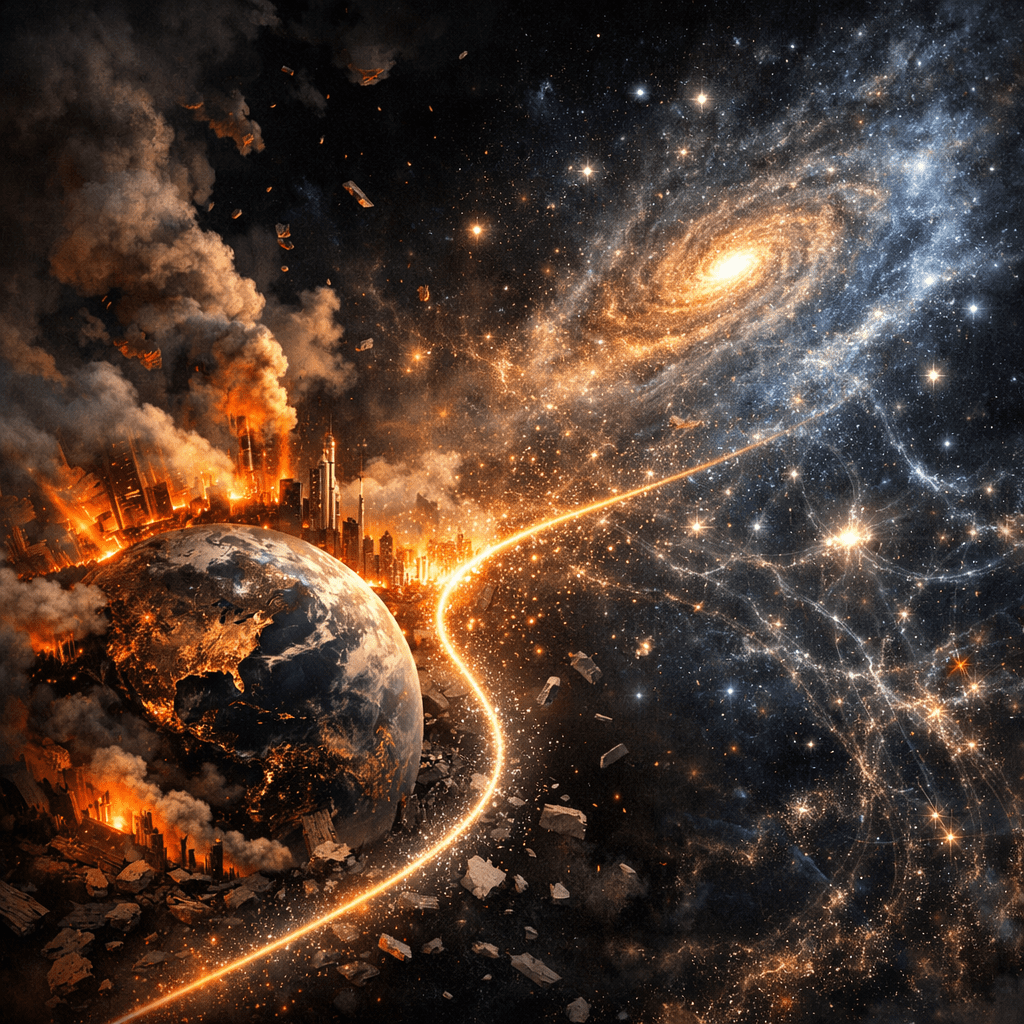
Humanity is moving through a narrow and dangerous passage. Environmental damage, political instability, rapid technological change, and economic pressure are all rising at once. Energy use is climbing, ecosystems are under strain, information systems are flooded with polarising noise, and institutions are struggling to keep pace. A major driver of this acceleration is corporate greed — an economic system that rewards short-term profit, constant growth, and the shifting of costs onto society and the planet. This is not about blaming individuals or countries, but about recognising how our global systems now turn natural stability into financial gain. Physics adds a deeper constraint: in all systems, order carries a cost. The more complex and organised something becomes, the more disorder it creates around it. Under sustained pressure, complex systems tend to destabilise, overshoot, and fracture.
Yet beneath this turmoil lies a strange and counterintuitive possibility. A single planetary collapse would unleash enormous chaos, but only within the narrow bounds of one world and one moment in cosmic time. A civilisation that survives, adapts, and eventually moves beyond Earth would spread irreversible change across unimaginably larger reaches of space and history. Over the long run, continuity generates far more total disorder than extinction. Paradoxically, this makes survival more likely, not because it is kinder or wiser, but because it carries greater consequence for the universe. Greed is driving us toward crisis, yet it is also accelerating innovation, expansion, and momentum. In that tension lies a restrained form of hope: that despite our failures and dangers, humanity may persist long enough to step beyond this planet and matter at a truly cosmic scale.
 Daedelus Kite