Borobudur is a temple built around an unusual absence, one that quietly reshapes how meaning, worship, psychological insight, and spiritual experience function.
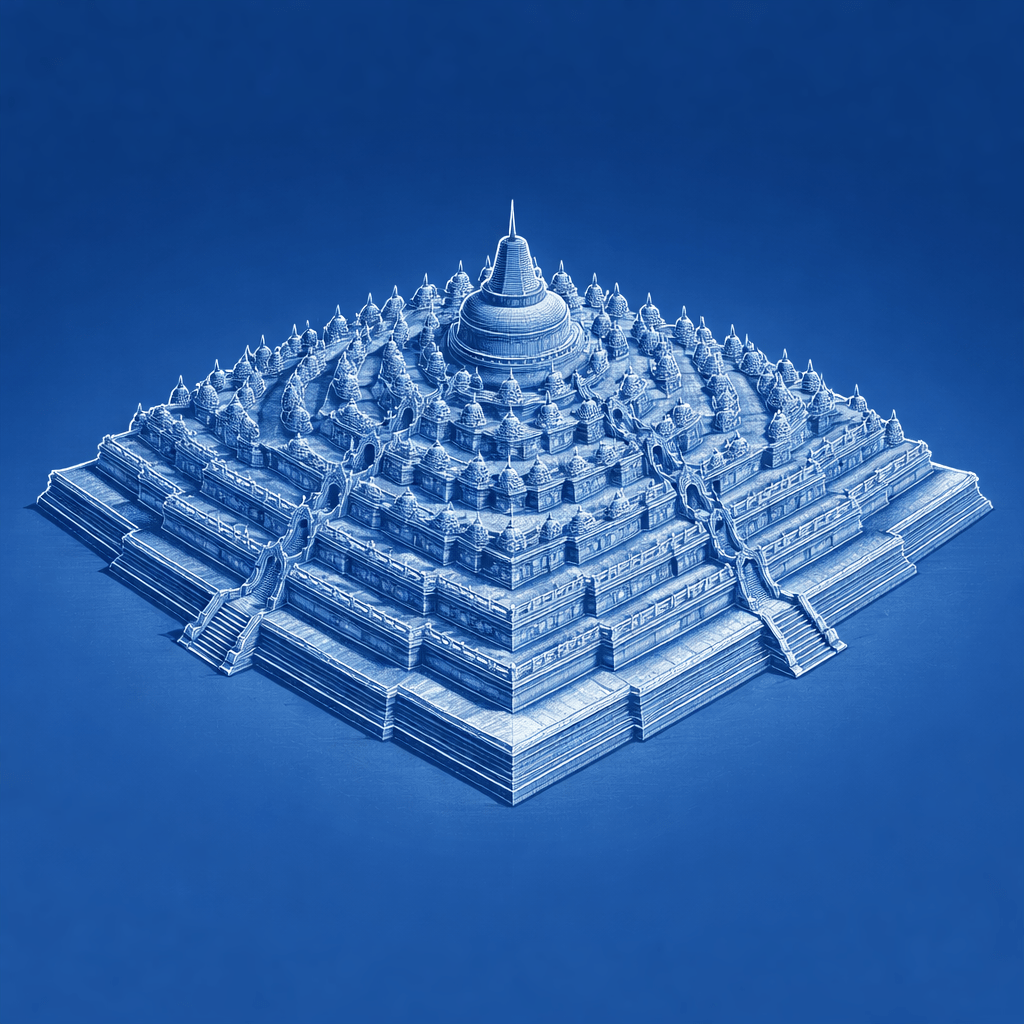
Borobudur, in Central Java, Indonesia, is a ninth-century Mahāyāna Buddhist monument constructed as a terraced hill rather than a hollow sanctuary. Its mass is largely earth and stone; there is no interior chamber to enter, an architectural decision that inverts the familiar logic of temple worship by refusing the idea of a privileged interior where meaning, authority, or truth is stored, and instead displacing devotion toward movement, relation, and exterior circulation. Pilgrimage is circumambulatory and vertical, conducted entirely along open galleries and terraces. The reliefs and architectural sequence correspond to the classical Buddhist progression from the world of desire, through the world of form, to the formless. The culmination is not an inner space but exposure: open sky, perforated stupas, and a sealed central stupa containing nothing. Worship takes place on the surface alone. Whether this alignment between architecture, engineering constraint, and Buddhist psychology was fully intentional, partially emergent, or shaped by traditions and practices we only partially understand remains an open historical question. That uncertainty does not weaken the structure. What is expressed here does not depend on any single explanatory account. Where similar conditions arise, comparable patterns may appear, not as a rule to be imposed, but as a tendency that reasserts itself.
Philosophically, the emptiness is not a hidden content but a structural condition. Existence is gift-wrapped all the way down: form relating to form, relation relating to relation, with no final object waiting inside the package. The whole relates to itself only through the relations of its parts, and the relation that constitutes the whole is enacted again in, through, and as each part. Each part relates to itself by relating to the others, not because it contains the whole, but because it repeats the same relational structure that makes the whole what it is. The center can only appear as a thing contingently, through lived experience itself, and collapses into error the moment that appearance is mistaken for a final object. The nothing is not absence in the naïve sense, but an unaddressable limit, something that cannot be grasped without being distorted. It can only be indicated, never occupied. This is the void named in Buddhist thought and echoed, among others, in apophatic Christian traditions, where understanding proceeds by recognising the limits of what can be said and what can be known. Meaning does not reside inside the structure; it emerges through how attention is guided, sustained, and eventually let go. The sealed summit is exact rather than austere: a refusal that preserves coherence, and a silence that does real work.
Categories
Borobudur: The Architecture of Empty Fullness
 Daedelus Kite
2 replies on “Borobudur: The Architecture of Empty Fullness”
LikeLike
LikeLike