Open a modern news homepage and nothing seems especially unusual. Headlines stack one after another, breaking banners pulse, politicians argue, commentators react, scandals erupt and dissolve, and somewhere among the noise a few careful investigations still appear. Public broadcasters, commercial television networks, global digital outlets and tabloid aggregators all occupy the same surface. They differ in tone and editorial standards, certainly, but they now operate inside a shared environment where information moves continuously and attention rarely settles. Some institutions are designed to slow the flow long enough for verification and context to take hold. Others are organised to keep the stream moving because movement itself is the commodity. Either way, the field has changed. The news still looks like news, but structurally it behaves less like a library of reports and more like a circulating current of signals.
What binds these systems together is not ideology but selection pressure. In crowded communication environments certain forms propagate more easily than others. Signals that are short, vivid, emotionally legible and easy to classify travel quickly through networks. Conflict, scandal, tribal affirmation and moral drama possess a kind of aerodynamic advantage. Over time the system quietly learns which shapes survive. Headlines across otherwise very different outlets begin to resemble one another not because editors share the same worldview but because the environment rewards similar forms. The result is not chaos but a patterned turbulence, an evolving morphology of signals shaped by the simple fact that attention is scarce and anything that reliably captures it acquires reproductive success.
The deeper shift appears in politics. In this environment a statement no longer needs to be carefully reasoned in order to become influential. It only needs to travel. Political figures discover that an outrageous remark, an unverified accusation or a deliberately provocative claim can move through the communication system far more efficiently than a measured explanation. The reward is visibility. Visibility becomes relevance. Relevance becomes power. Over time the communication environment begins quietly favouring the kinds of political signals that replicate most easily within it: emotionally charged, identity-driven and highly reactive. No grand conspiracy is required. The system itself performs the filtering.
This transformation unfolds through accumulation rather than spectacle. Societies rarely change direction because of a single dramatic lie or centrally orchestrated propaganda campaign. Instead they drift through innumerable small adjustments in what people notice, repeat and come to believe is plausible. Every headline, clip, comment and notification adds a minor curvature to the shared interpretive field. Individually the effects appear trivial. Collectively they reshape the cognitive landscape within which reality is recognised. The profitable patterns become familiar, the familiar patterns become normal, and the normal quietly teaches perception what the world is supposed to look like. The news is still reporting events. It is simply doing so inside a communication environment whose underlying physics have changed.
At this point another constraint begins to matter: the limits of the human mind itself. People can only hold so much complexity at once. There is a practical threshold to the number of interacting causes, perspectives and uncertainties that an individual can track while still feeling oriented in the world. For most of human history that threshold roughly matched the scale of the environments people inhabited. Today the informational environment has expanded far beyond it. Global networks, financial systems, geopolitical tensions, algorithmic media flows and technological infrastructures produce levels of complexity that no individual can directly comprehend. The surplus does not disappear. It simply moves elsewhere.
When complexity exceeds what minds can comfortably manage, societies begin redistributing it. Part of it is compressed into institutions, routines and simplified narratives that allow people to navigate the world without analysing it in full detail. Part of it is offloaded into technologies and systems that carry out enormous amounts of hidden computation on our behalf. And part of it becomes background pressure: uncertainty, volatility and interpretive drift circulating through the communication environment itself. The mind grasps only a local slice of reality while the wider system continues processing far more than anyone can see.
Under those conditions people naturally rely more heavily on shortcuts. Familiar identities, trusted voices, emotionally legible narratives and simple explanations provide cognitive shelter in a world that has become structurally difficult to parse. This is why rigid belief systems, strong political identities and reactive interpretations often become more attractive in turbulent information environments. They compress complexity into manageable form. They provide orientation when the underlying terrain has grown too intricate to survey directly.
Seen from a distance, the modern information landscape begins to resemble a vast distributed field of interpretation. Minds, institutions, technologies and media systems continuously exchange signals, each performing a small part of the work required to make the world intelligible. The excess complexity that individuals cannot carry alone does not vanish. It is stored across the environment itself, embedded in algorithms, markets, organisations and the constant flow of communication. What people experience as understanding is often only the calm surface of a much larger process unfolding beneath it.
This is the quiet paradox of the contemporary news environment. Information has never been more abundant, yet the conditions under which meaning stabilises have become increasingly fragile. The signals multiply, the patterns adapt, and the field of interpretation continues to evolve. The news still reports events. But the system through which those events become reality in the public mind has entered a new and far more intricate phase of its development.
Categories
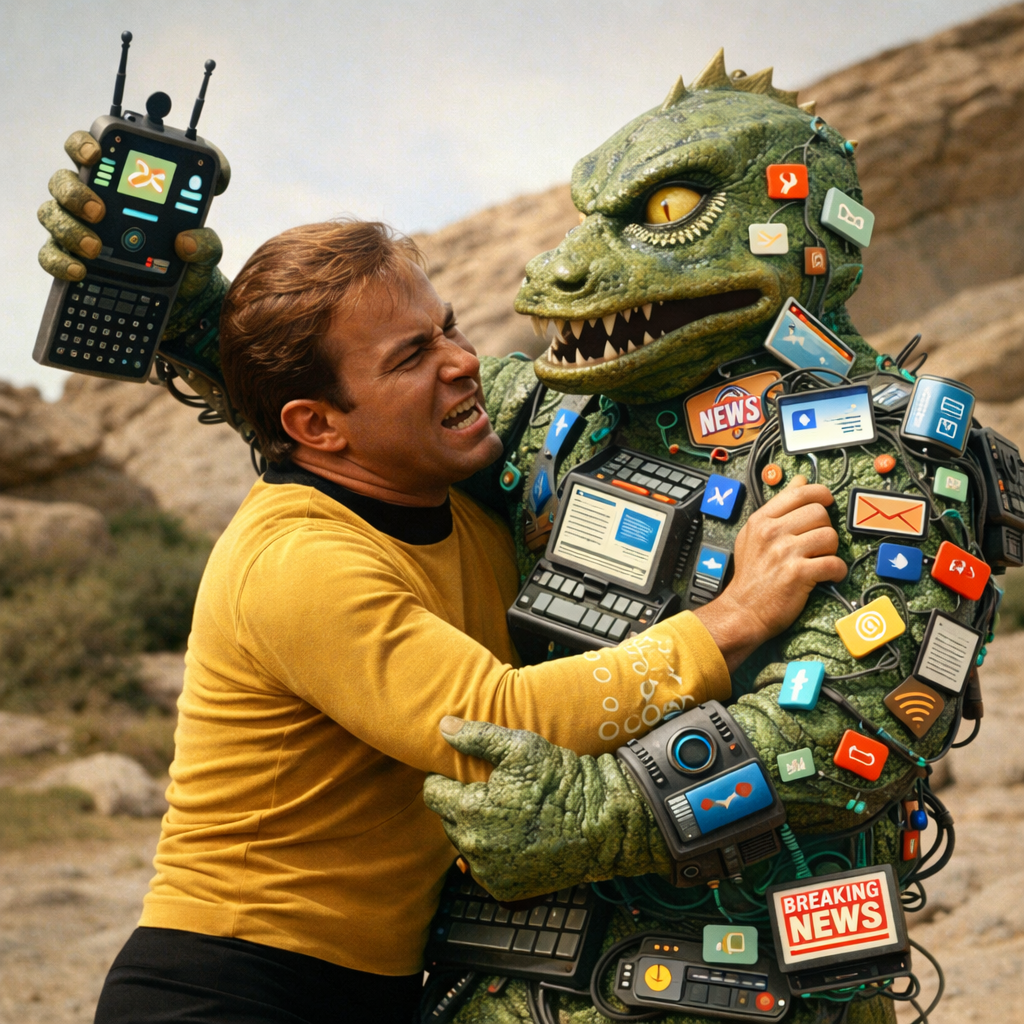
It’s the news, Jim, just not as we know it
 Daedelus Kite