Endless conflict persists not because it is healthy, just, or sustainable, but because fear is highly efficient at moving through uncertain human systems. What spreads easily is not always what nourishes. Fear can be structurally effective while being psychologically corrosive and socially disastrous.
That distinction matters. Signals that bind attention quickly can still produce damaged lives, brittle institutions, and exhausted cultures. Fear sharpens vigilance, simplifies complexity, hardens identity, and accelerates reaction, but the systems it helps reproduce are usually unhealthy ones. They contract perception, reward suspicion, normalise hostility, and make survival feel like the highest available good. A society organised around fear may achieve continuity of a kind, but it does so by degrading the human conditions that make life worth continuing.
Most people are too busy trying to survive to spend much time gazing into the well of historical contingency, structural causation, or logical catharsis. They deal with what is nearest: stress, fatigue, bills, illness, family, work, uncertainty. That is not a moral failure. It is one of the reasons harmful systems persist so easily. People do not need to understand the deeper structure of a system for that structure to reproduce through them. Yet analysis remains valuable precisely because it opens a potential otherwise obscured by pressure and repetition. It allows the field to become thinkable.
The deeper question, then, is not only why fear works. It is what should replace its primacy. If love, compassion, kindness, and understanding are to be more than private virtues or decorative ideals, they must be approached as systemic problems of design, transmission, and durability. What kind of communicative, institutional, and socioeconomic order maximises peaceful continuity for the greatest number of people? What sort of system allows care to circulate effectively without becoming sentimental, coercive, or fragile?
To answer that, it helps to clarify the problem more precisely. The problem is not that societies contain commerce, hierarchy, or divergent belief systems. Complex societies require exchange, valuation, coordination, differentiation, and disagreement. In healthier configurations, differences of value, status, and belief can exist in metastable relation, offsetting one another and helping sustain systemic continuity. The problem begins when commercial imperatives increasingly govern the conditions under which meanings, emotions, and identities are selected and reproduced.
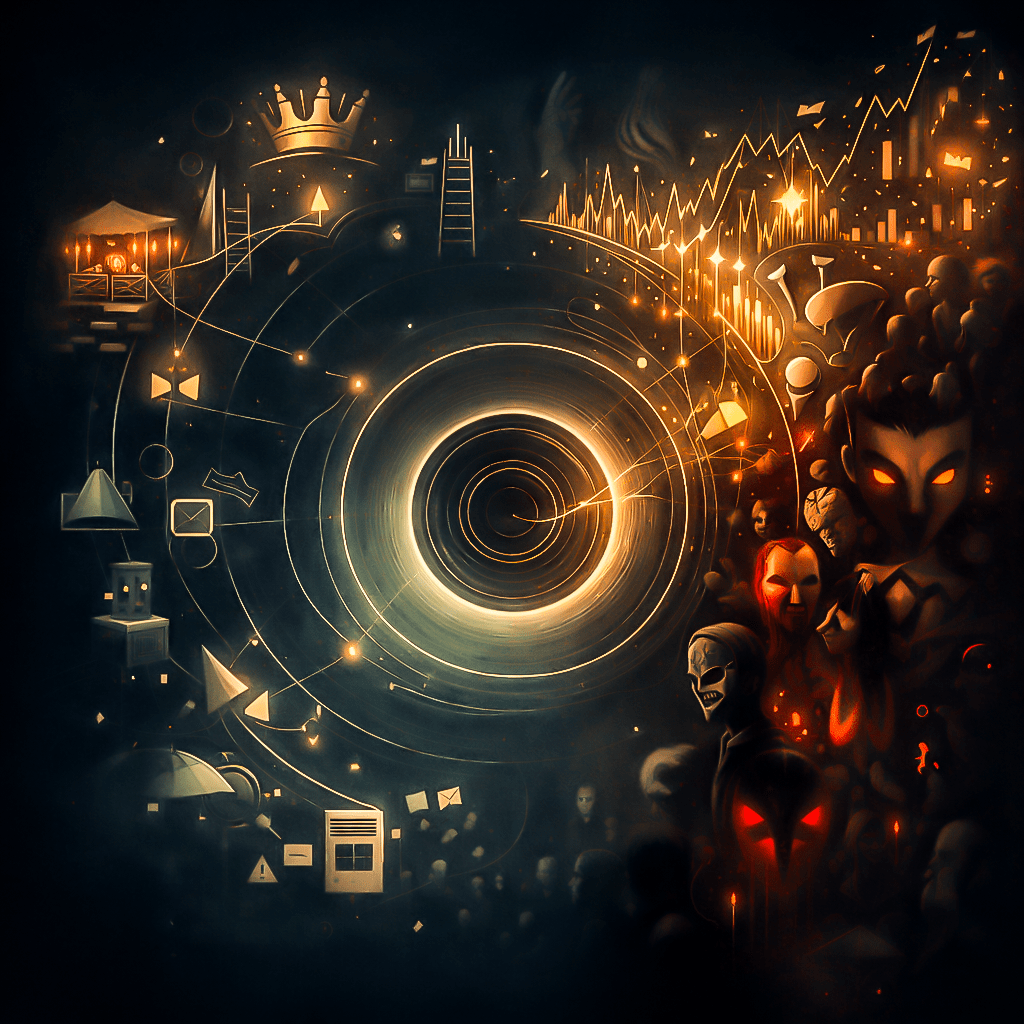
At that point, the field is no longer merely plural. It is increasingly organised by extractive incentives. Signals are selected less for truth, care, wisdom, or long-range viability than for velocity, retention, emotional yield, and economic capture. In degraded configurations, differences that might otherwise help reproduce the whole are drawn into a system that rewards volatility, amplifies fear, and slowly converts the reproduction of the whole into the consumption of its human substrate.
This is why fear becomes so dominant. It is not simply an emotion among others, nor only a manipulable weakness in human psychology. It is one of the most commercially compatible forms of transmissibility available to unstable systems. It binds attention fast, travels widely, sharpens in-group and out-group distinctions, and coordinates reaction with very little interpretive depth. In a field increasingly shaped by extraction, fear acquires structural advantage.
The result is a society that may remain operational while becoming increasingly unwell. It continues, but in an unhealthy mode. Institutions persist, markets move, media circulate, identities harden, and conflict reproduces itself, yet the deeper conditions of peaceful continuity are steadily eroded. What is sustained is not human flourishing, but a pattern of organised agitation that remains economically and politically useful to the systems feeding on it.
That is why the task is not merely to criticise fear or condemn the damage done in its name. The real challenge is to build forms of continuity that do not depend upon fear to hold together. How can trust travel well. How can cooperation endure pressure. How can complexity be sustained without demanding chronic insecurity as its price. How can kindness, understanding, and compassion become structurally durable rather than episodic, private, and easily overwhelmed.
This is where the work becomes practical. Care cannot remain a moral afterthought appended to systems designed around extraction. It has to be built into the selection environment itself. The question is not whether love sounds noble. It is whether institutions, economies, and communicative systems can be organised such that prosocial forms of relation are reinforced rather than penalised. Not sentiment, then, but design. Not piety, but transmissible viability.
Fear may be one of the most efficient media through which unstable systems preserve continuity, but that only sharpens the more important task: to build forms of continuity that no longer need to consume the people who sustain them.
Categories
Fear and Loathing in the Communicative Field
 Daedelus Kite