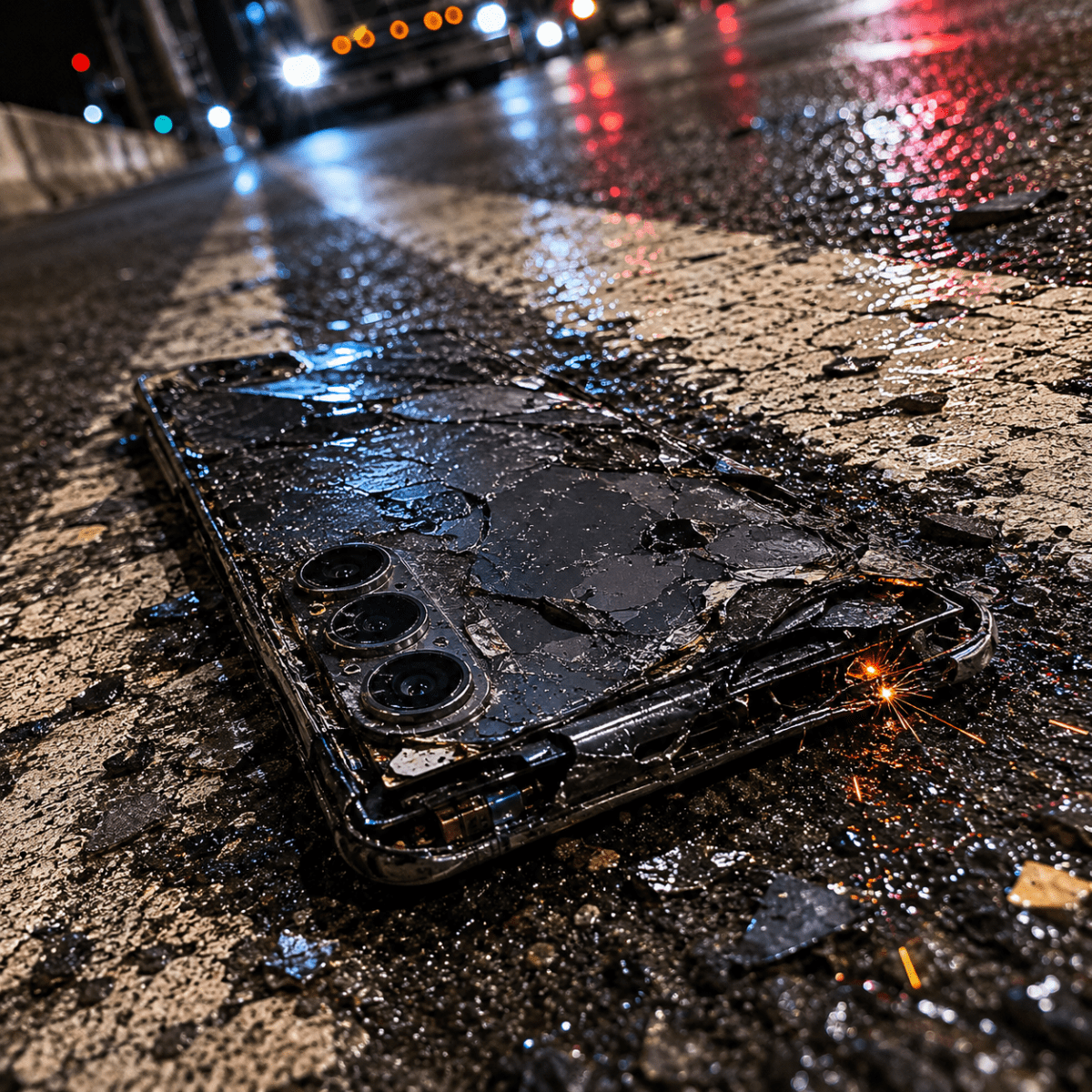
He had been drinking heavily when he decided, somewhere between exhaustion and revelation, that the phone had to die. Not metaphorically. Literally. The thing had become less an object than a portable administrative prosthesis through which work, banking, transport, passwords, social expectation, bureaucratic verification, and the tedious little rituals of contemporary existence endlessly circulated like digital haemorrhoids around the dying corpse of public life. So, standing beside a major road late at night, in a moment of sudden ecstatic clarity that probably felt far wiser than it actually was, he hurled the device into traffic. A truck flattened it magnificently. Several cars contributed additional commentary. Then, in a fit of operatic commitment to the bit, he gathered the shattered remains and flung them from a bridge into the dark canal below like some ancient offering to the gods of exhausted cognition and algorithmic despair.
For perhaps fifteen glorious seconds he felt free. Not happy exactly. More electrically unburdened. Like a medieval peasant who had somehow managed to burn down the local tax office while still fully aware that another one would be constructed immediately beside the ruins. The modern smartphone is sold as convenience but behaves structurally more like infrastructural obligation. You do not carry the device. The device carries portions of your legal, economic, and social existence. Once enough institutions route themselves through the same technological aperture, refusal stops looking like independence and starts looking like administrative self-harm. The next morning arrives not as liberation but as cascading procedural punishment: inaccessible accounts, broken authentication loops, vanished contacts, unreadable tickets, payment systems collapsing into verification purgatory. Freedom, it turns out, now requires QR codes.
And beneath all this sits the truly irritating part: the people running much of this architecture are not philosopher kings or cybernetic visionaries or even especially competent custodians of civilisation. They are mostly ambitious little optimisation goblins in overpriced sneakers, metabolising human dependency into subscription models while speaking in the grotesque dialect of “disruption,” “innovation,” and “frictionless ecosystems” as though reducing human existence into monetisable behavioural telemetry were some kind of moral achievement. Governments, meanwhile, increasingly resemble confused legacy software bolted awkwardly onto private technological empires they neither understand nor control. Entire populations now live inside systems they cannot inspect, negotiate, repair, or realistically exit. That is not freedom. That is soft infrastructural capture wearing the friendly face of convenience.
And yet the dark joke is that smashing the phone changes almost nothing except the bill. The network persists. The institutions persist. The dependency persists. The cost merely migrates location. Delay becomes penalties. Absence becomes exclusion. Refusal becomes administrative friction. Contemporary civilisation has engineered itself into a condition where participation itself is leased back to the population through privately mediated technological surfaces, and every attempt to escape the loop simply reveals how deeply the loop has already entered ordinary life. The phone sinks beneath black water while the system quietly waits onshore, arms folded, already calculating the replacement fee.
Categories
the phone died, the bill survived
The phone died; the contract lived on, quietly proving who really owns whom.