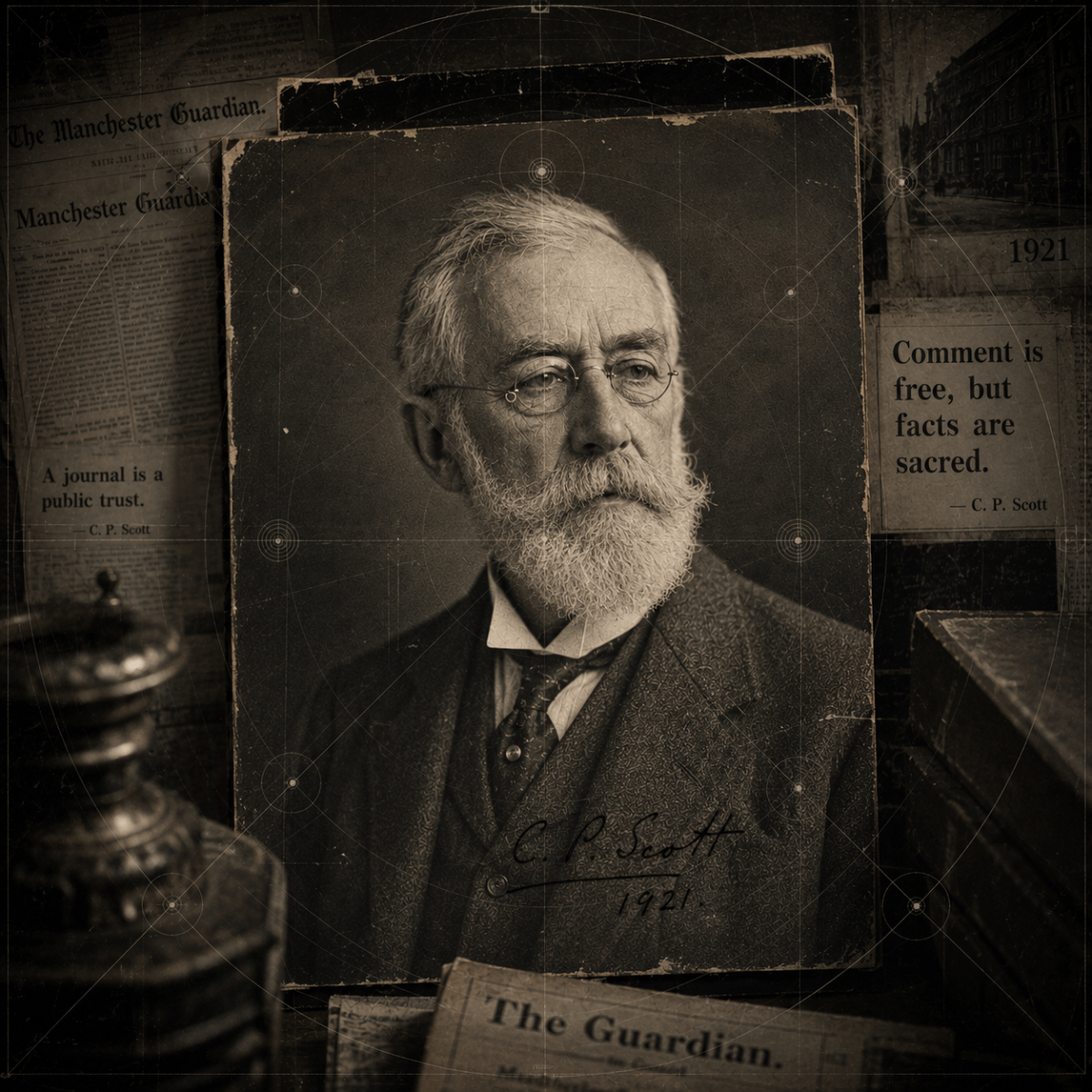
C. P. Scott was the long-serving editor of The Manchester Guardian, later The Guardian, and wrote “Comment is free, but facts are sacred” in 1921, in an essay marking the paper’s centenary. He had spent decades navigating ownership pressure, party politics, war, empire, propaganda, commercial journalism, and the accelerating influence of the mass press. The line was not decorative. It was a defence of journalism as a civic institution: opinion should remain open, adversarial, and plural, but the factual basis of public life must not be shaped by propaganda, profit, faction, or editorial vanity.
A century later, the sentence remains ethically compelling while becoming increasingly unstable as a description of reality. Facts still exist, but they no longer circulate through a communicative environment capable of reliably preserving their authority. They move instead through algorithmic systems, partisan media ecologies, disinformation campaigns, strategic communications, geopolitical rivalry, outrage markets, and attention economies engineered less for understanding than for engagement. Comment is not free. It is amplified, suppressed, repeated, gamed, monetised, emotionally targeted, and politically weaponised. The modern media environment does not merely report conflict. It metabolises it.
The deeper difficulty is that facts alone possess no intrinsic social force. A fact can be accurate and still become culturally invisible if outcompeted by narratives that are faster, simpler, more emotionally satisfying, or more strategically useful. Public opinion is no longer treated primarily as something to inform but as something to modulate. Visibility itself becomes a terrain of contest. Without some shared fidelity to external reality, journalism collapses into branding, politics into marketing, and public discourse into recursive tribal signalling detached from consequence. Facts may not be sacred in practice, but the alternative is informational feudalism: a world in which power determines visibility, visibility determines belief, and belief dissociatively drifts and detaches from the world it claims to describe.
Categories
comment is free, but are facts sacred?
Facts may not be sacred in practice, but the alternative is shameless informational feudalism: a world in which power determines visibility, visibility determines belief, and belief dissociatively drifts away from the world it claims to describe.