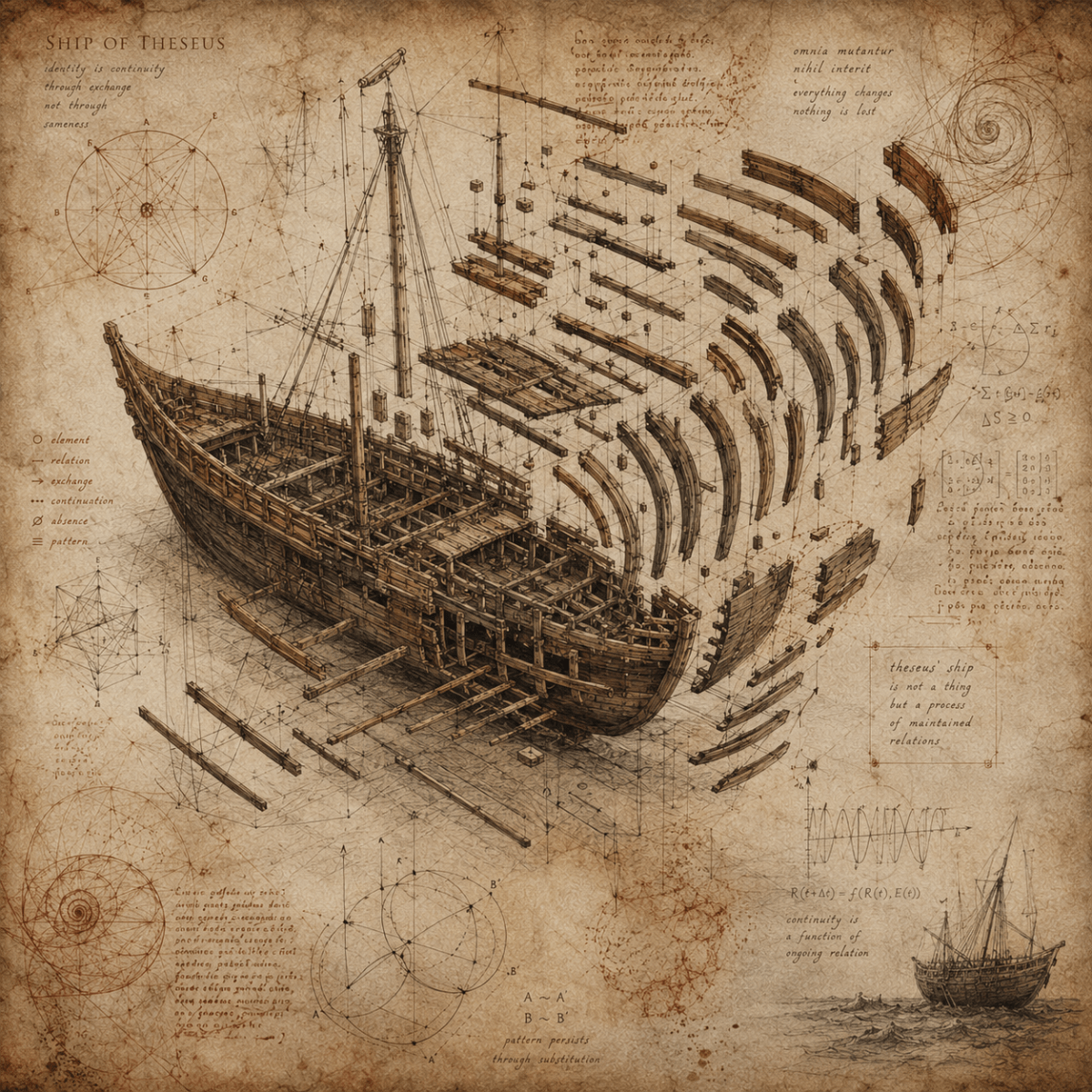
Biology studies organisms, economics studies markets, linguistics studies languages and sociology studies institutions. Each identifies patterns that remain recognisable while their constituents and circumstances change. The question shared across these investigations is what makes that continued organisation possible.
An organism renews its tissues. A river exchanges its water. A language gains and loses expressions. An institution changes its participants. Their continuity requires explanation even when their identity seems familiar. Naming the system identifies the organisation whose persistence we still need to understand.
When an investigation begins with a persisting system, some criterion of continuity is already in use. The system has been distinguished from its surroundings, and events at different times have been related as stages of its activity. These descriptions support accounts of behaviour, adaptation and communication. This inquiry asks how the dependencies they presuppose remain organised through change.
Continuity concerns the relations through which one occurrence remains consequential for another. Memory requires earlier activity to remain effective within present organisation. Identity requires differences to remain recognisable through transformation. A system’s continuation is an ongoing achievement within these dependencies.
Before continuity
Before names logical priority: the conditions through which distinguishable events acquire sequence and consequence. It asks how temporal continuity becomes possible in the first place. Relation is the starting premise. Difference permits distinction; delay gives propagation its interval; dependence makes one occurrence consequential for another. Absence is consequential through what a local expression excludes, leaves unresolved or requires from elsewhere.
An organised process unfolds across distinguishable occurrences. A heartbeat, conversation and thought each extends through relations among changes. Time is the finite propagation of relation. Occurrence, registration and response occupy different positions within that unfolding. Their non-coincidence permits sequence, comparison and further response. Where processes recur rhythmically, their relative timing establishes phase relationships.
No local organisation contains all the conditions of its own continuation. It depends upon relations that exceed its present expression. Logical orbit names this constitutive logical incompleteness. Its dynamical expression is recursive displacement under constraint: successive activity reconfigures the dependencies through which continuation becomes possible. The mechanisms sustaining this recurrence still require explanation.
Complete coincidence would erase the distinction through which coupled processes remain consequential to one another. Complete separation would erase their coupling. Continuity requires organised non-coincidence: sufficient relation for consequences to propagate, with differences through which further activity remains possible. Synchronised timing can coexist with differences in position, role and response. Delay and absence participate in this organisation by sustaining intervals that each local expression requires and cannot close.
A living organism continually exchanges matter and energy with its surroundings while coordinating activity across its changing tissues. A conversation continues as each expression alters what becomes available for interpretation and response. An institution reproduces expectations and practices through participants whose activity also changes those conditions. In each case, local identity depends upon a wider organisation of relations.
Here, communication names the establishment, maintenance and modification of temporal relations between processes. Its consequences extend beyond exchanged messages. Each interaction changes the possibilities available to subsequent activity, altering constraints, timing and the accessibility of different continuations. Communication gives continuing expression to the relations through which processes affect one another.
Probability describes the structured tendencies within these possibilities. Present organisation favours some continuations over others through constraints reconstructed by earlier and current activity. Interactions also disrupt those constraints. Persistence depends upon recurrent processes that renew the conditions supporting continuation across such change. A probabilistic account must identify the organisation being reproduced, the relevant alternatives, the timescale and a baseline for assessing any increased likelihood. A greater chance of continuation provides no guarantee of survival.
Information names a consequential difference that changes the possibilities for subsequent activity. Memory is the persistence of earlier effects within present constraints. Meaning emerges through recurrent relations among expressions, contexts, expectations and responses. Identity is the relative continuity achieved as these relations reconstruct an organisation across changing constituents and circumstances.
These dependencies acquire different expressions across molecular, cellular, organismic, linguistic and institutional scales. Local interactions reproduce and modify wider constraints that shape subsequent possibilities. An account of continuity must follow this mutual conditioning while specifying the mechanisms, boundaries and timescales relevant to its particular domain.
The practical inquiry begins by identifying which differences remain consequential, how their effects propagate and which dependencies sustain further activity. It then examines how recurrent processes maintain or reconstruct those relations, and what happens when their timing, coupling or constraints change. It also asks how that persistence affects the wider field on which it depends. Continuity becomes explainable through the organisation of these dependencies across transformation.
The argument participates in the relations it describes. Its words acquire consequence through reading, interpretation, criticism and use. Revision changes the possibilities available to subsequent thought and action. Its usefulness lies in making the conditions of continuity available for examination, while its own continuation depends upon relations no particular statement can exhaust.
Continuity is achieved through the recurrent reconstruction of relations that remain incomplete in every local expression.
Key takeaways
- Continuity requires an explanation of how relations remain consequential across change.
- Logical orbit names constitutive incompleteness; recursive displacement under constraint is its dynamical expression.
- Difference, delay and phase participate in the conditions through which systems continue.
- Incompleteness alone offers no guarantee of survival; persistence requires mechanisms that can be examined.

