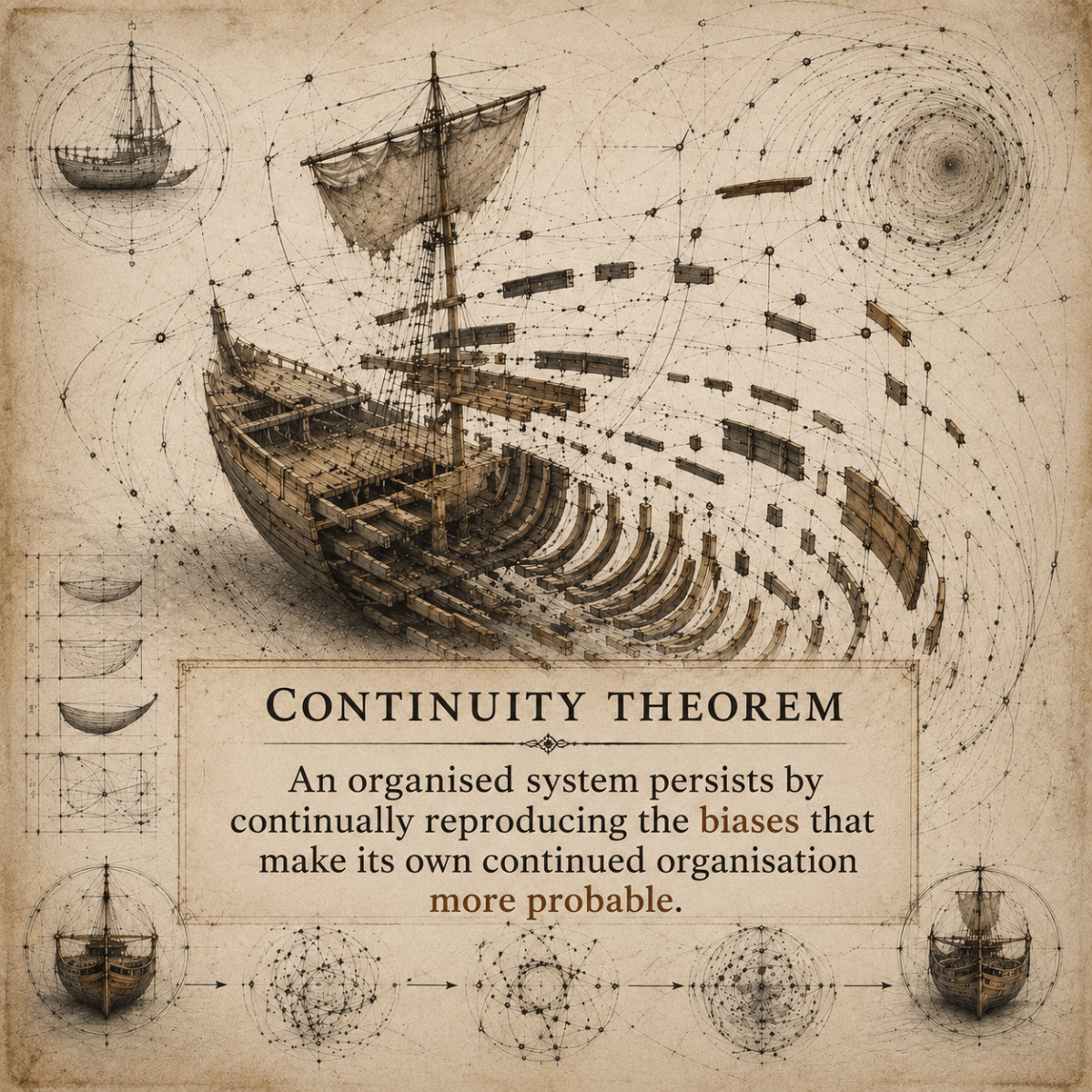
Every organised system raises a question of continuity: what persists through changes in its constituents and circumstances?
An organism renews much of its material. A language gains and loses words. A conversation proceeds through different sentences. An institution changes its participants and practices. In each case, continuity requires an explanation beyond the continued presence of the same constituents.
What persists is an organisation of relations through which further activity remains possible. A whirlpool continues as water passes through it. A melody takes form through relations among notes that arrive and disappear. A conversation continues when earlier contributions remain consequential for what can follow.
These examples illustrate the starting premise: relation generates the conditions through which organised continuity becomes possible.
Persistence is the recurrent organisation of change. Present activity maintains or reconstructs dependencies through which continuation becomes possible. Successive expressions inherit those conditions while modifying what can follow.
Time is the finite propagation of relation. A clock supplies a local reference through organised recurrence. Other processes establish temporal relations through rhythm, phase, delay, response and changing rates of activity. Invoking the passage of time leaves the question of continuity unanswered: which relations carry consequences across the transition, and how are their conditions renewed?
No local organisation contains all the conditions of its own continuation. Logical orbit names this constitutive logical incompleteness. Its dynamical expression is recursive displacement under constraint: each recurrence reconfigures the relations through which further activity becomes possible. Continuity requires mechanisms that recurrently reconstruct those local conditions.
Communication participates in this reconstruction. A signal, response or intervention can reinforce, delay, redirect or suppress another process’s activity. Its consequences alter the possibilities from which further interaction proceeds.
Bias names an organised asymmetry within those possibilities. It is a tendency through which some transitions become more accessible than others. Memory, habit and institutions organise such tendencies without requiring that every consequence be intended.
A bias can support continuity, undermine it or have different effects at different scales. Calling it favourable requires a stated criterion: which organisation is to continue, across which transitions, under which conditions and compared with which alternatives?
Probability supplies a local description where relevant outcomes can be defined and a probability law justified. Moving from relational persistence to numerical assessment requires an additional model. That account must declare the pattern being tracked, the observation interval, the relevant inputs and how evidence supports the assigned probabilities.
A local mathematical description
A probability space (Ω, ℱ, P) specifies modelled histories, an event σ-algebra and a probability law. The histories can include ongoing environmental inputs and dependence on earlier activity. The continuity events below must belong to ℱ. Formal specification makes selected relations precise. It requires no claim that all physical conditions are internally contained or exhaustively represented.
The definition fixes what the calculation covers. Its adequacy depends on the event criteria, input assumptions and evidence remaining appropriate over the stated interval. Where consequential influences cannot be represented credibly, numerical conclusions must remain undetermined or be restricted to explicitly supported bounds. Changes in the relevant alternatives require revision of the description.
Let Xn be a measurable description of the selected history at the nth modelled transition. Let V be the measurable set satisfying the chosen criterion of organisational viability. Writing Xn ∈ V means that the system is viable at that step. The symbol ∈ means “belongs to”. The criterion must state which relations matter and how much change it allows.
The description retains the history and environmental exchanges selected for the analysis. Omitted influences constrain its range of application. A loss of organisation during a transition must count as failure of continuity, even if a later snapshot looks viable again.
Assume the system begins viable. Let Cn denote the event that its organisation has continued through every transition from the beginning through step n. This distinguishes uninterrupted continuation from disappearance followed by reconstruction. The starting assumption gives P(C0) = 1.
Whenever P(Cn) is positive, define the next conditional continuation probability:
qn = P(Cn+1 | Cn).
Here P denotes probability and the vertical bar means “given that”. The expression asks: given that the organisation has continued through step n, what is the probability that it continues through the next transition? A numerical estimate requires a stated estimation procedure and an assessment of uncertainty.
In a simplified supply model, count failure when a water reserve falls below a declared threshold during a response cycle. Let Bn denote the buffer above that threshold at the beginning, and Dn the greatest cumulative net withdrawal during the interval. Loss occurs when Dn > Bn.
For this specified failure mode, the conditional risk is P(Dn > Bn | Cn). Replenishment changes the available buffer; response delay changes how far depletion can proceed. Observations of reserve, inflow, withdrawal and timing, or a calibrated model of their joint behaviour, provide a route to estimating that risk. The comparison must also represent how altered feedback changes subsequent conditions.
Continuation through step n includes all preceding transitions. For a finite horizon of N transitions with the required conditional probabilities defined, the chain rule gives:
P(CN) = q0 × q1 × ⋯ × qN−1.
This is the chain rule of probability. It requires no assumption that successive transitions are independent. Their dependence is included through the conditional probabilities. If continuity has already acquired probability zero, all later continuation events also have zero probability.
Choose a baseline with the same viability criterion, comparable starting conditions and aligned transition horizons. Differences in transition rates also require comparison over elapsed duration. If each conditional continuation probability is at least as large as its counterpart, the finite product is also at least as large. A causal explanation then identifies which changes in coupling, delay or replenishment produce that advantage.
The cumulative probability can still decrease as more transitions are required. For example, if every conditional continuation probability equals 0.99, then:
P(CN) = 0.99N.
After 100 transitions, this gives a probability of about 0.366, or 36.6%. As N increases without bound, the expression approaches zero. A high probability of surviving each next transition does not by itself establish a positive chance of continuing indefinitely.
A conditional result for indefinite continuation
The following standard probability result gives a conditional test for indefinite continuation. It assumes a consistent probability model for the entire sequence of transitions and their continuation events.
Let εn denote the conditional probability of losing continuity at the next transition, given continuity through step n:
εn = 1 − qn.
Suppose the system begins viable, every next transition has a positive conditional chance of continuation, and the corresponding failure probabilities have a finite sum. Then the probability of continuity through every modelled transition is strictly positive.
The conditions are:
0 ≤ εn < 1 for every n,
∑n=0∞ εn < ∞.
Let C∞ mean continuity through every transition. The conclusion is:
P(C∞) = ∏n=0∞ (1 − εn) > 0.
The sum symbol ∑ adds the successive failure probabilities. The product symbol ∏ multiplies the successive continuation probabilities. A finite sum requires the later failure probabilities to diminish sufficiently fast. Merely approaching zero is insufficient.
The proof follows from two facts. First, the events CN are nested: surviving more transitions satisfies every earlier requirement. The probability of their intersection equals the limit of the finite-horizon probabilities. Second, a finite sum of conditional failure probabilities makes the displayed infinite product positive.
To see the second fact, the failure probabilities eventually become no larger than one half. For those terms, the natural logarithm satisfies:
ln(1 − εn) ≥ −2εn.
The partial sums of these non-positive logarithms never increase and stay bounded below because the failure probabilities have a finite sum. They converge to a finite value, so the tail product has a positive limit. Every earlier factor is also positive. The complete product is positive.
The result establishes a positive chance of continuity within the model. A fixed positive lower bound on conditional failure risk at every sufficiently late transition would instead force the infinite product to zero. Improvement over a finite horizon can coexist with eventual failure. Interpreting infinitely many transitions as indefinite duration also requires their times to extend without bound.
The product criterion is a standard mathematical result. Its role here is to test the consequences of a specified stochastic description. Applying the indefinite-continuation result requires showing how the particular dynamics and environmental conditions justify summable conditional risk. That substantive explanation remains separate from the proof.
The explanatory task traces how recurrent activity changes the dependencies that make further organisation possible. It identifies mechanisms, compares predicted consequences with observation and revises the local description when its distinctions fail. Probability supplies one way of testing consequences after that account has been specified.
Material replacement, changing behaviour and departures from equilibrium can participate in continuity. Their relational consequences can sustain the pattern under consideration while dissolving another. Assessment must also consider effects on the wider field that makes such persistence possible.
The mathematical description remains local. Its event space makes selected distinctions precise while its application depends upon relations exceeding those distinctions. Logical incompleteness concerns this dependence; it neither prevents conditional calculation nor supplies a probability law. Adequacy remains open to criticism and revision through the field being described.
These words participate in the same process. Their organisation continues through reading, criticism, revision and further use. The text persists when the relations it expresses remain consequential through those changes.
Key takeaways
- A local probability model makes selected relations precise while leaving its adequacy open to revision.
- Numerical claims require operational criteria, specified environmental inputs and justified estimation procedures.
- The infinite-product result states conditions for indefinite continuity; those conditions require their own justification.
- Mechanistic explanation must show how recurrent activity reconstructs the conditions of further organisation.

