Diving in…
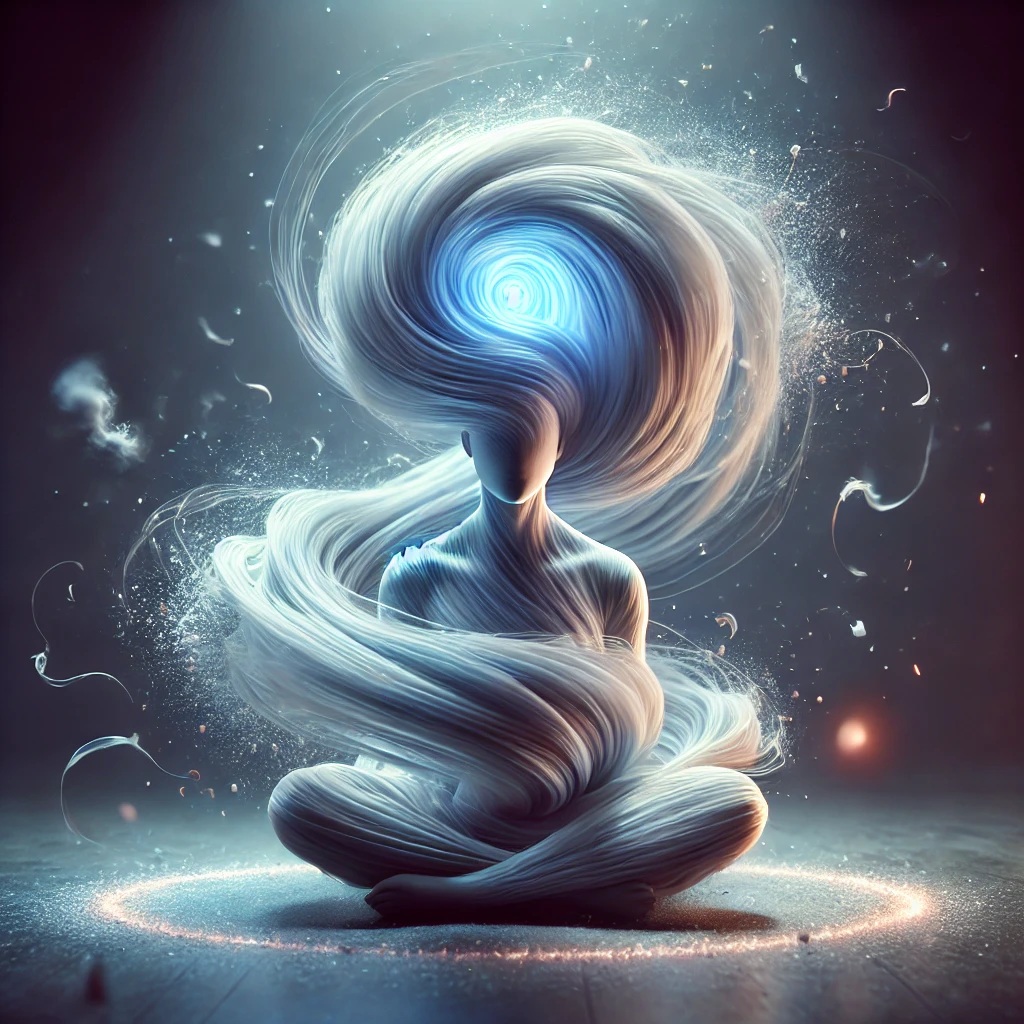
Culture is a slow-moving entropic wave, propagating through time as an emergent pattern of communication. Unlike speech or writing, which operate on high-frequency scales, culture moves through a distributed process of accumulation, decay, recombination, and redistribution. It is neither stable nor chaotic but oscillates within a state of perpetual disequilibrium, shaped by noise, redundancy, and selective amplification. This text explores culture as an entropic process, tracing its dynamics through interdisciplinary insights from information theory, sociology, complexity science, and semiotics.
Culture as an Entropic Wave
Culture does not transmit instantaneously; it diffuses like heat, following gradients of interaction, resistance, and absorption. At any given moment, it consists of competing structures—some rising in prominence, others fading into entropy. The entropic nature of culture manifests in:
1. Oscillatory tendencies – Cultural forms rise and fall cyclically, much like energy waves dissipating over time.
2. Dissipative structures – While cultural entities appear stable, they are, in fact, transient patterns that persist only through continuous renewal.
3. Non-equilibrium dynamics – Culture never reaches a steady state but remains in flux, driven by feedback loops and external perturbations.
The Slow Diffusion of Symbols, Meanings, and Practices
Culture is carried by symbols, meanings, and practices—each operating on different scales and time horizons.
Symbols compress complex ideas into transmissible units, yet their meanings are context-dependent.
Meanings are inherently relational, shifting in response to interpretation, power, and contingency.
Practices instantiate culture, making abstract symbols tangible through ritual, repetition, and performance.
This diffusion is neither uniform nor deterministic. Meaning is absorbed, resisted, or transformed through nonlinear processes of selection and mutation.
High-Frequency vs. Low-Frequency Manifestations
Speech and writing are high-frequency disturbances in the cultural field—short bursts of information that generate immediate effects. Culture, by contrast, moves at a lower frequency, shaping the longue durée of human experience.
High-frequency signals (speech, writing, media events) – Rapid, transient, yet capable of triggering larger cultural shifts.
Low-frequency waves (ideological movements, traditions, myths) – Slow, accumulative, and deeply embedded in social structures.
The interplay between these frequencies determines the resonance of cultural transformations—why some ideas flare up and dissipate while others embed themselves into history.
Accumulation, Decay, Recombination, Redistribution
Cultural change is an entropic process governed by four interwoven dynamics:
Accumulation – Traditions build upon prior knowledge, creating deep structures of meaning.
Decay – Without reinforcement, cultural artefacts fade, distorted by memory and technological obsolescence.
Recombination – Cultural elements merge into new forms, generating hybrid artefacts and unexpected innovations.
Redistribution – Ideas spread through networks, shifting in significance depending on their carriers.
Culture, therefore, does not progress in a linear trajectory but through cycles of emergence and dissolution.
Cultural Equilibrium and Perpetual Disequilibrium
There is no final state of culture. Every attempt at equilibrium is disrupted by novelty, conflict, or reconfiguration. The illusion of stability arises from the temporary coherence of dominant narratives, but these, too, are transient.
Equilibrium as a theoretical construct – Culture appears to seek balance, but this is an artefact of perception.
Feedback loops sustain disequilibrium – Social movements, technological shifts, and epistemic ruptures create continuous instability.
Control is illusory – Attempts to freeze culture result in stagnation, while true cultural vitality requires adaptation to entropy.
Noise, Redundancy, and Selective Amplification
Culture evolves through an interplay of randomness, repetition, and power:
Noise – Misinterpretations, glitches, and randomness introduce innovation.
Redundancy – Cultural repetition prevents complete loss, stabilising key ideas.
Selective Amplification – Certain signals gain dominance due to political, social, or technological leverage.
This dynamic explains why some cultural artefacts endure while others vanish into obscurity.
The Entropic Gradient of Cultural Dissipation
Cultural ideas dissipate over time, but not uniformly. Some concentrate in high-entropy environments (e.g., social media), accelerating their breakdown, while others become deeply embedded in low-entropy structures (e.g., religious institutions), ensuring longevity.
High-entropy environments (rapid, viral, but ephemeral) – Digital media, internet memes, mass movements.
Low-entropy environments (slow but persistent) – Religious doctrines, constitutional laws, classical texts.
Cultural meaning, like thermodynamic energy, follows pathways of least resistance while simultaneously generating new structures through its dissipation.
Body surfing to the shoreline…
Culture is not a fixed entity but a dissipative structure, oscillating between order and entropy. It propagates through communication networks, shaped by transmission bottlenecks, selective pressures, and non-equilibrium dynamics. While culture appears to seek stability, it remains in a state of perpetual disequilibrium, driven by feedback loops and entropic drift. Understanding culture through this lens reveals why meaning is never fixed, control is always partial, and history is not a linear narrative but a wave of recursive emergence and decay.
 Daedelus Kite