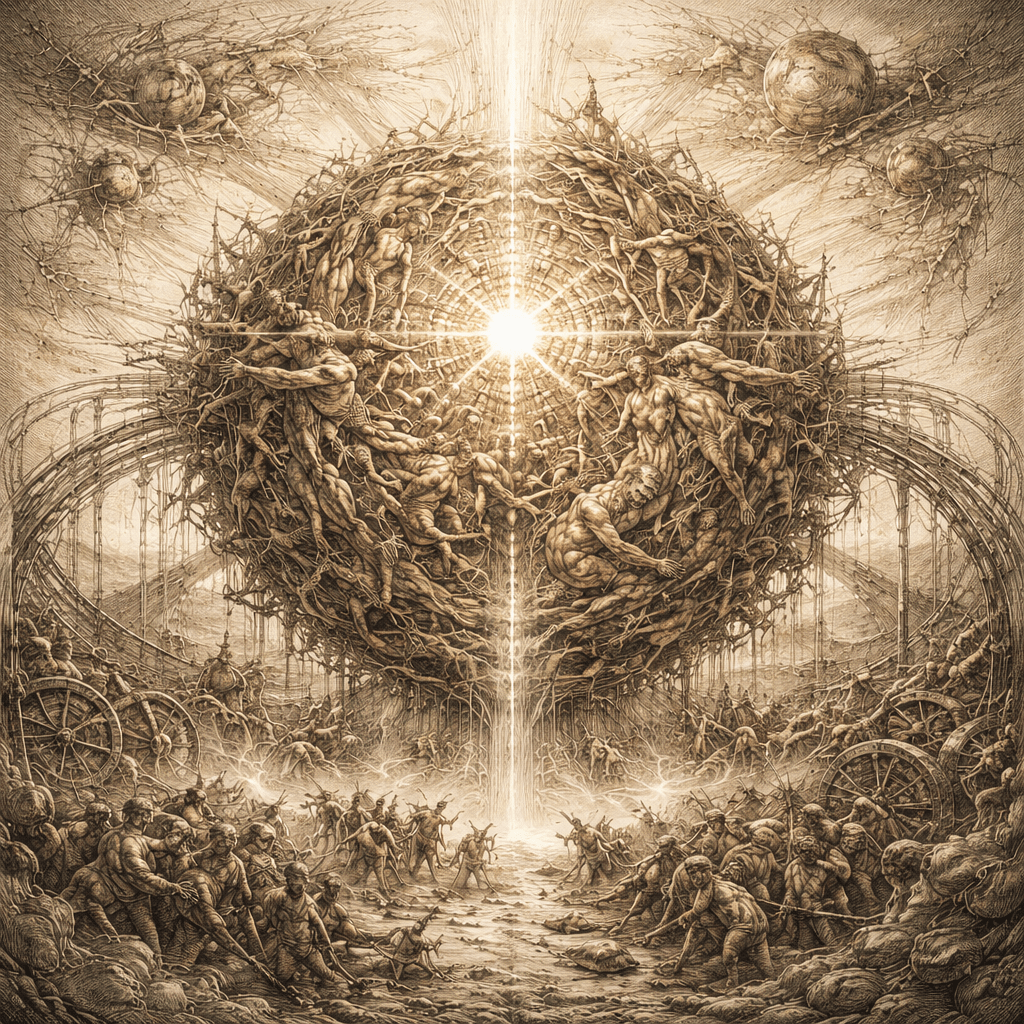
Modern power does not stabilise disorder. It metabolises it.
At planetary scale, technological systems no longer merely respond to uncertainty; they generate the specific forms of instability that make them indispensable. Chaos is not an unfortunate by-product of progress. It functions more like waste heat in an engine: not something the system seeks to eliminate, but something it must continually produce in order to keep running. Control, coordination, and capital now operate through this heat. The more turbulence a system can induce, the more justification it acquires to intervene, optimise, regulate, and extract. This is not a moral failure layered onto technology. It is a general systems property of how local order is sustained in distributed fields.
Autocratic and authoritarian configurations are especially effective within this dynamic because they compress uncertainty while suppressing feedback. They create environments where volatility is high but correction is slow, where decisions move quickly but consequences are diffused. From the outside this appears pathological. From within the system it is efficient. Fear, urgency, and dependency form steep gradients that can be rapidly leveraged. The instability generated becomes the evidence that intervention is necessary. The system feeds on the chaos it produces, then points to that chaos as proof of its own legitimacy. Platforms, security architectures, and financial mechanisms thrive under these conditions not because they resolve instability, but because they are structured to circulate it.
What is often missed is that those who appear to benefit most from this configuration are themselves constrained by it. Alignment with authoritarian dynamics is not simply a preference for domination; it is adaptive behaviour inside a field that rewards instability production and punishes restraint. Power at this scale is not freedom of action but obligation to role. The more capital, visibility, and infrastructural centrality an actor accumulates, the less latitude they retain to alter course. Wealth does not confer exit. It deepens structural coupling. Even recognition of moral failure or structural irrationality does not dissolve the trap, because deviation threatens the coherence of the very networks that sustain position and relevance.
This is why the configuration is powerful, but fragile. Its fragility does not come from weakness; it comes from self-reference. Coherence is built almost entirely from within the system itself. Every correction is internal. Every justification is recursive. There is no longer a meaningful exterior vantage point from which the system can be evaluated, only more throughput, more scale, more mediation. The system becomes a closed circulatory loop, efficient at motion yet increasingly blind to what it is consuming. Reality does not disappear simply because representation fails. Ecological limits, psychological exhaustion, social fracture, and material scarcity continue to accumulate beyond what the system can metabolise.
This is where scale changes everything. For most of human history, costs could be displaced. Disorder could be exported across geography, deferred across generations, absorbed by marginal populations, or dissolved into environments that appeared effectively infinite. That latitude made the system seem sustainable. At planetary scale, it no longer is. There is nowhere left to externalise cost. The field has closed. What was once elsewhere is now internal. Entropy does not dissipate outward; it circulates inward. This is what makes the present moment existential rather than merely political or economic.
The failure here is cybernetic and philosophical at once. These systems confuse amplification with control, acceleration with intelligence. They assume that increasing mediation can substitute for understanding, and that complexity can be outrun rather than inhabited. Human beings, however, remain cognitively bounded, emotionally contagious, and deeply tribal. At small scales, those traits are survivable. At global scale, when deliberately stimulated and commodified, they become structurally dangerous. The system rewards precisely the behaviours that destabilise collective coherence because those behaviours maximise throughput.
We are all inside this machinery. There is no clean exit, no pure standpoint, no untouched observer. Technology is not something we use from the outside; it is the relational field in which contemporary subjectivity, power, and meaning now form. The error is not entrapment itself, but denial of it. Treating this configuration as optional or temporary only deepens the orbit. Even those who appear to command the system are bound by the same dynamics they amplify.
Acknowledgment does not mean surrender. It means recognising that entropy, conflict, and uncertainty cannot be eliminated, only routed. The real design question is where disorder accumulates, how quickly it compounds, and who is forced to absorb its cost. Systems that depend on permanent crisis to justify themselves cannot stabilise without destroying their own conditions of survival. At planetary scale, restraint becomes a form of intelligence.
The future will not be decided by who can generate the most chaos, but by who can metabolise instability without needing to amplify it, who can absorb uncertainty, distribute its cost, and allow coherence to emerge without turning disorder into fuel. Until that distinction becomes legible, the system will continue to consume its own turbulence and call the process growth.
 Daedelus Kite
One reply on “Power”
LikeLike