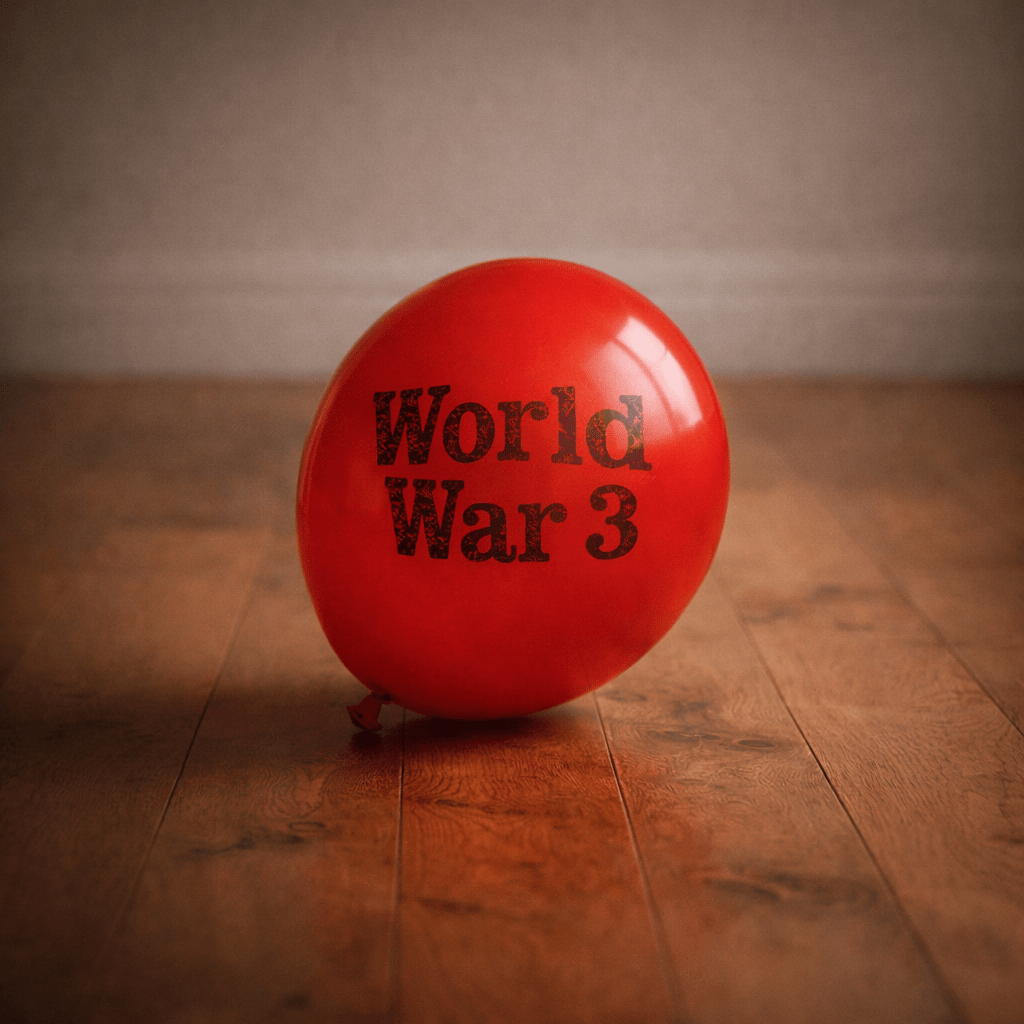
Interstate war continues between Russia and Ukraine, and it does not stand alone. Armed conflict and strategic confrontation persist across multiple regions at once, including parts of the Middle East, Africa, South Asia, and the Western Pacific, where tensions involving China, Taiwan, and surrounding powers remain structurally unresolved. Beyond overt fighting, competition increasingly takes distributed forms: sanctions, trade restrictions, cyber operations, intelligence activity, surveillance, and information warfare operate continuously across borders. It is within this environment that the phrase “World War III” circulates. Various definitions exist, some focused on great power confrontation, others on economic integration, technological coupling, or global participation. None are authoritative. The term functions less as an empirical description than as an attempt to stabilise language around a condition that does not present as a single event. Conflict does not begin, peak, and end. It persists, shifts domain, and reappears elsewhere, ensuring that organised competition is always active somewhere in the system.
What matters here is not a moral judgement about any particular conflict but a structural observation about how the world now operates. Language and technology form a single dynamical complex that compresses reality into manageable representations so large systems can keep moving. These representations are remedial rather than explanatory. They arrive after the fact and reduce distributed pressures into narratives, categories, and labels that feel coherent but rarely track underlying dynamics. Contemporary communication technologies intensify this compression, narrowing attention and vocabulary while amplifying differential, rivalry, and misalignment. The result is not that war is necessary, nor that peace is impossible, but that tension propagates continuously as a structural feature of globally coupled systems. Ideologies, moral claims, and political extremities arise downstream of this condition rather than causing it. This is not an argument about right or wrong. It is an account of how conflict emerges, circulates, and persists when pressure is distributed across technological, economic, and communicative fields. Understanding this requires shifting from moral narration to structural perception, from asking who is justified to recognising how strain is generated, maintained, and shaped within a world that no longer pauses between episodes of competition.
Categories
World War
 Daedelus Kite