Yesterday, sitting with a coffee, I fell into conversation with a group of photography students. It occurred to me that photography, particularly digital photography, is a curious artefact. It feels modern, yet in an important sense it belongs to a slower world, a medium that still obliges attention to pause between perception and interpretation. Consider what actually happens when a photographer enters a room. The eye scans, possibilities form, one frame is chosen, the shutter clicks, another may follow, and only gradually does interpretation begin. Meanwhile the room changes. Light shifts. People move. Attention drifts. Each photograph enters the memory of the moment and subtly shapes the next one taken. The present aligns with traces of its immediate past. What appears to be a mechanical record is in fact a cascade of signals, interpretations, and autocorrelated feedback unfolding through delay.
The act itself quietly demonstrates something more general. Signals propagate through time, encounter delay, return as feedback, and gradually stabilise patterns of recognition. A system learns itself through the correlation between what is happening now and what has just happened. Memory, in this sense, is not a static archive but a harmonic structure emerging from repeated alignment between successive states. Remove the delay and the correlation disappears. The system stops comparing itself with its own recent past. It loses the interval in which it can recognise its own patterns. What appears locally as inefficiency — the pause between perception and response — is the mechanism through which coherence forms.
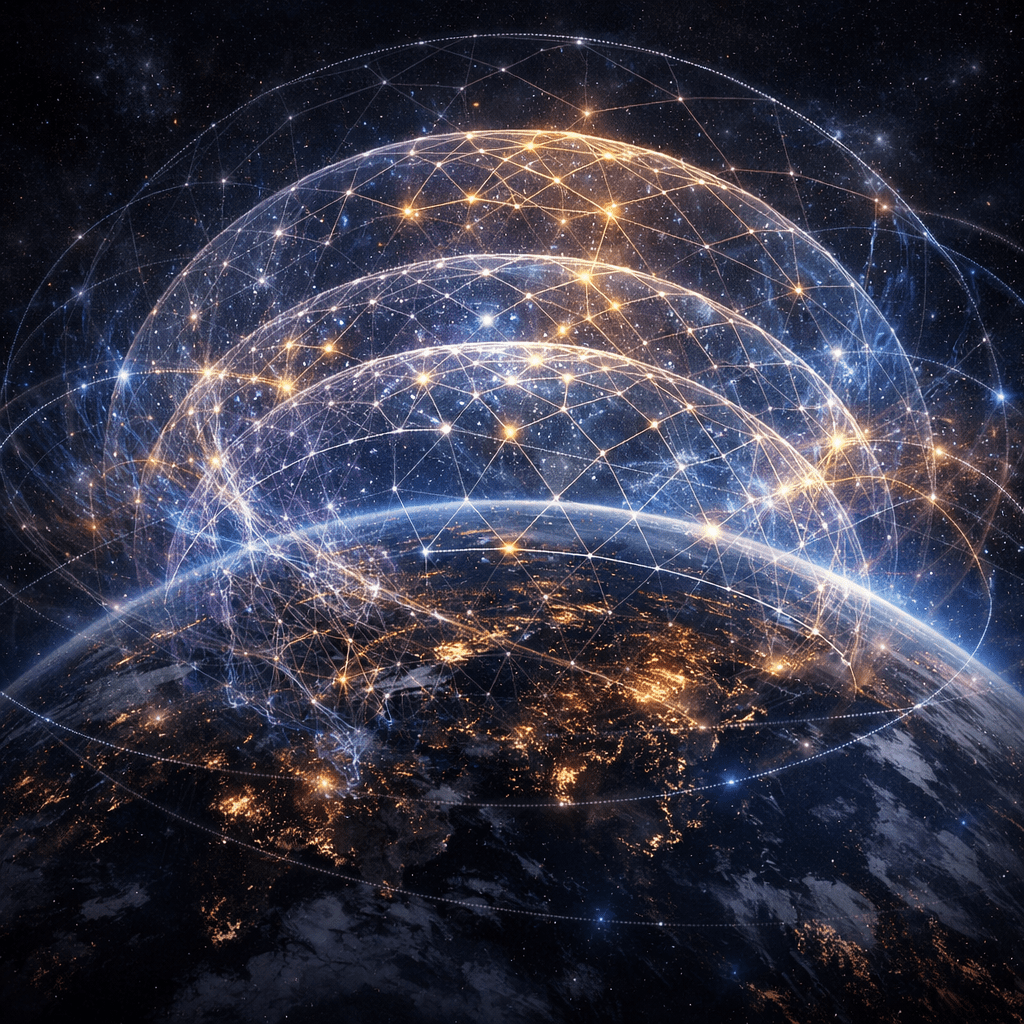
Those same dynamics now operate across the wider communication environment in which contemporary events unfold. Missiles, drones, satellites, fibre-optic cables, and media networks all participate in a single planetary signalling lattice where signals propagate at near-instant speed and unfolding conflicts, including the war now visible in the Middle East, are carried into a global narrative circulation. Images move before analysis, statements before reflection, outrage before verification. Political messaging, media commentary, and public reaction share the same low-latency infrastructure. The field becomes continuously excited. Interpretation begins collapsing toward reaction. The system starts responding to its own signals faster than it can absorb their meaning.
Seen from this perspective the café conversation and the global communication system are not separate stories but the same structure expressed across different scales. Complex systems maintain coherence through delay, phase difference, and feedback. When communication accelerates too far, that phase difference begins to narrow. Cognition and signalling move toward the same operational surface. Reaction begins to outrun recognition. The system loses the interval required to correlate its present state with its immediate past.
Human learning has never depended on memorising precise instructions for every possible situation. We develop grammars for navigating the world — broad heuristics that allow recognition across unfamiliar circumstances. Those grammars emerge through the slow alignment of signals across successive moments. Patterns repeat with slight offsets, forming the harmonic scaffolding through which perception, language, and action remain intelligible to themselves. When the communication environment compresses those moments too tightly, the correlations struggle to form. Signals multiply. Reactions proliferate. The quieter process through which systems recognise their own patterns begins to falter.
Technological acceleration carries a structural risk. Remove the delays through which meaning stabilises and the system becomes fast — but blind to its own past, drifting into reflexive volatility rather than sustaining the conditions for strategy, learning, adaptation, growth, and intelligence.
Categories
The Structural Risk of Technological Acceleration: Why Delay, Feedback, and Time Still Govern Complex Systems
 Daedelus Kite
8 replies on “The Structural Risk of Technological Acceleration: Why Delay, Feedback, and Time Still Govern Complex Systems”
LikeLike
LikeLike
LikeLike
LikeLike
LikeLike
LikeLike
LikeLike
LikeLike