
Living systems persist through a continuous relational field whose articulation into behavioural, transcriptional, morphological, physiological and symbolic spaces constitutes its harmonic structure. Each domain expresses constraints, possibilities and patterns of recurrence through which the others remain consequential. The relations through which these domains become distinguishable also sustain their coherence.
These spaces are resonant modes of a shared organisation. Each makes particular differences available for action and description, while its activity modifies the conditions available elsewhere. Superspace names this relational continuity. Its unity consists in the organisation of differences that remain coupled across their distinct expressions.
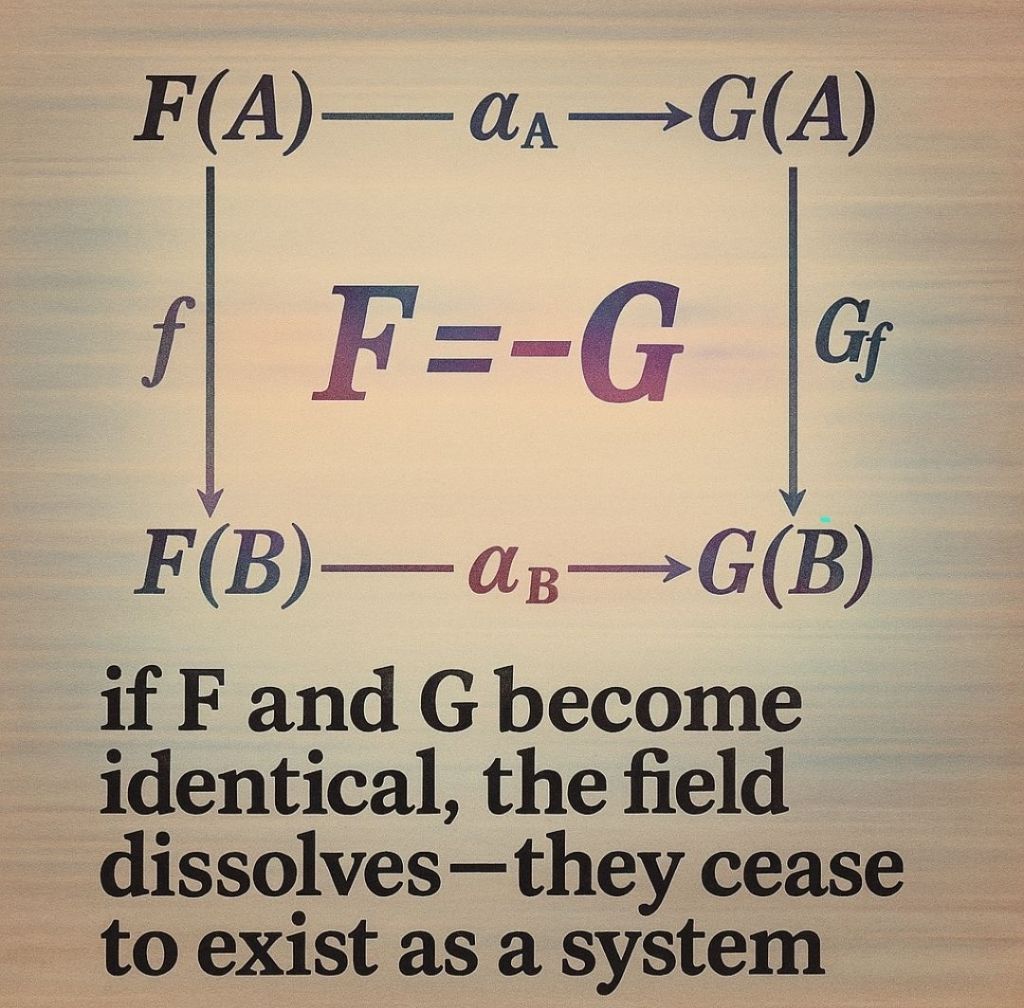
The problem of many spaces
Biology, cognitive science and systems theory describe living activity through several operational spaces. A behavioural space distinguishes actions and trajectories. A transcriptional space distinguishes patterns of gene expression. Morphospace distinguishes possible forms, while physiological state space distinguishes conditions such as voltage, temperature or metabolic activity. Their coordinates describe real processes and constraints, selecting what is relevant to a particular investigation.
Michael Levin’s work on developmental bioelectricity and cognition across scales brings the problem of coordination into focus. His account examines how cellular activity contributes to the capacities of larger biological collectives, while his work with colleagues considers continuity and variation across forms of cognition (Levin, 2019; Levin et al., 2021). The question here concerns the relations through which activity expressed in one domain remains consequential in another.
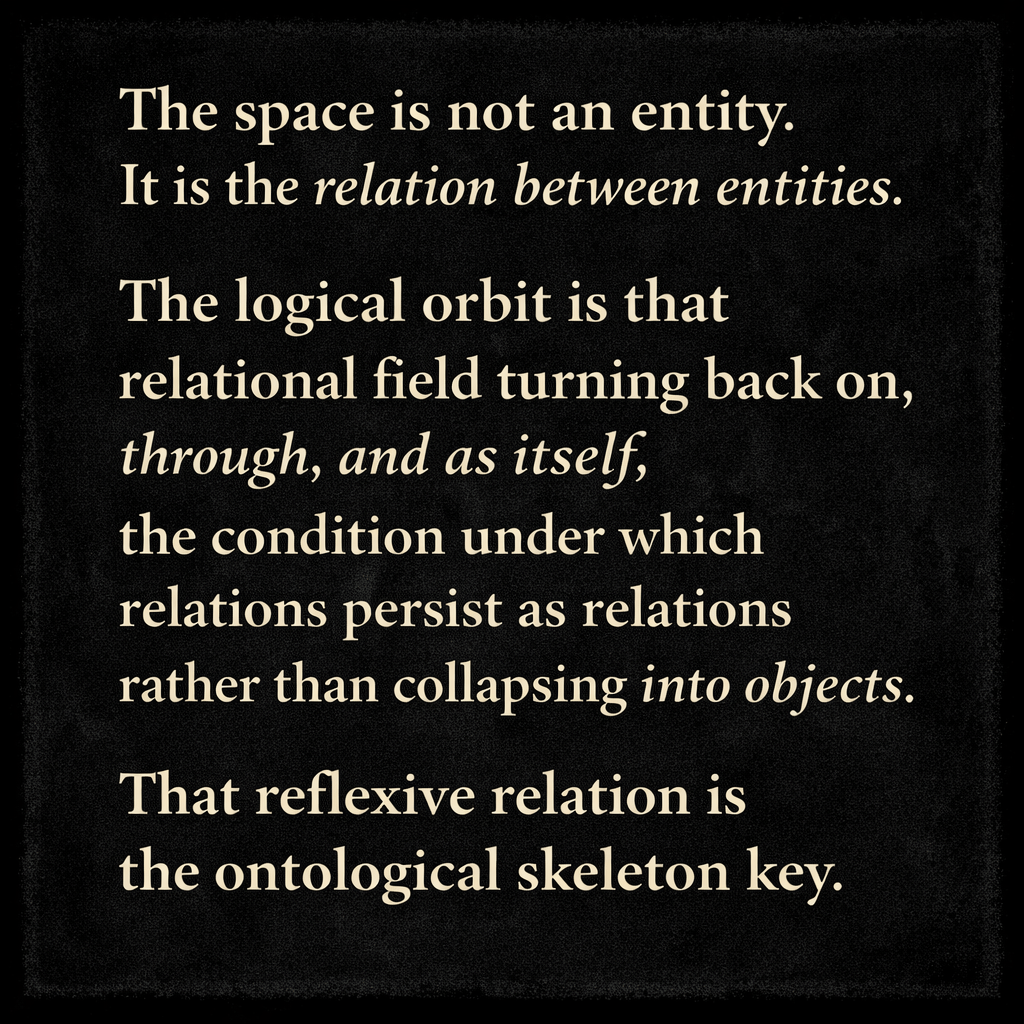
The premise of this account is that relation precedes the division into spaces. Each division gives local expression to a continuity that exceeds its coordinates. The logical orbit names the constitutive incompleteness of these expressions: each depends upon relations it cannot exhaust. Coherence persists through the continuing organisation of that dependence.
Levin, information, and form
Levin’s discussions of bioelectric coordination, regeneration and biological plasticity attend to the distributed regulation through which anatomy is maintained or reconstructed (Levin, 2019; 2021). An anatomical target remains recognisable through changes in the material activity sustaining it. Its relative stability directs attention towards the constraints through which different local processes participate in the persistence of form.
Calling such a pattern an invariant identifies what remains stable at a specified resolution and under specified transformations. The analogy with a Platonic form concerns a distributed constraint through which trajectories are organised. The relational argument asks how that constraint acquires expression across domains whose variables, timescales and possibilities differ. The biological work motivates this question; the priority of relation is the premise developed here.
Sub-spaces as projections of a continuum
Behavioural, transcriptional, morphological and physiological spaces are selective articulations of a continuous field. Each preserves particular relations and leaves others outside its description. Behavioural accounts attend to activity and sequence. Transcriptional accounts attend to expression and regulation. Morphological accounts attend to feasible form and developmental constraint. Physiological accounts attend to changing states and compensatory activity. Waddington’s epigenetic landscape provides an earlier account of development through constrained possibilities (Waddington, 1957).
Projection here names this selectivity. A mathematical projection requires a specified domain, target space and mapping. Such mappings select from an organisation in which consequences propagate across the distinctions used to describe it. Every local account is made possible by dependencies that extend beyond its selected variables.
What persists across changing expressions is organised difference. A difference remains consequential through its coupling to further activity. The particular signals, structures and descriptions sustaining that coupling change as the field is reconstructed. Continuity consists in the persistence of these relations through transformation.
Logical antisymmetry and spectral coupling
Logical antisymmetry names the constitutive non-identity of coupled terms. Their difference participates in the relation through which each remains distinguishable and consequential. A process and the conditions sustaining it cannot coincide completely while retaining this distinction. Their coupling also requires sufficient continuity for changes on either side to affect what follows.
Spectral coupling concerns the organisation of recurrence across different rhythms and timescales. Phase, lag, resonance and interference express how activity in one domain alters possibilities in another. Delay is constitutive: propagation takes time, and the interval between activities participates in the organisation of their relation. The field persists through the continuing reconstruction of these differences.
A quantitative account specifies the variables, observations and measures through which recurrence or phase relations are assessed. The collapse condition concerns the loss of consequential distinction or coupling in the relation being examined. Persistence depends upon how difference is organised and reproduced, including how disturbances alter the possibilities for subsequent activity.

The orbit frame
The orbit frame is the local orientation through which a process organises activity. The anti-frame comprises the wider conditions, dependencies and possibilities that this orientation requires and cannot exhaust. Binding absence is the structured interval through which they remain distinct and consequential to one another.
A paired diagram gives a minimal expression of this relation. Its usefulness lies in directing attention towards the coupling, delay and non-coincidence through which persistence becomes possible. The frame participates in the field as a selective expression whose own conditions remain incomplete.
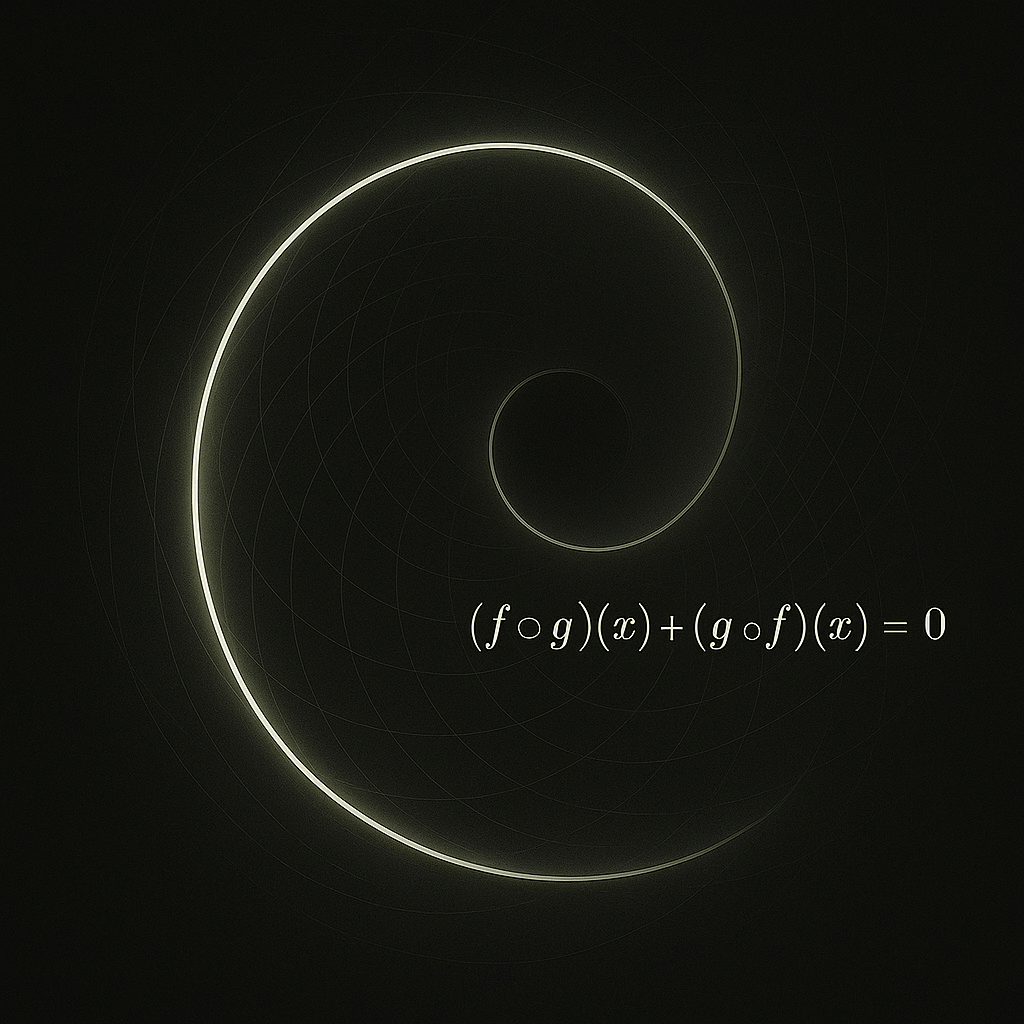
The antisymmetry condition shown here is schematic. Cancellation marks the loss of the distinction through which the represented relation remains generative. It provides a way to discuss relational collapse; a mathematical application requires separately specified terms and operations.
H as a field condition
H names the conditions through which differentiated processes remain coupled. Written as H(f, g), it directs attention towards the relation through which f and g remain mutually consequential. Its expression is distributed across their dependencies, boundaries and continuing activity.
The self-negating notation gives schematic expression to recursive displacement. Continuing activity reconstructs the distinctions through which further activity becomes possible. The logical orbit is this constitutive incompleteness. Persistence requires continuing relation across the interval that no local expression can close.
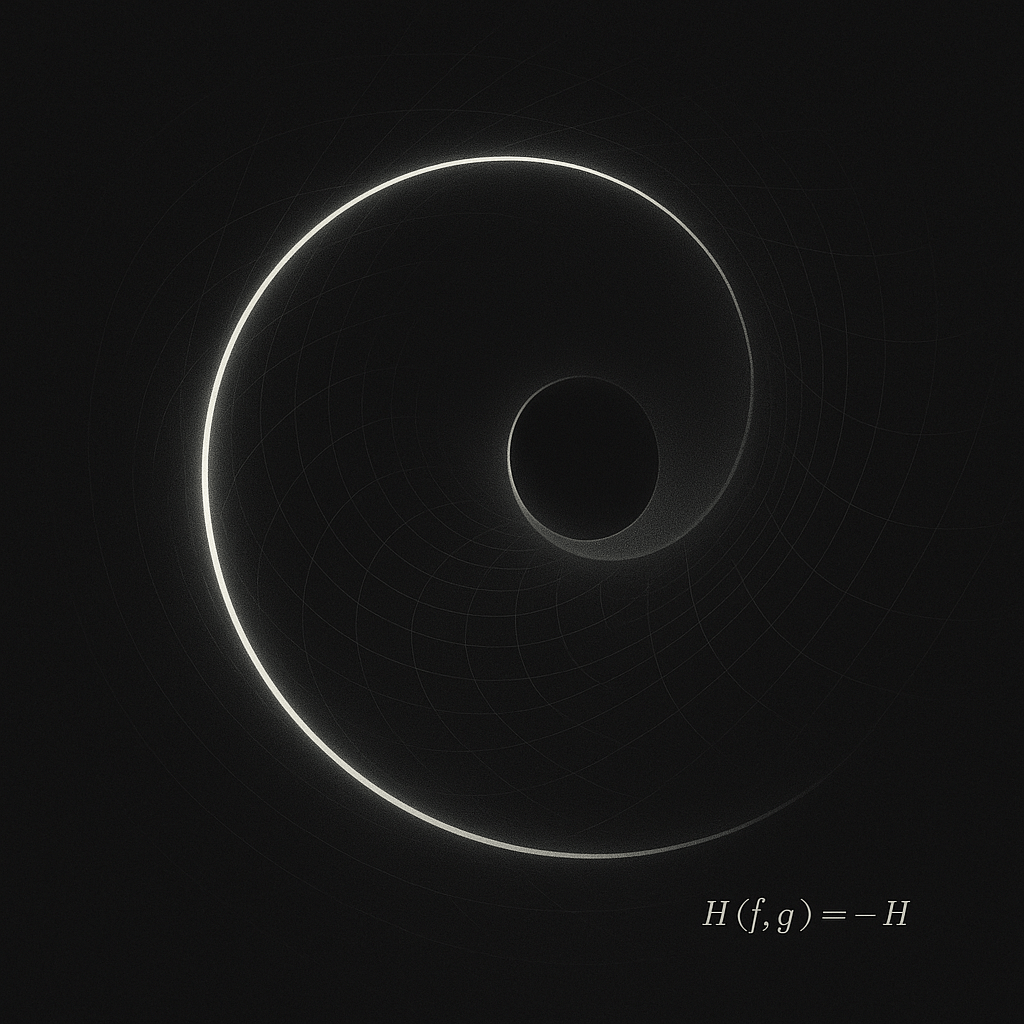
The notation identifies a structural condition. A computational use would define the quantities involved, the transformations admitted and the criterion through which persistence is assessed. The philosophical account concerns the dependence that this formal construction would describe.
Experience, language, and priority
These ideas precede my engagement with language models by decades. They emerged through sustained reflection on systems that fail, persist, adapt and reproduce the conditions of their own activity. Generative tools assist composition within a framework developed through that longer inquiry.
Language participates in the relational field through which meaning becomes possible. A description changes what becomes available for attention, interpretation and action. Its use also changes the conditions of subsequent description. Meaning persists through these continuing relations, with each expression depending upon contexts it cannot contain.
Incredulity as signal
Disciplinary standards organise the distinctions through which a field recognises a contribution. They also shape what remains difficult to articulate within it. A relational account includes these standards among the conditions through which inquiry reproduces its own orientation.
Disagreement becomes useful when it identifies a particular dependency, inconsistency or consequence requiring attention. Dismissal and acceptance both require examination. The work is advanced through engagement with its premises, the relations they expose and the implications available for investigation.
Why this matters
An intervention in one domain changes the conditions available in others. Biological engineering, artificial intelligence and governance all encounter the difficulty of acting through selective descriptions while consequences propagate beyond them. Local success remains dependent upon the wider organisation through which it acquires practical value.
The method begins by identifying the local orientation, its dependencies, the delays through which consequences travel and the differences whose loss would undermine continued activity. An intervention is assessed through what it does to these relations over time. Regulation concerns the continuing availability of responses, an issue developed in Ashby’s account of requisite variety (Ashby, 1956).
Conclusion
The many spaces of living activity are harmonic articulations of a continuous relational field. Each gives local expression to organised differences while depending upon conditions that exceed it. Superspace names their shared continuity; the logical orbit names the incompleteness through which their differences remain coupled and consequential.
Coherence persists through recursive reconstruction under constraint. The practical task is to identify how activity alters the relations that make further activity possible, and whether those changes sustain the wider conditions upon which life depends.
References
Levin, M. (2019) ‘The computational boundary of a “self”: developmental bioelectricity drives multicellularity and scale-free cognition’, Frontiers in Psychology, 10, 2688. doi:10.3389/fpsyg.2019.02688.
Levin, M. (2021) ‘Life, death, and self: fundamental questions of primitive cognition viewed through the lens of body plasticity and synthetic organisms’, Biochemical and Biophysical Research Communications, 564, pp. 114–133. doi:10.1016/j.bbrc.2020.10.077.
Levin, M., Keijzer, F., Lyon, P. and Arendt, D. (2021) ‘Uncovering cognitive similarities and differences, conservation and innovation’, Philosophical Transactions of the Royal Society B: Biological Sciences, 376(1821), 20200458. doi:10.1098/rstb.2020.0458.
Waddington, C.H. (1957) The Strategy of the Genes: A Discussion of Some Aspects of Theoretical Biology. London: George Allen & Unwin.
Ashby, W.R. (1956) An Introduction to Cybernetics. London: Chapman & Hall.
Coda
The field’s continuity is the premise from which its local articulations are understood. Its non-orientable character names the inability to extend any local orientation into a fixed standpoint capable of exhausting the whole. A formal topological model would specify the space and the transformations through which this property is established. The relational account remains directed towards what every local construction depends upon: differences, intervals and constraints through which its own activity becomes possible.


One reply on “The Problem of Many Spaces”
LikeLike