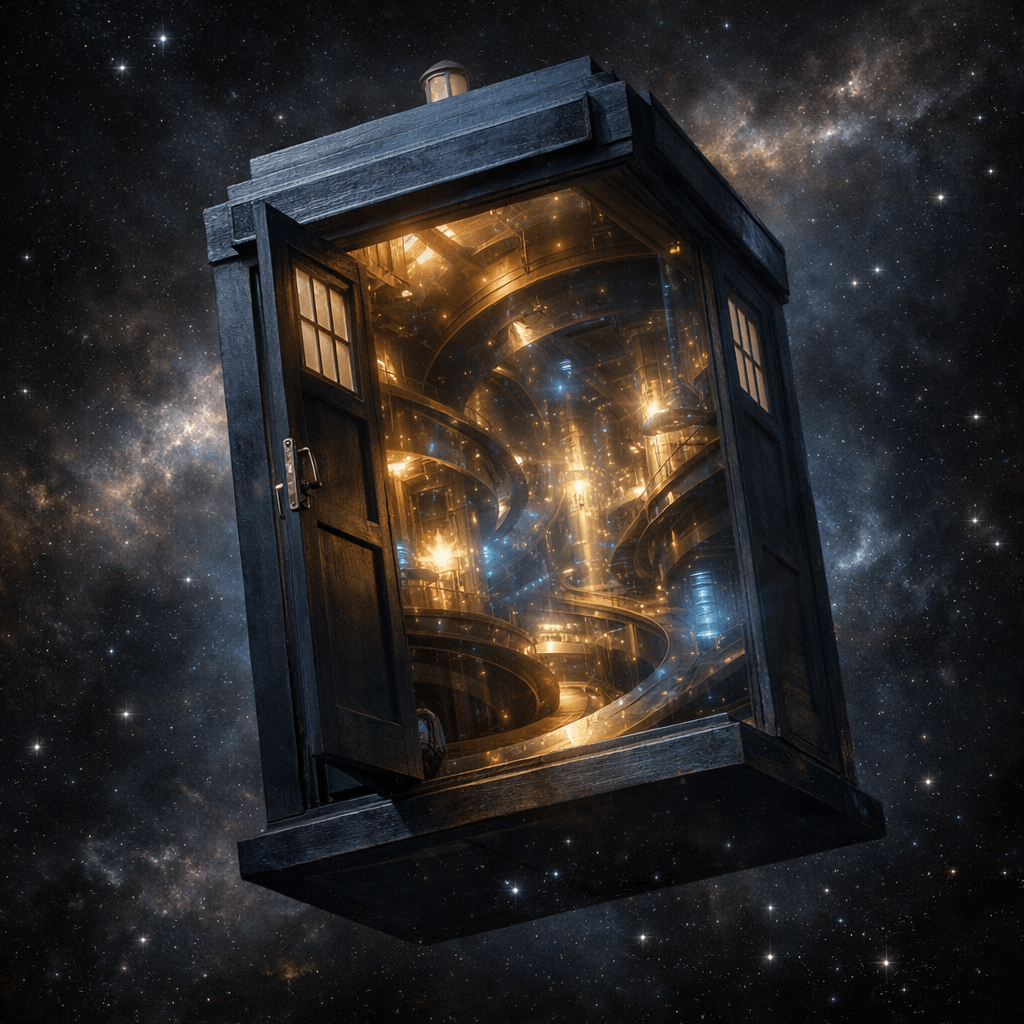
The afterlife, if the phrase is to be used at all, is not best imagined as a sentimental annex bolted onto death. Nor, however, is it something about which confidence is easily justified. What we call a life may be only a local and temporary stabilisation within conditions the person cannot comprehend or contain. The person is real, obviously, but perhaps not primary. There is, at the very least, some excess in experience that cannot be flattened into biography, anatomy, or social role: not a second substance hiding inside the first, but a coherence by which experience exceeds itself, refers beyond itself, and folds back through itself, remaining more than any single perspective can contain. That proves nothing about survival. It only blocks premature closure.
From there, the question begins to invert. It may not be that a person first exists and then later confronts the possibility of survival. It may be that personhood itself is only a brief and unstable expression of conditions it cannot fully know. This life would then be less the origin than a passing cross-section, less a final vessel than a temporary contour borrowed for a while from processes that remain inaccessible. But even this must be said with care, because language arrives already primed to turn conditions into objects and abstractions into things.
That is part of the difficulty. Terms like spirit, void, nothingness, and afterlife come burdened with the grammar of entities. Language makes substances out of limits. It turns absences into nouns, gives them boundaries, and places them somewhere, as though what is at issue were merely hidden from view rather than implicated in the very conditions by which view, world, and observer become possible at all. The slide begins almost immediately. Nouns imply thingness. Predicates imply stable properties. Sentences imply a world already organised enough to contain what is being named. Yet what is being approached here, if anything is, may be less an object than the incompletion around which objects, selves, and worlds gather their temporary coherence.
Under those conditions, everything appears bound not by substance alone but by what no thing can close over or finally contain. Whatever seems self-standing is only ever locally stabilised around an irreducible incompletion, because no entity, person, or system is fully coincident with itself. Continuity depends on what is missing, deferred, displaced, or held elsewhere. Persistence is not simply the triumph of presence. It is also the recurrence of non-identity. A thing holds together not because it possesses itself in full, but because it does not.
So that emptiness cannot be treated as a mere hole, nor merely as lack. Better to say that there is some generative interval through which relation, form, and persistence become possible at all. The self, the world, and whatever may exceed both are not anchored by positive fullness alone, but by a distributed incompletion that prevents reality from resolving into a flat, closed, final thing. What looks like closure from nearby may be only temporary coherence under conditions too deep to be directly surveyed. The deeper difficulty does not disappear. It withdraws into the very possibility of appearance.
Confidence grounded in experience is not irrational. If an experience is real as experience, then it has evidentiary weight, at least for the one to whom it occurred. The problem is not that such experience is worthless, but that its scope is limited. It may justify seriousness, reflection, even a kind of disciplined faith, but not easy metaphysical certainty. One can have good reason to trust that something significant occurred without being entitled to claim clear knowledge of what, exactly, the experience disclosed. Experience may carry force without carrying final interpretation.
That may be one of the prices of sentience. A conscious being inhabits experience from the inside without direct access to the status of what exceeds that interiority. We do not get clean proof regarding other minds, much less whatever might lie beyond the local conditions of embodied life. That absence may not be an accident. It may be one of the structural costs of having a perspective at all. To be a self may already mean to be bounded by a constitutive asymmetry: able to encounter, intuit, and be affected by more than one can stabilise into knowledge.
So faith, in the stronger and more interesting sense, is not belief without experience. It is what sometimes follows when experience outruns the concepts available to contain it. Not superstition. Not gullibility. More like a disciplined refusal to collapse an anomalous or excessive experience either into naive certainty or into premature dismissal. Strange interior recognitions, intuitions, resonances, grief, moments of impossible significance, and whatever else strains the available vocabulary may be real as events in consciousness without thereby licensing a settled metaphysics. The wiser position is neither cynical reduction nor inflated doctrine, but a harder agnosticism: to admit that experience may open onto dimensions of reality beyond present explanatory reach, while also admitting that such opening does not abolish the limit that keeps us from proof.
And yet it is also nothing. Not merely nothing in the dismissive sense, but nothing constitutively. That is the harder turn. Whatever exceeds the world of ordinary access may have to appear, from within that world, precisely as no thing. Not because it is trivial or empty in the cheap sense, but because any positive presentation would already drag it into the grammar, ontology, and containment structures proper to ordinary objects. From this side, then, the more primary condition may be forced to register as void, absence, or emptiness. Not because there is simply nothing there, and not because there is certainly something there, but because what would stand prior to that distinction cannot arrive as a stable item within it.
Perhaps, then, there is nothing. Oblivion. Yet even that may alter less than it first appears, because the absolute impermeability of whatever exceeds life to the conditions of lived experience can only register here as absence. Not a positive object. Not a hidden substance waiting behind the curtain. Not even physics, exactly, though physics occasionally brushes the edge of such questions. More like a prior condition under which logic, world, and mind become possible at all, while itself appearing from this side as no thing. Not because it is simple, but because whatever lies at that depth would be unavailable to direct possession, direct speech, or direct knowledge.
That is why ignorance here is not merely a defect to be repaired. It may be structural. To say “it is unknowable” already risks saying too much, because even that grants a determinate status from within the very frame whose limit is in question. The stronger claim fails. The weaker one holds. There is a constitutive limit internal to knowledge, language, and world-description, and this limit is not merely ignorance about an object but part of what makes objects, selves, distinctions, and descriptions possible in the first place. From the living side, then, the void is not merely what may await us. It is already here as the impossible interior edge of being, present only as what cannot be crossed, contained, or known.
The elegance of it is that the void need not be opposed to spirit at all, though even that leans too heavily on inherited words. Better to say that what appears from this side as emptiness may simply mark the point at which our categories fail. Failure of access is not proof of non-being. But neither is it proof of being. It is only proof that whatever stands at the root of being does not arrive in forms the living mind can stabilise, own, or reduce to doctrine, confidence, or view. So the unknowable is not incidental to reality. It may be one of its deepest conditions.
We do not merely confront that limit at the end. We live within it now. This life, in all its partiality, opacity, unstable coherence, and ceaseless referral beyond itself, may already be one of the forms in which that limit appears. Or rather: one of the forms in which appearance briefly gathers around what cannot itself appear.
Categories
Afterlife