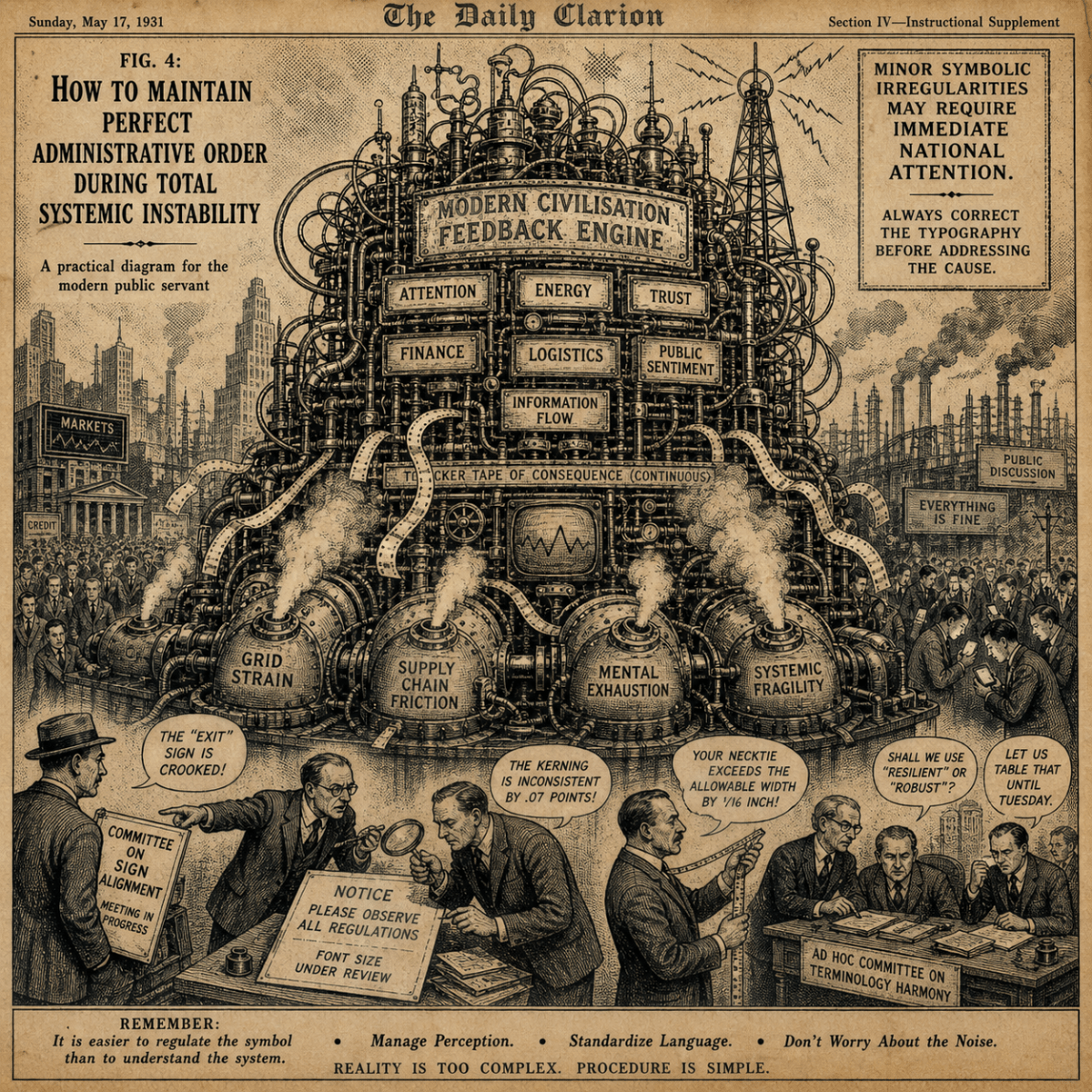
We have entered an era in which the second-order complexity of ubiquitous information and energy feedback systems has become the new centre of gravity. Not industry alone. Not territory alone. Not even ideology in the older twentieth-century sense. The decisive terrain is now the recursive infrastructure through which signals circulate, stabilise, amplify, and reorganise behaviour across planetary scales in near real time.
The important shift is not simply “more technology.” It is that systems increasingly act upon the consequences of their own representations. Markets react to predictions about markets. Populations react to narratives about populations. Algorithms optimise against the behavioural distortions produced by earlier optimisation layers. Power no longer sits primarily in objects, but in modulation: shaping the phase relationships between attention, logistics, finance, governance, energy, and perception. Delay itself becomes strategic terrain because delay determines feedback quality, and feedback quality determines whether a system learns, oscillates, fragments, or coheres.
Apparently unrelated crises now arrive braided together. A drought in one grain belt can harden election rhetoric elsewhere. A shipping delay can become a supermarket argument, then a trust problem, then a policy panic. A data-centre power demand can distort housing politics through grid pressure, land use, and local resentment. A platform ranking tweak can affect mental health, labour markets, public health behaviour, and geopolitical sentiment without ever announcing itself as governance. The domains still look separate at the surface. Underneath, they are increasingly coupled through shared feedback infrastructure.
In that environment, raw force matters less than coherence under recursive stress. The states, organisations, and institutions that survive are not necessarily the strongest in the traditional sense, but those capable of maintaining adaptive continuity while absorbing informational turbulence without catastrophic overcorrection. Stability increasingly depends upon managing phase delay, preserving interpretability, and preventing runaway autocatalytic amplification inside communication systems that now operate faster than the human nervous system evolved to metabolise.
The irony is that the more tightly coupled the global system becomes, the more locally irrational behaviour emerges at the surface. Panic, tribalism, conspiratorial thinking, bureaucratic paralysis, ideological recursion, and algorithmically amplified emotional volatility are not separate anomalies. They are often signatures of a civilisation attempting to coordinate itself through feedback architectures whose complexity exceeds the semantic and institutional bandwidth available to stabilise them.
Categories
The Symbol Is Easier to Regulate Than the System