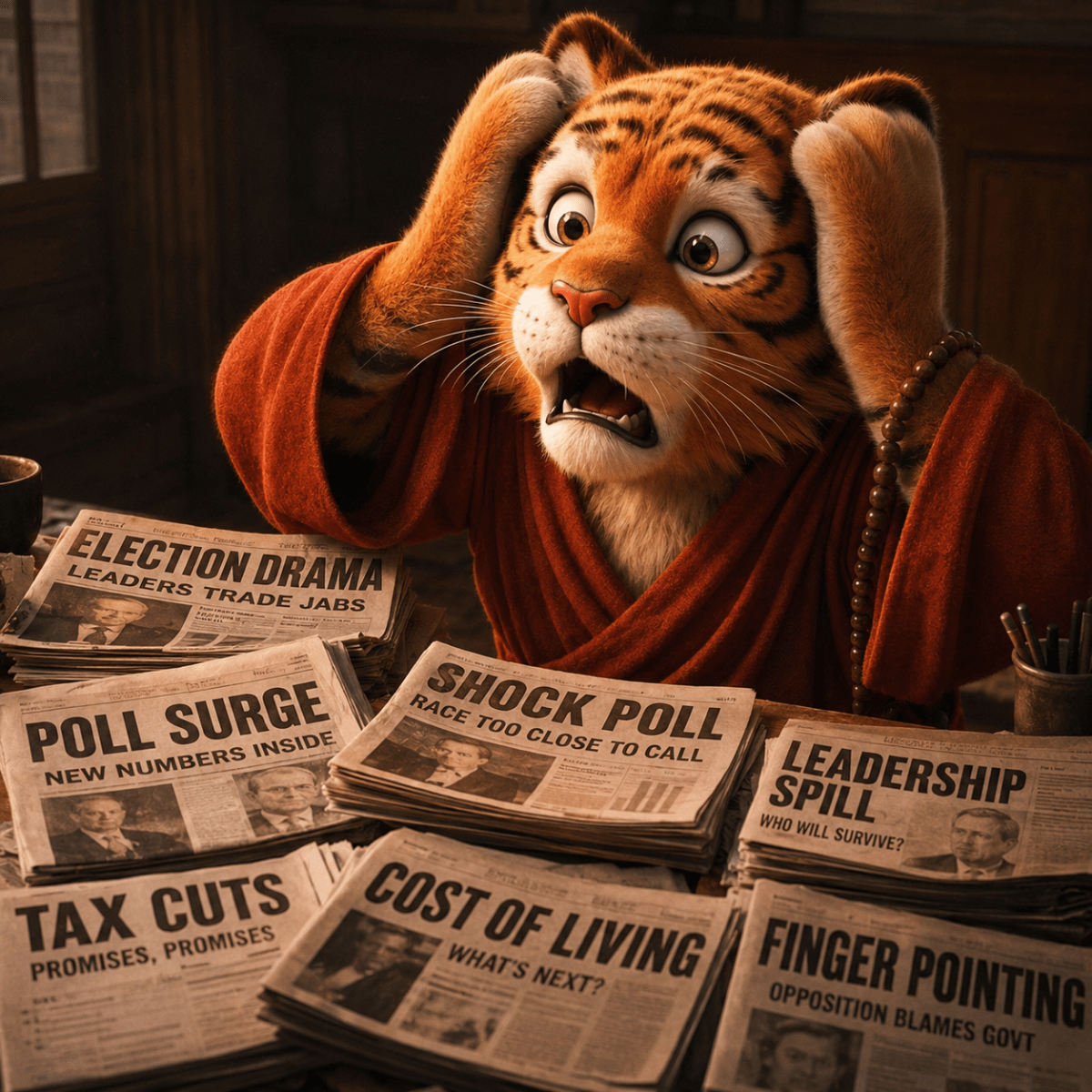
The Australian media system increasingly resembles an institutional constellation of broadcast nodes performing the rituals of political reporting while avoiding much of the substance. Endless commentary about polls, personalities, tactical manoeuvres, leadership speculation, and parliamentary theatre is presented as national analysis, while the deeper structural questions are quietly escorted from the room. Housing, energy, technological concentration, media ownership, institutional legitimacy, economic precarity, and social fragmentation are treated as disconnected events rather than components of the same system. The result is journalism that often feels less like investigation and more like compliance wearing the costume of scrutiny.
Meanwhile, millions of frustrated voters are drifting toward increasingly simplistic political answers. Some of that frustration is entirely justified. Institutions have become less responsive, less competent, and less trusted. But when public anger is channelled into populist grievance without serious examination of causes, incentives, consequences, or power structures, something has failed. A media environment that cannot explain complexity should not be surprised when complexity is rejected in favour of slogans, scapegoats, and political finger-painting.
The darker joke is that this does not require conspiracy. Incentives are usually enough. Billionaires own media organisations. Advertisers shape priorities. Political access depends on relationships. Audience attention rewards outrage more reliably than understanding. Careers are built by remaining inside the boundaries of acceptable discussion. Nobody needs to meet in a secret bunker and plan the decline of public discourse. The machinery can manufacture it automatically, one commercial decision at a time.
Then there are the freshly minted technology oligarchs, routinely presented as visionaries while constructing some of the largest systems of behavioural influence in human history. Their wealth is mistaken for wisdom. Their influence is mistaken for legitimacy. Their platforms are mistaken for public squares. The mythology is almost impressive. A civilisation capable of building planetary-scale information systems has somehow convinced itself that stock price and intelligence are roughly interchangeable concepts.
None of this requires intelligence in any particularly deep sense, and consciousness has very little to do with it. It merely has to be useful. Useful to capital. Useful to influence. Useful to the accumulation and concentration of power. The machine does not need to understand what it is doing. It only needs to keep doing it. The real danger is not that anyone is secretly steering the system. The real danger is that increasingly nobody is.
 Daedelus Kite
One reply on “aussie media fail”
…and its not as simple as just getting better reporters, teams, managers, boards, owners and/or improving variously regulatory biases from government and corporations. No, the transactional essence of media assure their drift from useful fact to performative role play.
First guess on causal factors is that they are all stupid. Not nice. However, we can ask serious questions about the overall retardation (literally – slowing down) of media accuracy, relevance, and consequence.
Media are now, for better and for worse, bolt-on defensively neurotic broadcast nodes for atavistic ideology, socioeconomic inequity and for maintaining the symbolic order as it is. Which is kind of stupid except that I doubt whether anyone has much choice. The media are no more free from powerful influence and neurotic censorship than are fish able to.leave and live beyond the water that sustains them: grift is the game and no one wants to upset this gravy train. And this, this is why we can’t have nice things…
LikeLike