Institutional incompetence fuels political opportunism. Social media rewards outrage, nobody accepts responsibility, and democracy inherits the bill.

Institutional incompetence fuels political opportunism. Social media rewards outrage, nobody accepts responsibility, and democracy inherits the bill.

A system that discourages difference eventually undermines its own capacity to learn, adapt and survive.

The student walkout against One Nation points to a larger problem: the affective politics of cultivated antagonism that has become disconcertingly effective as a technologically-mediated, commercially-leveraged narrative system.

A nation cannot be unified by dividing a people against themselves. The danger begins when that contradiction becomes a political method.

A movement founded on representing those with the least power increasingly depends upon support from those with the most.

Theirs is a role play of analysis, simply and unwittingly giftwrapping populist-adjacent themes for broad public consumption; little on insight, big on performative role play.

Populism turns complex national problems into kindergarten theatre, then sells the applause as policy.

One Nation raised millions for political theatre while a Queensland hospice had to beg for palliative care funding. This is clearly ridiculous but is also hardly an isolated incident of misplaced priorities and dodgy reasoning in sociopolitical systems.

The future will not be defined by any single party or leader. It will be defined by the widening gap between the complexity of the systems governing society and the increasingly simplified narratives through which society attempts to understand them

Having watched the world’s most powerful nation fall backwards into the plumbing of populist discontent, Australia now seems oddly determined to follow.
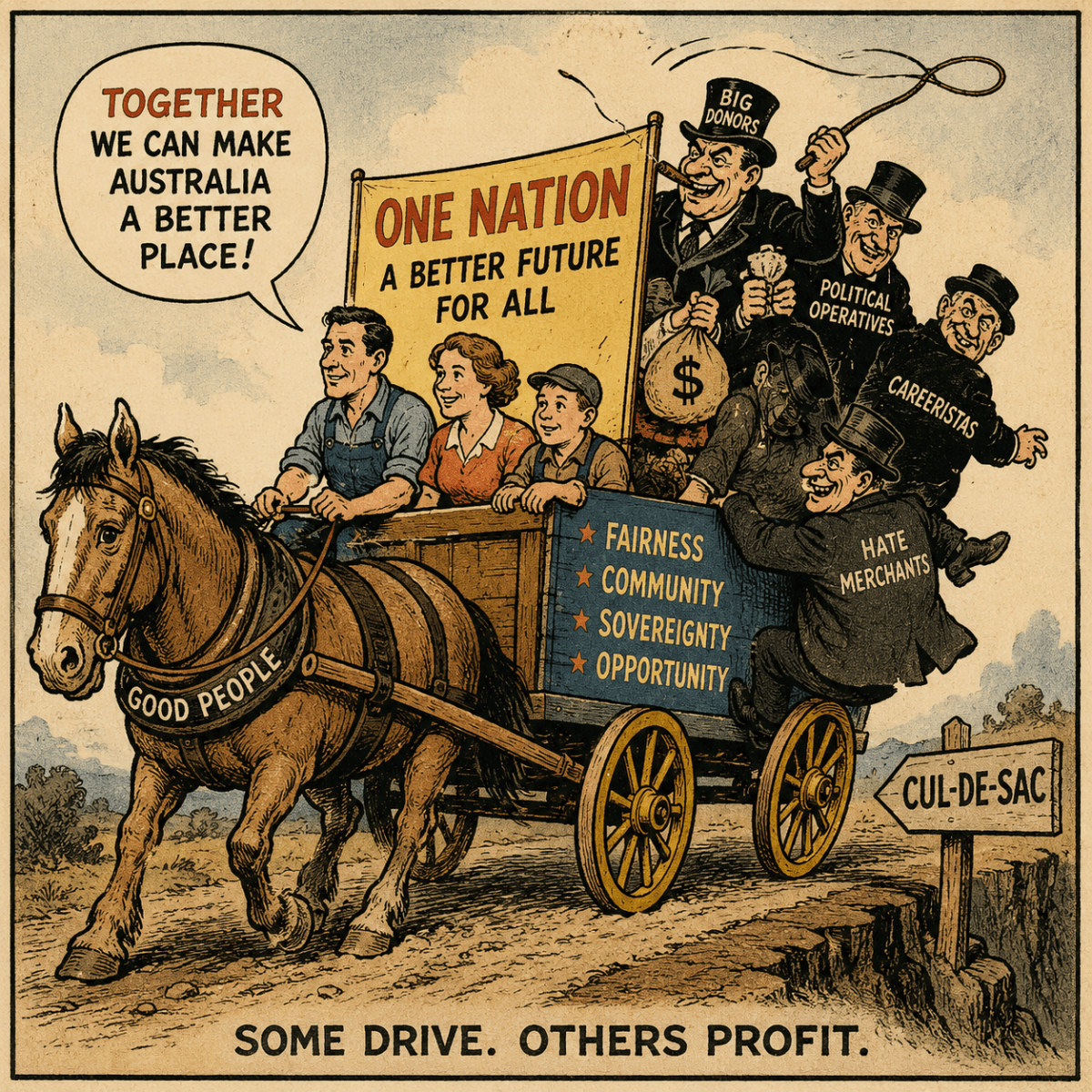
They paint themselves into a hyper-simplistic corner because simplified narratives feel stabilising during periods of systemic uncertainty. But once political language collapses into slogans, binaries, and permanent outrage, the capacity to think strategically about complex realities begins to erode. The rhetoric that initially appears empowering gradually becomes constraining. Every new problem must be forced through […]

The Coalition’s recent turn on immigration should not be read only as a policy announcement. I read it as a communication event built around one of the oldest political instruments available: the conversion of broad social anxiety into a visible outsider. In its own language, the Coalition’s Australian Values Migration Plan promises to strengthen “Australian […]
Have a WordPress.com account? Log in now.

