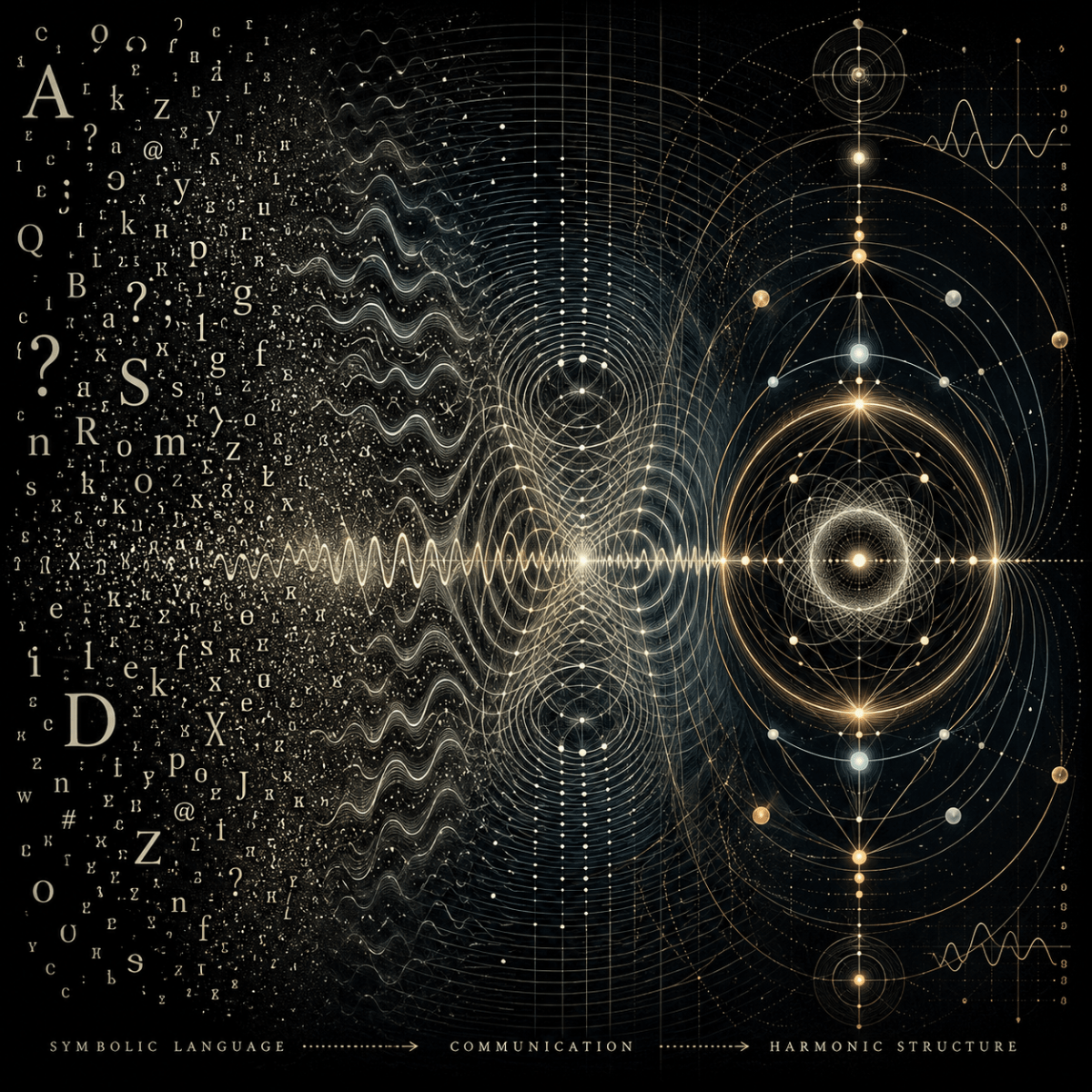
Entrainment is one of those remarkable phenomena that quietly reveals itself almost everywhere once one begins looking for it. Across physics, biology, engineering, astronomy, and neuroscience, systems with radically different structures and vastly different physical scales nevertheless exhibit the same tendency: when they interact, they organise themselves through time. Frequencies adjust, phases align, and coherent patterns emerge without any central authority imposing order. Weak interactions accumulate until the system discovers a relatively stable mode of organisation. This is often described as movement toward a lower-energy state, but the attractor is more than a simple energetic minimum. It is a dynamically self-sustaining pattern in which relationships become mutually reinforcing and the organisation itself becomes easier to preserve.
The breadth of this phenomenon is striking. Pendulum clocks suspended from the same beam synchronise. Heart cells beat together to produce a coherent pulse. Networks of neurons transiently lock into shared rhythms during perception and cognition. Electrical generators distributed across continents maintain common phase to keep power grids stable. Planetary systems settle into orbital resonances that can persist for millions of years. Atoms, cells, organisms, machines, and celestial bodies differ enormously in size and composition, yet the same mathematical ideas repeatedly appear: coupling, resonance, harmonic relationships, phase locking, and synchronisation. Physical scale seems to matter far less than temporal compatibility.
This suggests a broader possibility. Perhaps rhythm is not simply something organised systems possess, but one of the principal ways they exist. Structure may often be the visible consequence of deeper organisations in time, where persistence emerges from enduring patterns of phase and frequency rather than from spatial arrangement alone. Harmonic relationships need not imply perfect synchrony. Many systems remain stable precisely because they preserve characteristic offsets, delays, and complementary phase differences. Coherence is therefore not the absence of difference but the organisation of difference through time.
Whether this principle extends beyond familiar oscillatory systems remains an open scientific question. Yet the repeated appearance of entrainment across so many domains suggests that temporal organisation occupies a far deeper role in nature than is often recognised. There may exist a broad family resemblance connecting systems that remain dynamically coupled through time despite enormous differences in scale and composition. Exactly how deep that resemblance extends—and whether it ultimately touches the same relational foundations hinted at by phenomena such as quantum entanglement—remains uncertain. Even so, the evidence increasingly suggests that resonance, harmonic structure, coupling, and persistent relation are not isolated curiosities, but among the most fundamental architectures through which complex systems organise and endure.

