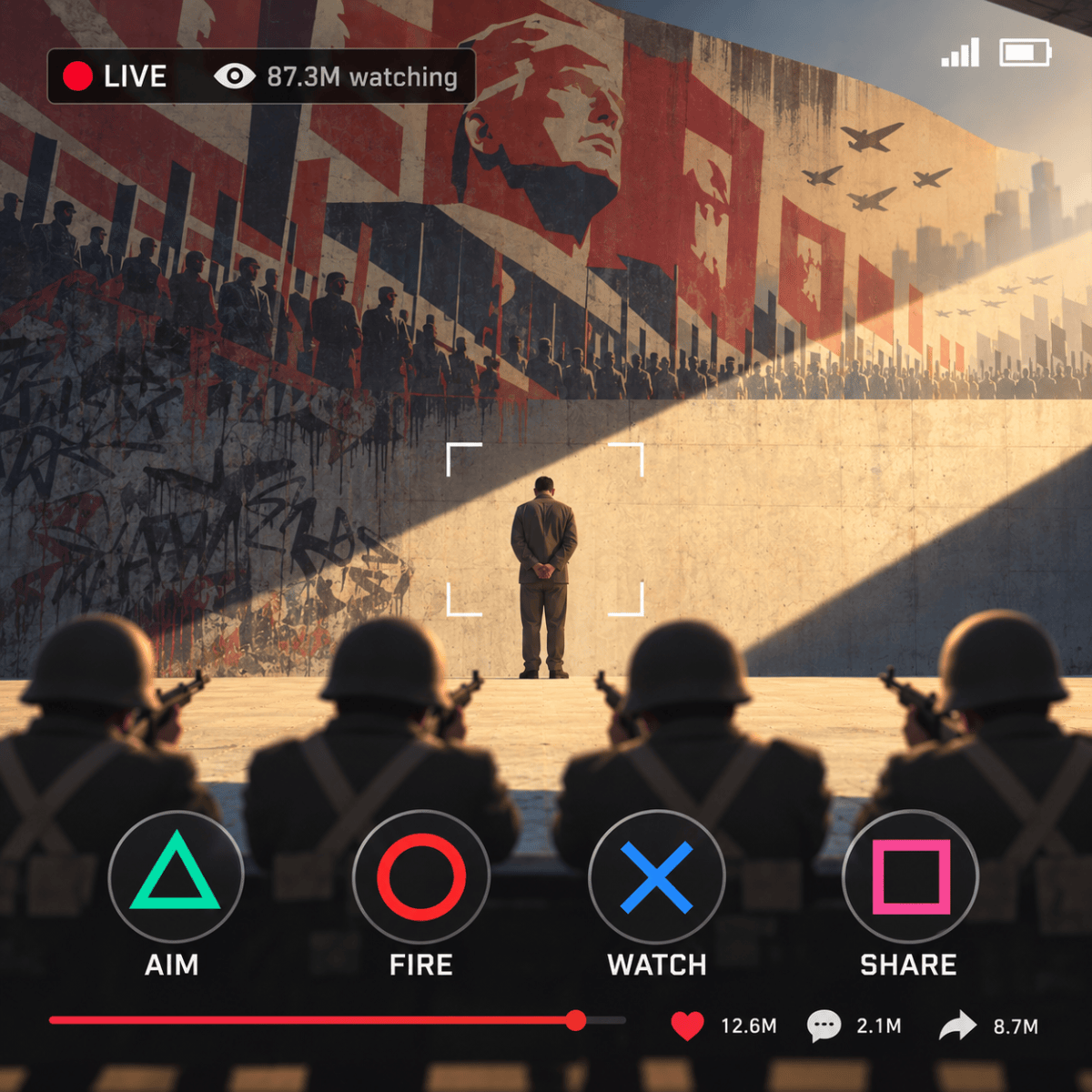
There is something profoundly disturbing about the spectacle of broadcast killing, although we should recognise how ordinary it has already become. I can switch on YouTube in the morning and watch people being killed by drones in Ukraine, sometimes from the perspective of the machinery doing the killing. We can observe another human being’s final moments from an armchair, with the option of skipping the advertisements. Death circulates through digital media, acquiring audiences, commentary and political significance. But what happens when a government deliberately broadcasts its own executions? Foucault (1977) described the historical movement from spectacular sovereign punishment towards less visible systems of disciplinary control. Contemporary technology brings the two together. Government becomes both executioner and broadcaster, while punishment acquires the reach and persistence of global communication. The question is not whether people will watch. We already know they will. It is what happens to political authority and collective behaviour when spectatorship becomes part of the state’s exercise of lethal power. The scaffold has acquired broadband. I hesitate to call it progress.
History offers little reassurance. Gatrell (1994) describes English public executions as occasions of ambiguous public response. Crowds could affirm the law’s authority while also transforming punishment into carnival, sympathy or defiance. The state controlled the scaffold, but not its meaning. Linders (2002) demonstrates how American authorities increasingly sought to regulate execution audiences, whose composition and behaviour affected the legitimacy of punishment itself. Revolutionary France offers a more destructive variation. The execution of Louis XVI announced a new political order, but the subsequent Terror increasingly tied political legitimacy to the identification and elimination of enemies. Andress (2006) traces how war, fear and political factionalism sustained escalating violence, eventually consuming figures such as Robespierre. These histories reveal a recurring difficulty. Public killing does not simply demonstrate political power. It reorganises the relationships through which power is recognised, contested and reproduced. When authority depends upon identifying enemies, identifying enemies acquires political value. The distinctions sustaining the spectacle begin reproducing themselves, sometimes at the expense of those who established them. The guillotine, as it turned out, was remarkably indifferent to political credentials.
Cruelty is the deliberate infliction of suffering, but its consequences extend beyond perpetrator and victim. Suffering generates fear, submission, fascination, outrage, resistance and retaliation. These responses return to the relationships that produced them, changing the conditions under which subsequent actions occur. Spectators, institutions and political authorities become organised around recurring distinctions, even when their responses are opposed. Fear attracts attention, attention encourages repetition, and repetition establishes familiarity. Familiarity acquires authority, influencing what gets repeated. Agreement is unnecessary. Supporters and opponents remain coupled through the distinctions they reproduce. The spectacle does not simply communicate an existing arrangement of power. It changes the relationships through which that power operates. Every subsequent response occurs within conditions partly reorganised by what has already happened. A government seeking to demonstrate finality through execution introduces an event whose consequences cannot be confined to the death itself. The punishment ends, but its communication continues, accumulating meanings, associations and grievances beyond anybody’s control. Killing someone is comparatively straightforward. Controlling what their death comes to mean is another matter.
Governments compound this difficulty when they mistake commanding attention for exercising control. Political authority depends upon distinctions between legitimacy and illegitimacy, obedience and defiance, security and threat. Public punishment dramatises those distinctions while inviting audiences to reproduce and contest them. Those who commit spectacular violence sometimes seek recognition, publicity and enduring cultural significance. Broadcasting their execution risks amplifying precisely the communicative influence the state would be wiser to diminish. Their punishment becomes another event around which grievances, identities and allegiances organise. The state demonstrates its power while providing its adversary with an extraordinary platform. Opposition does not necessarily interrupt the process. Condemnation, celebration, outrage and fascination all contribute to the circulation of the event, although their consequences differ. The spectacle acquires significance through the conflict it generates. Political authorities then confront an altered environment in which further demonstrations of resolve appear necessary, especially when earlier demonstrations have failed to produce security. The machinery begins rewarding its own repetition. It is an impressive achievement to execute an enemy and still leave them participating in the political conversation.
The question is not whether capital punishment is justified. It is an extreme measure, and its legitimacy raises questions beyond this discussion. My concern is the transformation of punishment into a communicative performance whose consequences outlive the sentence. Peace requires managing conflict without allowing violence to organise collective life. Force is sometimes necessary to prevent harm, but necessity does not confer virtue upon its exercise. Some firing-squad procedures have included a rifle loaded with a blank cartridge, leaving the marksmen uncertain about their individual contribution to the killing. The practice is not universal, but the underlying principle is instructive. Broadcasting distributes uncertainty differently. Governments authorise, officials administer, platforms distribute, and audiences watch, condemn, celebrate or share. These contributions are not morally equivalent, but their wider consequences become entangled. Responsibility passes around like a wild card in a deck, while everyone remains capable of pointing towards somebody else’s more consequential role. The execution ends, but the relationships it reorganises persist, altering the probability of further spectacles. We have developed extraordinary technologies for distributing information, only to discover that cruelty travels exceptionally well. A civilisation capable of turning its own moral deterioration into a public spectacle has acquired a formidable capacity to repeat itself. Round and round it goes. Where it stops, nobody wants to know.
References
Andress, D. (2006) The Terror: The Merciless War for Freedom in Revolutionary France. New York: Farrar, Straus and Giroux.
Foucault, M. (1977) Discipline and Punish: The Birth of the Prison. Translated by A. Sheridan. New York: Pantheon Books.
Gatrell, V.A.C. (1994) The Hanging Tree: Execution and the English People 1770–1868. Oxford: Oxford University Press.
Linders, A. (2002) ‘Execution spectacle and state legitimacy: The changing nature of the American execution audience, 1833–1937’, Law & Society Review, 36(3), pp. 607–655.

