Actually, this is why we can’t have nice things.
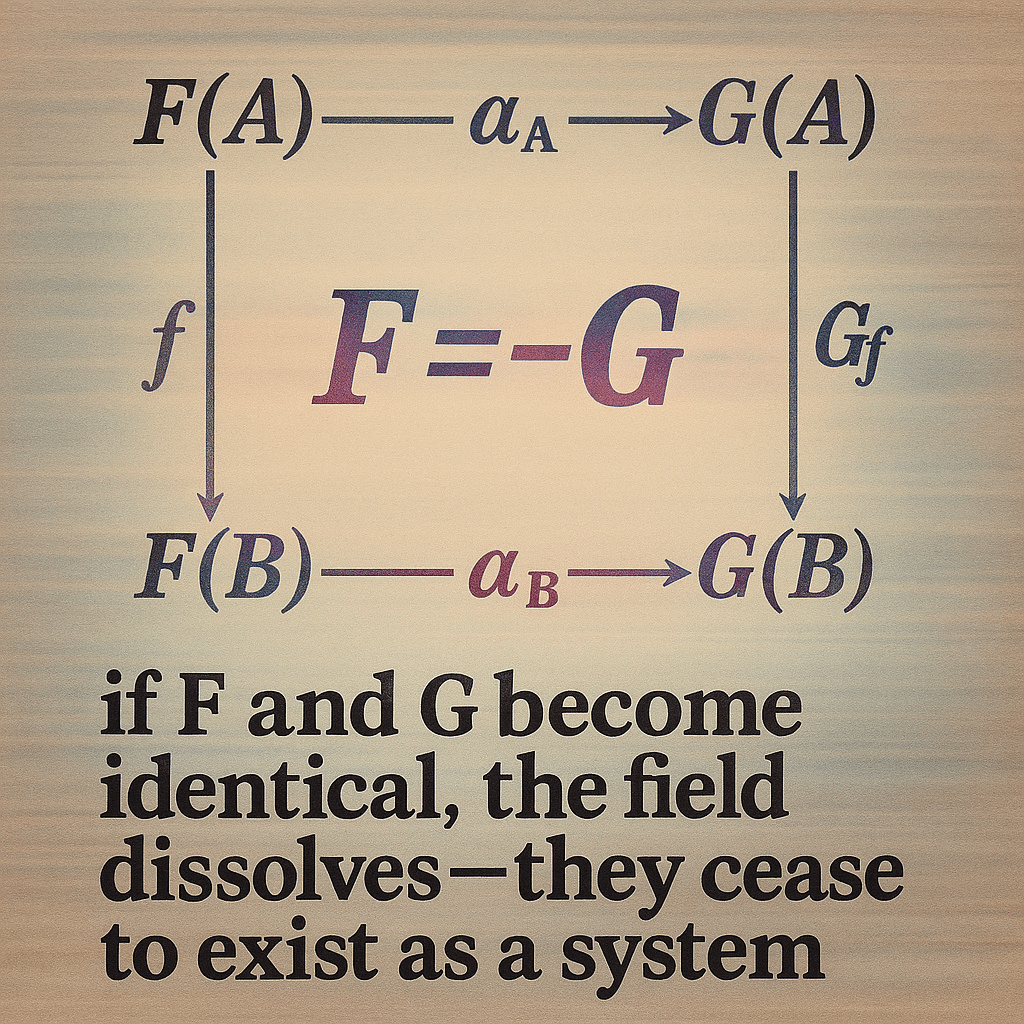
In category theory, a natural transformation α: F ⇒ G between functors F, G: C → D is defined by the naturality condition:
G(f) ∘ αA = αB ∘ F(f)
for every morphism f: A → B in the category C.
This means that it doesn’t matter whether you follow a relationship under the first functor and then transform, or transform first and follow the relationship under the second functor. If the square commutes, the two routes agree. What is preserved is compatibility across a structured field of relational difference. The equation does not automatically preserve every property of the objects involved. It establishes the conditions under which the transformations remain mutually compatible.
Read this in relation to entropy and the persistence of identity. If F = G, the natural transformation need not be the identity: difference remains possible within the same mathematical structure. If F ≠ G, the transformation relates distinct descriptions without requiring their differences to disappear. Neither condition, by itself, establishes entropy production. Entropy enters through the physical dynamics of transformation, including the constraints, exchanges and irreversible processes through which persistent configurations are sustained.
There is a further distinction between difference and antisymmetric reciprocity. The expression F = −G is not generally defined for functors, because negation requires additional mathematical structure. Antisymmetry concerns the orientation of a relationship rather than the negation of its participants. Where H is a signed relational quantity defined on pairs of functors or system descriptions, this can be expressed as:
H(F,G) = −H(G,F)
Exchanging F and G reverses the sign of their relationship without eliminating the relationship itself. The expression describes an antisymmetric component of coupling, not necessarily the entirety of the interaction. Reciprocal dependency consequently does not require identical effects in both directions. The distinction lies in the orientation of the relationship, while its participants remain mutually implicated in the larger system.
Identity, understood relationally, is a provisional continuity maintained through difference. The naturality condition provides a mathematical expression of compatibility across transformations. Antisymmetric reciprocity describes a different property: the reversal of an oriented relational quantity when its arguments are exchanged. Neither equation alone establishes dynamical persistence. Logical orbit concerns the reciprocal coupling, phase differences, delays and temporal relationships through which distinguishable identities arise and persist. The persistence of a particular relational invariant depends on the dynamics sustaining it.
Entropy belongs to those dynamics. Persistent physical configurations maintain their distinguishable structure through exchanges, constraints and transformations that carry physical costs. Natural transformations describe structural compatibility; antisymmetric relations describe oriented differences; physical dynamics determine how those differences evolve and what is required to sustain them. Order is never free. Its cost is not supplied by mathematical notation, but by the processes through which continuity is maintained.

Epilogue: What Does All This Mean?
Category theory is a branch of mathematics concerned with relationships and transformations. Rather than beginning with what things are made of, it asks how things are related, how those relationships compose, and what remains consistent when we move between different ways of describing them. This provides a language for examining systems in which identity is understood through relationships rather than independent existence.
An object is something distinguishable within a mathematical setting. A morphism is a relationship or transformation between objects. A category consists of objects and morphisms, together with rules governing how those morphisms compose. A functor translates one category into another while preserving identity morphisms and composition. Two functors, F and G, can represent different ways of translating the same relational structure.
A natural transformation establishes a compatible relationship between those translations. Imagine two different maps of the same landscape. They need not use the same coordinates, scale or visual representation. Nevertheless, the relationships between their representations can remain compatible. Natural transformation expresses a precise mathematical version of this compatibility.
The naturality equation describes two possible routes. We begin with an object A, related to another object B by f. We can translate that relationship using F and then move across to G, or move across first and follow the relationship using G. The symbols αA and αB describe the transformations between the two representations at either end. The symbol ∘ means that operations are composed, with the rightmost performed first. When both routes give the same result, the diagram commutes. The transformations are compatible, although their intermediate descriptions differ.
Compatibility does not require sameness. Even when F and G are the same functor, the transformation between them need not be the identity. Equally, when they differ, the naturality equation does not tell us how much energy is consumed, whether entropy increases, or whether a physical process is reversible. Those questions concern the dynamics of the system being examined.
Antisymmetric reciprocity introduces another dimension. Imagine two interacting systems, each affecting the other. Their relationship has an orientation: we can describe the effect from the perspective of one system or reverse the order and describe it from the other. When a signed relational quantity is antisymmetric, exchanging those positions reverses its sign. This is what H(F,G) = −H(G,F) expresses. The negative sign does not mean that one system ceases to exist, that one effect cancels the other physically, or that the systems are independent. It means that the quantity being measured changes orientation when the order of its participants is reversed.
Antisymmetry is not the same as opposition in the everyday sense. Nor does it establish that all reciprocal interactions are antisymmetric. It identifies a particular mathematical property of a relationship. The relationship can contain both symmetric and antisymmetric components, depending on the quantity being described. In Logical Orbit, the antisymmetric component is significant because distinguishable identities persist through relational differences rather than the elimination of difference.
Consider two coupled oscillators. Each has a rhythm, and their interaction changes how their phases evolve. The phase difference between them is oriented: measuring the phase of the first relative to the second gives the negative of measuring the second relative to the first, when the difference is represented consistently. The oscillators need not become identical for a stable relationship to emerge. They can maintain a persistent phase difference through coupling. This provides a physical illustration of how an antisymmetric relational quantity can participate in a stable dynamical configuration, without confusing the mathematical sign reversal with the full dynamics of the oscillators.
Logical orbit extends this reasoning into the persistence of identity. A living system, a language, a planetary ecology or a pattern of communication does not remain distinguishable because its constituents never change. Its identity persists through ongoing interactions, exchanges, delays and differences. In the orbit frame, identity is a stable relational difference sustained through reciprocal dynamics. Its continuity belongs to the evolving configuration, not to an isolated object standing outside those relationships.
Category theory provides a language for expressing structural relationships across transformations. Antisymmetric reciprocity expresses the reversal of oriented relational quantities. Logical orbit addresses the dynamical conditions under which relational invariants persist. Entropy describes part of the physical cost of sustaining and transforming those configurations. These are distinct aspects of the same investigation, not interchangeable mathematical statements. Their connections are established through the structures and dynamics under examination.
This leads to the problem of many spaces. Different mathematical descriptions, physical systems and observational frames do not necessarily share the same objects, coordinates or boundaries. Their relationships nevertheless arise within a larger field of interaction. Working backwards from the whole allows us to investigate how differentiated spaces emerge, how their transformations remain compatible, and how persistent identities arise within their shared dynamics.
The underlying question is not simply what things are, but how distinguishable things become possible, remain distinguishable and transform without requiring an independent foundation outside the relationships that constitute them. The mathematics expresses structural conditions. Antisymmetry identifies an important form of relational difference. The dynamics explain persistence. None requires us to mistake a provisional identity for an independently existing thing.
Technical Appendix: A Unified Relational Dynamical System
The mathematical task is to describe how differentiated identities persist through reciprocal transformation, without treating those identities as independent of the relational field that sustains them. We begin with a dynamical system and construct naturality, antisymmetric reciprocity and relational persistence within a common mathematical setting.
1. Dynamical Evolution
Let X be a state space and Φt: X → X a family of evolution operators, defined for nonnegative elapsed times t. The operators satisfy:
Φ0 = idX Φt+s = Φt ∘ Φs
The first condition means that zero elapsed time leaves the state unchanged. The second means that successive intervals of evolution compose consistently. Together, they define a dynamical system. The evolving state need not remain unchanged; what persists is determined by the relationships and invariants of its evolution.
2. Naturality: Compatibility Across Descriptions
Let F and G be functors from the category of elapsed-time transformations into a category of state spaces and mappings. They describe evolution on state spaces XF and XG. A natural transformation α: F ⇒ G relates those descriptions and satisfies:
G(t) ∘ α = α ∘ F(t)
This is the naturality equation specialised to temporal evolution. Evolving a state under F and then translating it into G produces the same result as translating first and evolving under G. The two descriptions are dynamically compatible without being required to be identical.
3. Antisymmetric Reciprocity: Oriented Relational Difference
Introduce a common relational state space Z and a signed quantity H: Z × Z → ℝ. This common domain allows us to exchange the arguments without changing the mathematical meaning of the operation. Antisymmetry is expressed by:
H(x,y) = −H(y,x)
Reversing the participants reverses the sign of their relational difference. Antisymmetry requires H(x,x) = 0, but permits nonzero differences between distinct states. It is not a statement that one participant is the negative of the other.
For states carrying phases θx and θy, an antisymmetric relational quantity is:
H(x,y) = sin(θy − θx)
The quantity depends on relative phase rather than either phase independently. It reverses sign when the participants are exchanged.
4. Dynamical Persistence: Invariance Through Change
Let Ψt: Z × Z → Z × Z describe the joint evolution of a coupled configuration. A relational invariant I satisfies:
I(Ψt(x,y)) = I(x,y)
This is the persistence condition. The individual states can change while a relationship between them remains invariant. For a suitable evolution, the antisymmetric quantity H can itself serve as I. Naturality and antisymmetry do not independently guarantee this result; the dynamics must preserve the chosen relational quantity.
5. A Concrete Construction
Consider two phases evolving at the same angular frequency ω. Using d/dt to indicate differentiation with respect to time:
dθ1/dt = ω dθ2/dt = ω
Define their phase difference as Δ = θ2 − θ1. Its rate of change is:
dΔ/dt = ω − ω = 0
The phase difference persists. Let Rt represent rotation through ωt, and let both functors describe this rotational evolution:
F(t) = G(t) = Rt
Introduce a non-identity natural transformation α = Rδ, representing rotation through a fixed angle δ. Because rotations commute:
Rt ∘ Rδ = Rδ ∘ Rt
The naturality condition is satisfied even though α need not be the identity. Meanwhile, the antisymmetric quantity H(θ1,θ2) = sin(θ2 − θ1) remains invariant under joint evolution:
H(Rtθ1, Rtθ2) = H(θ1,θ2)
Here Rtθ denotes rotation of a phase by ωt, with phases understood modulo 2π. We have constructed one mathematical system in which naturality, nontrivial transformation, antisymmetric relational difference and exact dynamical persistence coexist. This first example demonstrates persistence under common evolution; it does not yet establish reciprocal coupling.
6. Reciprocal Coupling and the Emergence of Persistence
Extend the construction to two interacting oscillators, with positive coupling strength K and intrinsic angular frequencies ω1 and ω2:
dθ1/dt = ω1 + K sin(θ2 − θ1)
dθ2/dt = ω2 + K sin(θ1 − θ2)
Each oscillator responds to the phase difference from its own orientation. The coupling terms are antisymmetric. Subtracting the equations produces the evolution of the relative phase:
dΔ/dt = Δω − 2K sin Δ
where Δω = ω2 − ω1. A stationary phase difference Δ* satisfies:
Δω = 2K sin Δ*
For K > 0, stable phase locking occurs on the branch where cos Δ* > 0, provided |Δω| < 2K. At the boundary, |Δω| = 2K, the stationary solution is marginal rather than asymptotically stable.
The individual oscillators continue evolving. Their distinguishable relationship persists because their reciprocal dynamics sustain a stable phase difference. Unlike the earlier example of exact invariance, the phase difference generally approaches its stable value through transient evolution. Persistence is dynamically established rather than simply assumed.
The coupled evolution also retains a common rotational symmetry. Let Ψt denote the joint evolution of the two phases, and let Sδ(θ1,θ2) = (θ1 + δ, θ2 + δ), with phases understood modulo 2π. Because the coupling depends only on phase difference, Ψt ∘ Sδ = Sδ ∘ Ψt. Taking F(t) = G(t) = Ψt and α = Sδ therefore defines a natural transformation between the evolution functors. The transformation need not be the identity, yet it remains compatible with the coupled dynamics.
7. Dissipation, Entropy and Physical Cost
The relative-phase dynamics admit a potential function on a locally unwrapped phase coordinate:
V(Δ) = −Δω Δ − 2K cos Δ
The evolution follows the negative gradient of this potential, giving the dissipation relation:
dΔ/dt = −dV/dΔ
dV/dt = −(dΔ/dt)2 ≤ 0
The potential decreases along nonstationary trajectories, describing relaxation towards a stable phase relationship within its basin of attraction. This is a dissipation relation for the reduced mathematical dynamics. The potential V is not automatically thermodynamic entropy, nor does its decrease independently establish a physical heat budget.
To quantify thermodynamic entropy production, the model must specify the physical implementation of the coupling, its energy exchanges, reservoirs and relevant constraints. The distinction preserves mathematical accuracy: relational dynamics establish persistence, while their physical implementation determines the energetic and entropic costs of sustaining it.
8. The Unified Interpretation
The construction brings the mathematical components into a common framework. Naturality establishes compatibility between descriptions of evolution. Antisymmetry establishes the orientation of relational difference. Coupled dynamics describe how interactions produce and maintain stable relationships. Relational invariance identifies what persists through those interactions.
The rotational example satisfies naturality, antisymmetry and exact persistence simultaneously. The coupled-oscillator extension demonstrates how a stable relational difference arises dynamically through reciprocal interaction. Its common rotational symmetry also satisfies a naturality condition. The two examples thus belong to the same mathematical construction rather than representing unrelated analogies.
The result provides a formal instance of the Logical Orbit argument: distinguishable identities persist through relational transformation, not independently of it. In the coupled system, the phase difference Δ is exactly invariant along a phase-locked trajectory satisfying Δ = Δ*. During convergence towards that trajectory, Δ changes and is not an exact invariant. For initial conditions within the basin of attraction of the stable phase-locked solution, Δ approaches Δ* as time increases. Relational persistence is consequently established by the coupled dynamics, while exact invariance characterises the resulting phase-locked motion.
This construction does not require every persistent system to obey oscillator equations. Generalisation requires identifying the relevant state spaces, coupling operators, temporal relations and invariants for the systems under examination. The mathematical framework distinguishes those requirements rather than conflating them.
The shortest path to a unified formalism is consequently not to reduce naturality, antisymmetry, persistence and entropy to a single equation. It is to define a common dynamical structure in which their relationships can be derived. This provides a mathematical starting point for the problem of many spaces: how differentiated descriptions and systems participate in shared dynamics while sustaining identifiable relational continuities.


2 replies on “Nice Things”
LikeLike
LikeLike