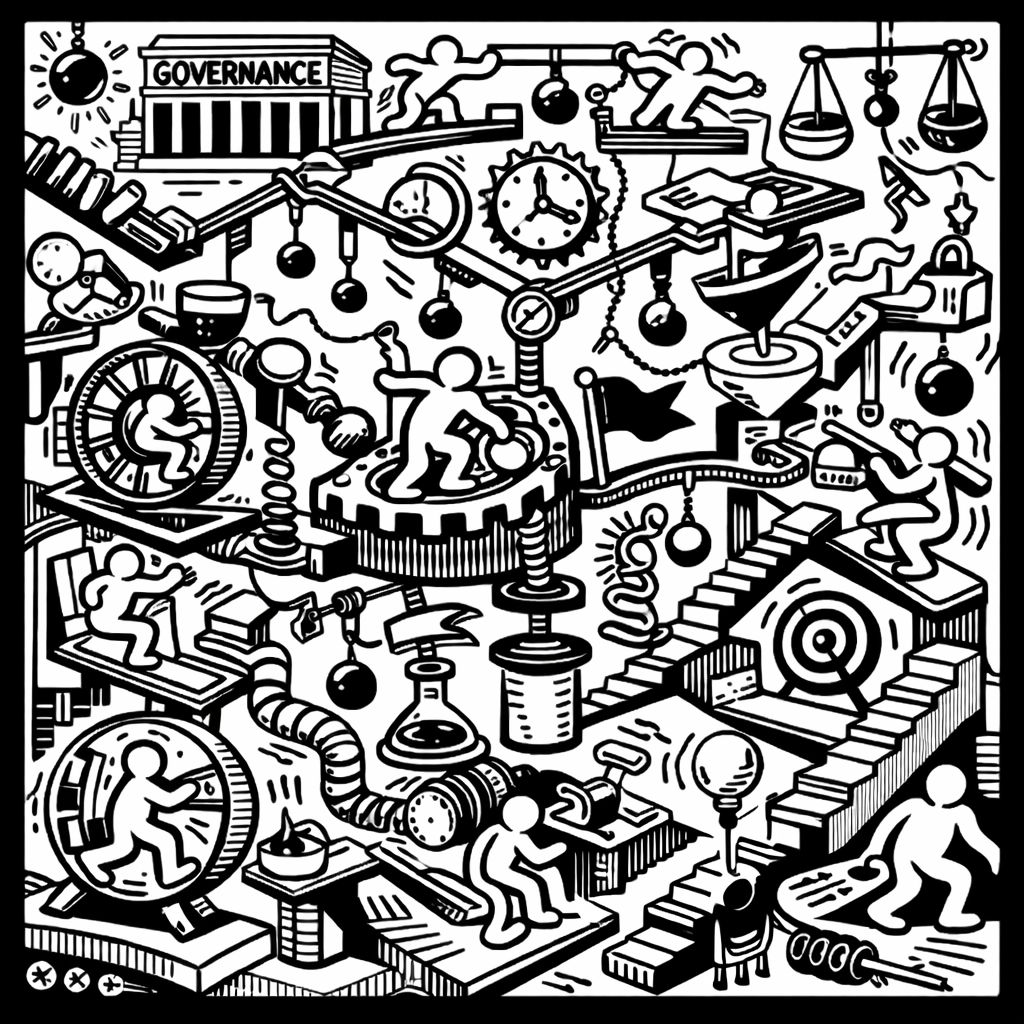
Governance can be understood as the management of phase relations within an ensemble, not the enforcement of uniform behaviour. In any governed system—social, institutional, technical, or ecological—coherence does not arise from fixing positions or eliminating difference. It arises from partial synchronisation: agents align enough to act collectively while remaining out of phase enough to retain responsiveness. Governance fails when it mistakes alignment for sameness.
From a systems perspective, each actor operates with its own rhythm: local conditions, incentives, capacities, interpretations. Governance couples these rhythms. It does not erase them. Effective governance allows a shared pattern to emerge while preserving stable offsets between centre and periphery, rule and case, intention and outcome. These offsets are not inefficiencies. They are the medium through which feedback, learning, and legitimacy occur.
This is a harmonic process. Like coupled oscillators, elements adjust their behaviour in response to one another until a low-energy, dynamically stable configuration appears. Order is not imposed from above; it emerges when coupling is strong enough to coordinate action but weak enough to avoid collapse into rigidity. Too little coupling produces fragmentation. Too much produces brittleness. Governance lives between these extremes.
Psychologically and communicatively, this explains why governance cannot rely on perfect clarity or total control. Meaning does not transmit intact. Interpretation lags instruction. Compliance is never exact. These delays are not failures of governance; they are how reality pushes back against abstraction. Systems that try to eliminate delay and difference lose their ability to sense themselves. They become fast, legible, and blind.
Good governance therefore sustains structured non-alignment. It preserves time for consequences to unfold, space for local variation, and ambiguity where rules meet lived conditions. The aim is not closure, final resolution, or total synchrony. The aim is continuity: a stable pattern of coordination that remains adaptive because it never fully resolves its own differences.
Governance, at its core, is harmonic. It holds systems together by managing phase offsets, not by eliminating them. Difference, delay, displacement—these are not problems to be solved. They are the operating conditions that keep collective life in motion.
 Daedelus Kite