Advertising sells illuminated absence, incentivising us to pursue idealised selves that remain permanently, profitably out of reach.
Categories
the gap is the product

Advertising sells illuminated absence, incentivising us to pursue idealised selves that remain permanently, profitably out of reach.

Social media platforms are usually described as communication technologies, but their deeper operational logic is closer to behavioural recurrence management. They do not optimise for resolution, understanding, repair, or psychological settlement. They optimise for continued return. That means the platform is not primarily designed to complete the user’s need, but to make the user come […]

Malignant narcissism can be understood as a hollow configuration of mind that emerges when a fundamental relational balance fails, not because the self is excessive, but because the self is excessively and pathologically overdetermined, unable to sustain the essentially harmonic dynamic tension between internal and external that makes selfhood viable. In a healthy cognitive system, […]

Memory is often described as a storehouse, but in practice it behaves more like a living weave. Individuals remember unevenly, cultures remember selectively, and civilisations remember strategically. What survives transmission is rarely detail and almost never balance. What persists is pattern: threat, loss, success under pressure, moments where coordination mattered and failure carried cost. Psychology […]

Intelligence is becoming a liability. Not socially ornamental intelligence, not credentialed cleverness, but actual understanding. The kind that sees structure, delay, recursion, consequence. The kind that notices when a system is lying to itself. That form of intelligence generates friction. It interrupts performance. It destabilises belonging. It exposes the hidden costs that simple stories are […]

Large systems of power, regulation, ideology, and identity do not stabilise by winning or resolving the problems they address. They stabilise by remaining unfinished. Political institutions, security apparatuses, markets, cultural movements, and ideological projects sustain themselves by managing problems they cannot conclusively solve: inequality, threat, disorder, legitimacy, desire, dissent. Total control would terminate their function. […]

Teresa Brennan was an Australian feminist philosopher whose work crossed psychoanalysis, philosophy, and social theory, frequently placing her at odds with academic orthodoxy. She challenged dominant Lacanian interpretations by insisting that affect is not a linguistic effect or private feeling but a materially transmissible force that moves between bodies and across institutions. This stance drew […]

Conflict and competitive adversarialism are not necessarily moral failures or aberrations. They are contingent, historically acquired, culturally entrained mechanisms by which complex cognitive, cultural, and communicative systems reliably differentiate, learn, and reproduce themselves over time. These mechanisms arise because complexity does not form around completeness, nor does it arise from closure, certainty, or final resolution. […]

Consciousness entails perspectival isolation. Subjective experience is necessarily local, bounded by the fact that one mind does not have direct access to another. Philosophy of mind, phenomenology, and cognitive science converge on this constraint, whether framed as first-person authority, privacy of qualia, or irreducible point of view. Language does not remove this barrier. It operationalises […]
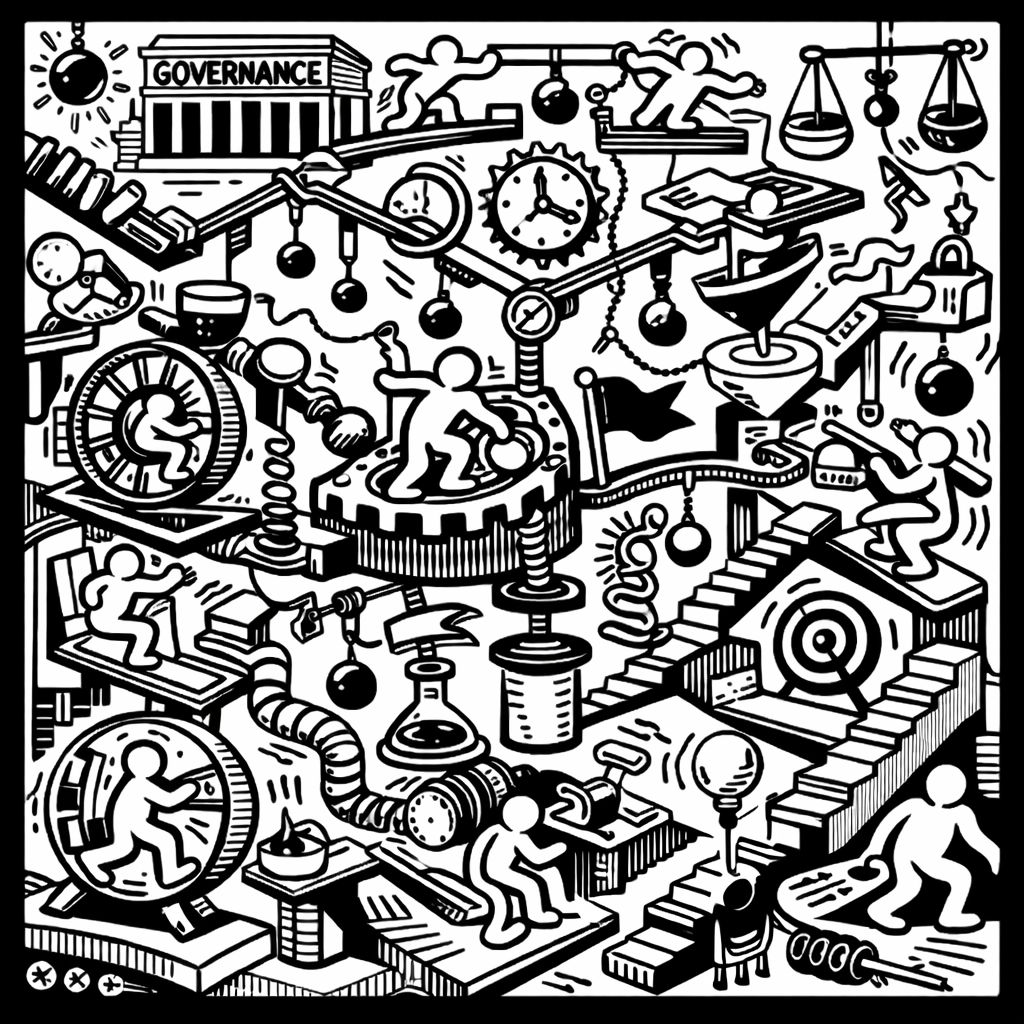
Governance can be understood as the management of phase relations within an ensemble, not the enforcement of uniform behaviour. In any governed system—social, institutional, technical, or ecological—coherence does not arise from fixing positions or eliminating difference. It arises from partial synchronisation: agents align enough to act collectively while remaining out of phase enough to retain […]
Have a WordPress.com account? Log in now.

