02-DD

02-DD
Institutions rarely fail because they cannot recognise problems. They fail because recognising problems is not the same as escaping the conditions that reproduce them.

A strong current in modern thought still treats things as if they exist first, complete in themselves, and only later enter into relation with other things. The individual. The institution. The nation-state. The market. The technological platform. These are often imagined as discrete objects possessing internal coherence, as though persistence were generated primarily from within […]

Energy markets do not merely price fuel. They encode the recurrence structure of civilisation’s dependency on energy. Refinery cycles, shipping delays, seasonal demand, storage constraints, geopolitical tension, and futures speculation appear as price movement, but price is only the visible signal. Beneath it sits a temporal field of repeated dependence. Energy markets are not merely […]
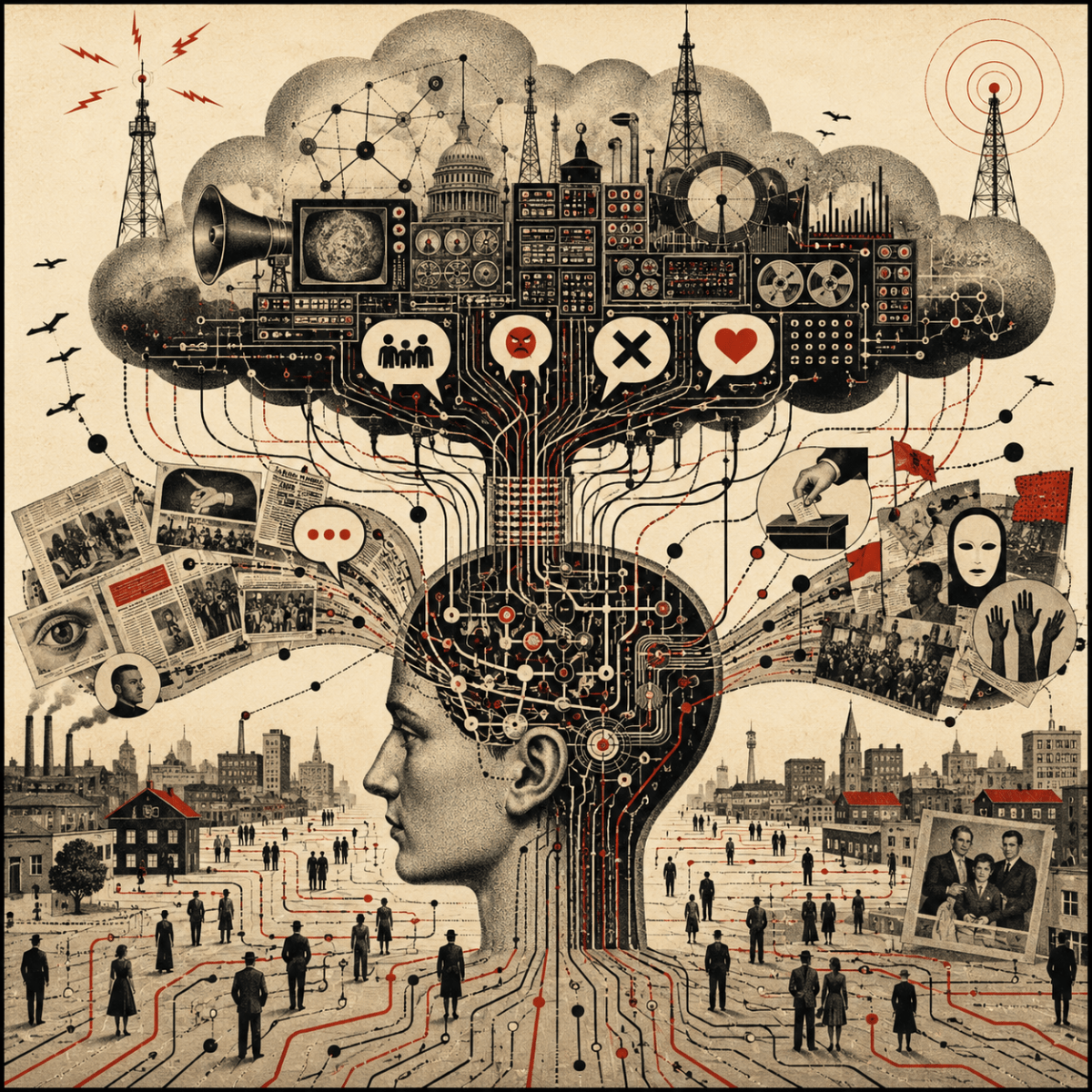
Cognitive bandwidth becomes cultural destiny because the carrying capacity of technologically mediated communication systems exceeds the carrying capacity of the biological minds living inside them.

Peace isn’t some prize at the end of history. It’s not a flag, not a speech, not a deal signed under bright lights with everyone pretending they meant it. It’s a job. A quiet, ongoing, unglamorous job. You run it or it fails. That’s it. It lives in the tension people can tolerate without turning […]

Politics is not failing because people have become irrational; it is failing because the systems that coordinate perception, timing, and response have slipped out of phase, and what we are experiencing as conflict, populism, volatility, and institutional drift is the visible surface of a deeper timing problem in large-scale communication systems, one that also describes […]

It is a strange and quietly dangerous habit of our age to treat peace, language, and meaning as though they arrive fully formed at the end of history, fixed as semiotic anchors to be engineered, stabilised, and installed, rather than as fragile continuities that persist only because the relations that give them form are never […]

Australia works because it stays balanced. Its democracy is not built on simple agreement, but on the disciplined interaction between different ways of seeing the world. Labor and Liberal are not just rival teams. Together, they form the smallest political structure capable of holding a complex society together. Two sides generate debate, correction, and restraint. […]

Formal Abstract This document presents a formal, process-based theory of language, information, and dynamic meaning systems. Communication, cognition, identity, legitimacy, and truth are treated not as static entities but as temporally constituted processes sustained through repetition, coupling, and feedback within distributed fields. A minimal axiom set grounded in acts, timing, coupling, recursion, variation, and emergent […]

Conflict and competitive adversarialism are not necessarily moral failures or aberrations. They are contingent, historically acquired, culturally entrained mechanisms by which complex cognitive, cultural, and communicative systems reliably differentiate, learn, and reproduce themselves over time. These mechanisms arise because complexity does not form around completeness, nor does it arise from closure, certainty, or final resolution. […]

Field logic approaches complex systems as relational fields sustained by difference over time, not as collections of discrete components governed by linear causation. It is most relevant where systems are fast, tightly coupled, and vulnerable to runaway self-reinforcement, as in contemporary technological, media, and political environments. In these regimes prediction does not mean forecasting specific […]
Have a WordPress.com account? Log in now.

