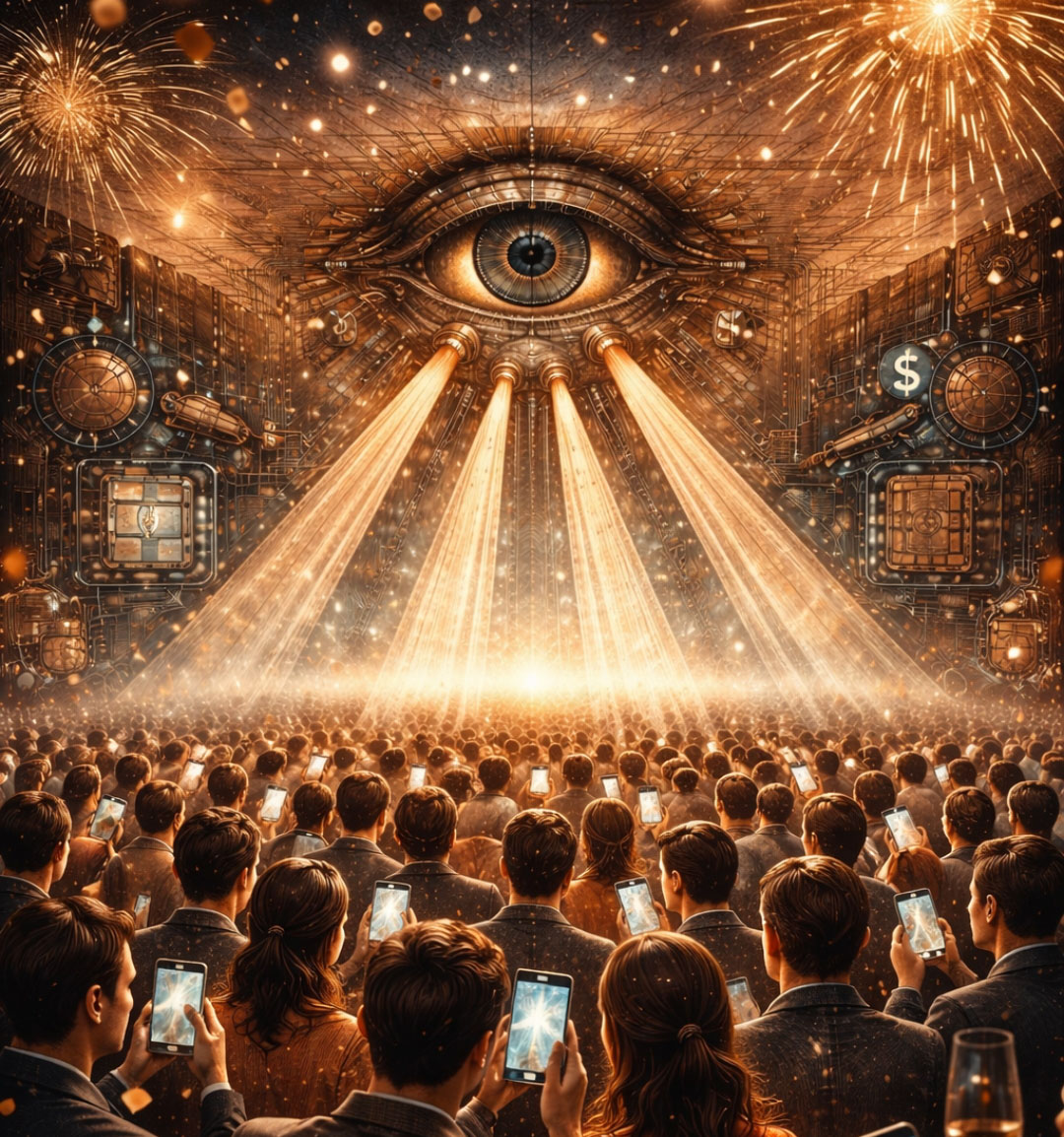
We are likely worrying about the wrong thing. The danger is not that AI amplifies stupidity, volatility, selfishness, or ideological corruption. The danger is the speed of that amplification, the smoothness with which it integrates into ordinary life, and the ease with which this acceleration is framed as inevitable. It is not inevitable. But velocity alone is sufficient to do the damage. Speed replaces deliberation. It closes feedback loops before resistance, adaptive course-correction, or alternative trajectories can form.
What looks like technical over-determination is more basic. Possibility itself is being destroyed. Commercial systems do not simply select outcomes. They compress the future until only a narrow set of monetisable trajectories remains. Futures disappear before they can stabilise, and that disappearance is misread as progress. Loss is reframed as efficiency.
Culture still produces alternatives. Meanings branch. Symbols multiply. But this happens downstream. The constraint arrives earlier, before articulation, before a possibility becomes legible as a choice. Every extension removes alternatives. This is structural, not moral. Expansion flips into subtraction. The harder a system optimises, the more aggressively it invalidates what cannot be immediately monetised, stabilised, or governed.
Capitalism normalised this exchange without recognising its topology. What is distributed is not risk but consequence, spread across a globally coupled socio-technical manifold in which nothing is external. There is no outside. Informational, thermodynamic, psychological, cultural, and geopolitical costs remain internal, even when delayed. Delay does not erase cost. It stores it.
The mechanism is legible in the system’s filtering, not its language. What matters is which signals are amplified, which are allowed to fluctuate briefly, and which are suppressed before they can accumulate meaning or consequence. Understanding comes from tracking the filter: what persists, what oscillates, and what is never allowed to stabilise. This is how diminishing choice is experienced as empowerment. Interfaces multiply options while the underlying state space contracts.
Complex communication systems are not stable containers. They are oscillatory fields. Collapse is not an anomaly. It is intrinsic. Greed does not create instability. It exploits it. The logic is simple: extract now, let someone else pay later. In a fully integrated algorithmic system, there is no someone else. Delay reallocates harm through the field. Tension accumulates. The field remembers.
This makes the speed of authoritarian phase-shifts decisive. These rapid transitions feel strong, even triumphant, but none are final. States are not endpoints. They are temporary modulations within a communicative field that cannot settle without breaking. Apparent rigidity is stored strain. Release arrives as unmanaged chaos. Oscillation follows. A rapid cash grab can succeed briefly. It cannot endure.
What is approaching is not only climate catastrophe, though that is real. It is global instability driven by phase oscillations across tightly coupled systems. Intelligence is being narrowed. Validated cleverness is corralled into constrained technical forms. Meanwhile the assumptions, blind spots, denials, and deceptions driving power accelerate the erosion of their own foundations. Wealth accumulates atop structures hollowed by the same optimisation that produced it. Vaults sit over collapsing probability.
Greed now governs psychology, culture, logic, physics. Many do not care, or cannot afford to. Isolation from consequence has become the defining feature of political and economic life. Extreme wealth can delay impact, not escape it. Delay ensures that harm arrives first where buffering is weakest. Coherence degrades. Everything feels suspended, held together by habit rather than stability.
This is not science fiction. Attention is narrowing. Thought is compressing. Each of us functions as a local coordinate system inside the same field, mistaking partial frames for the whole. What follows is not spectacle but drift. When systems lose the capacity to integrate consequence, they do not fail cleanly. They oscillate, fracture, and reach for certainty through simplification.
None of this is unexpected. The only surprise is how quickly inevitability was assumed.
 Daedelus Kite