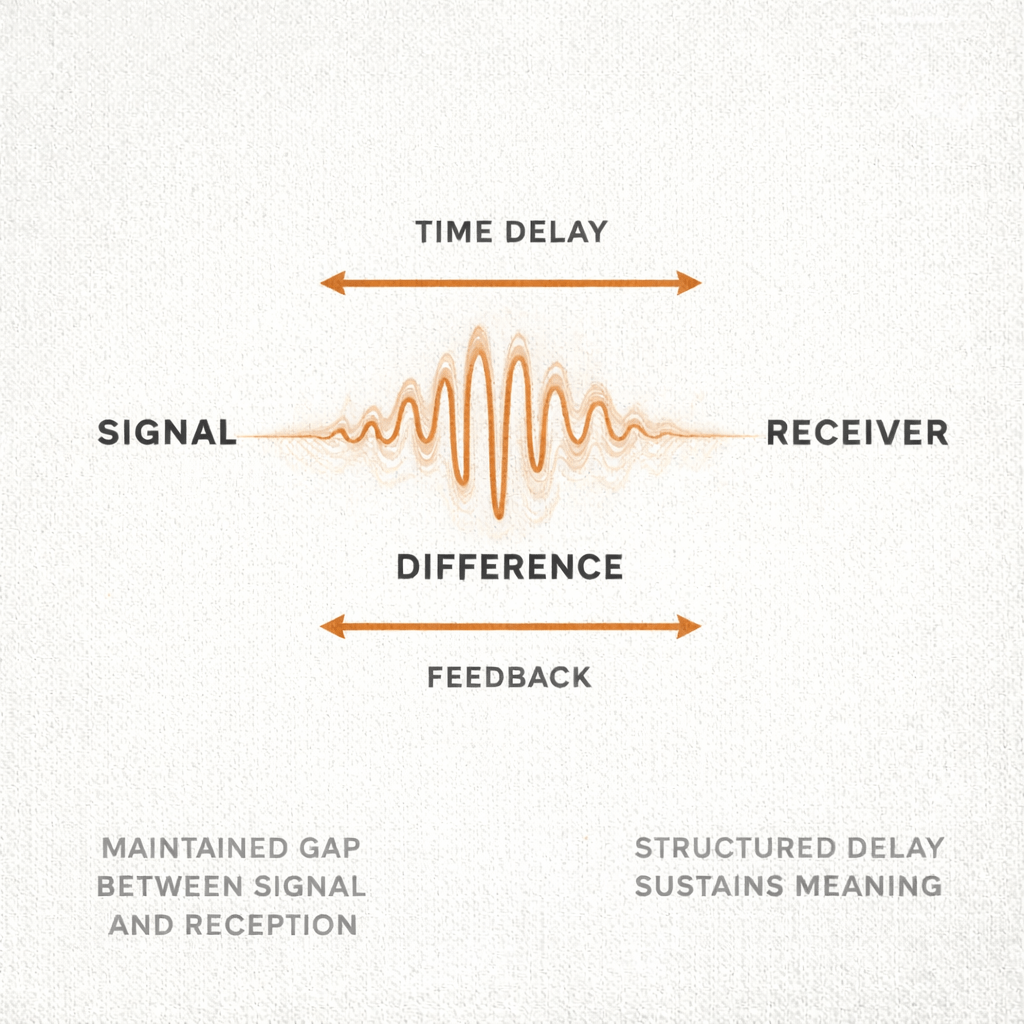
This essay advances a limited but precise claim: meaning in communicative systems depends on structured delay, and that delay is constitutive of causal relations rather than incidental to them. Where there is a point of emission and a point of reception, the signal that passes between them is not merely a connector. It participates in the constitution of both points and of the relation that binds them. Causality here is not linear transmission from A to B, but a relational process sustained through non-coincidence.
Meaning requires separation. A signal must not coincide with its reception. If emission and reception collapse into identity, there is no causal articulation and no communicative event. The interval between them is not empty. It is an active domain in which difference persists long enough to be registered, transformed, and repeated. That interval is what allows causality to appear as sequence rather than as simultaneity.
Difference is therefore primary. Identity is not given in advance but produced through differentiation. A system becomes identifiable by repeatedly distinguishing itself from what it is not. This distinction must be reiterated to persist. Differentiation and self-reference are coupled operations. A system refers to itself by reproducing the difference between itself and its environment, not by collapsing that difference.
Self-reference, understood in this way, is not a logical defect but a generative condition. Through recursive operations, a system produces internal descriptions of itself. These descriptions are necessarily partial and delayed. They do not coincide with the system they describe. This internal distance produces curvature within the system’s own space of operations, allowing continuity without closure.
Niklas Luhmann formalises this insight by defining system differentiation as the repeated reproduction of the difference between system and environment. Boundaries are not static demarcations but operational achievements, maintained through ongoing communication. Meaning arises neither purely inside the system nor purely outside it, but at the boundary sustained through recursive distinction.
This logic extends to definition itself. Bertrand Russell observes that all definitions rely on other terms, and that at some point a system of knowledge must accept certain terms as intelligible without definition. This circularity is not a failure of rigor. It is the condition under which abstraction and reference can begin. Definition depends on managed incompleteness rather than on absolute grounding.
Taken together, Luhmann’s account of differentiation and Russell’s account of definitional circularity describe the same structural condition from different perspectives. Systems and concepts persist by maintaining internal distance from themselves. Delay, recursion, and partiality are not obstacles to meaning. They are its enabling conditions.
Field logic generalises these observations across communicative domains. Meaning is not treated as a property of symbols or of mental states, but as an emergent property of sustained separation between signal and reception within a field. Any system that acts on itself through signals must preserve delay between emission and reception. That delay allows the signal to be encountered as other, rather than as a reflex of the system’s current state.
Under conditions of pressure, including war, crisis governance, and high-throughput technological environments, systems attempt to reduce this delay in order to increase coordination. Feedback loops are shortened. Distinctions harden. Definitions appear fixed. Local coherence improves, but global adaptability degrades. Uncertainty is not eliminated; it is displaced into bodies, margins, or future states. This displacement is entropy understood structurally: the cost of maintaining alignment by compressing delay.
From this perspective, semiotics is best understood as a theory of sustained differentiation rather than representation. Signs function because they defer closure. Meaning persists because reception does not coincide with emission. Field logic identifies the underlying invariant: intelligibility depends on bounded delay. Where delay is denied or treated as inefficiency, communication does not fail noisily. It becomes self-identical, brittle, and incapable of correction.
—
References (Annotated)
Beer, S. (1972). Brain of the Firm. London: Allen Lane, The Penguin Press.
Beer develops a cybernetic account of organisational viability grounded in recursion, feedback, and the regulation of variety. His work is relevant for its insistence that stability depends on maintaining internal differentiation rather than enforcing centralised control. The open consequence is a view of governance as continuous modulation of delay and feedback rather than optimisation toward closure.
Klemperer, V. (2006). The Language of the Third Reich: LTI – Lingua Tertii Imperii (M. Brady, Trans.). London: Continuum.
Klemperer documents how political language under totalitarian conditions becomes compressed, repetitive, and self-validating. This supports the claim that reduced delay and narrowed differentiation produce local coherence at the cost of meaning and correction. The unresolved implication is how similar dynamics now emerge through technological systems without explicit ideological coordination.
Luhmann, N. (1995). Social Systems. Stanford: Stanford University Press.
Luhmann treats society as constituted by communication that reproduces the difference between system and environment. His formulation that system differentiation consists in the repetition of this difference underpins the account of self-reference and delay developed here. The open problem concerns how such systems sustain differentiation under accelerating communicative conditions.
Peirce, C. S. (1931–1958). Collected Papers of Charles Sanders Peirce. Cambridge, MA: Harvard University Press.
Peirce defines meaning as an open-ended process of interpretation, where each interpretant is a further response rather than a terminal decoding. This supports the claim that delay and non-coincidence are constitutive of signification. The consequence is a semiotics that remains structurally open and resists final closure.
Russell, B. (1920). Introduction to Mathematical Philosophy. London: George Allen & Unwin.
Russell argues that all definitions are ultimately circular and that some terms must be taken as intelligible without definition. This grounds the claim that circularity and incompleteness are conditions of knowledge rather than errors. The open question is how systems preserve this necessary circularity without collapsing into tautology.
Saussure, F. de. (1983). Course in General Linguistics (R. Harris, Trans.). London: Duckworth.
Saussure locates meaning in differential relations within a system rather than in reference to external objects. This supports the emphasis on difference as foundational. The unresolved trajectory is how such differential systems behave when distinctions are forced to collapse under communicative pressure.
Shannon, C. E. (1948). A mathematical theory of communication. Bell System Technical Journal, 27, 379–423, 623–656.
Shannon formalises communication as signal propagation across a channel, explicitly excluding meaning. His relevance here is structural rather than theoretical, providing a minimal model of non-coincidence between emission and reception. The open move is to treat information not as quantity but as structured difference sustained through delay.
Weick, K. E. (1995). Sensemaking in Organizations. Thousand Oaks, CA: Sage Publications.
Weick shows how meaning in organisations arises retrospectively through cycles of action and understanding. This reinforces the role of delay in enabling correction and sensemaking. The unresolved implication is how sensemaking degrades when temporal spacing between action and interpretation is systematically compressed.
 Daedelus Kite