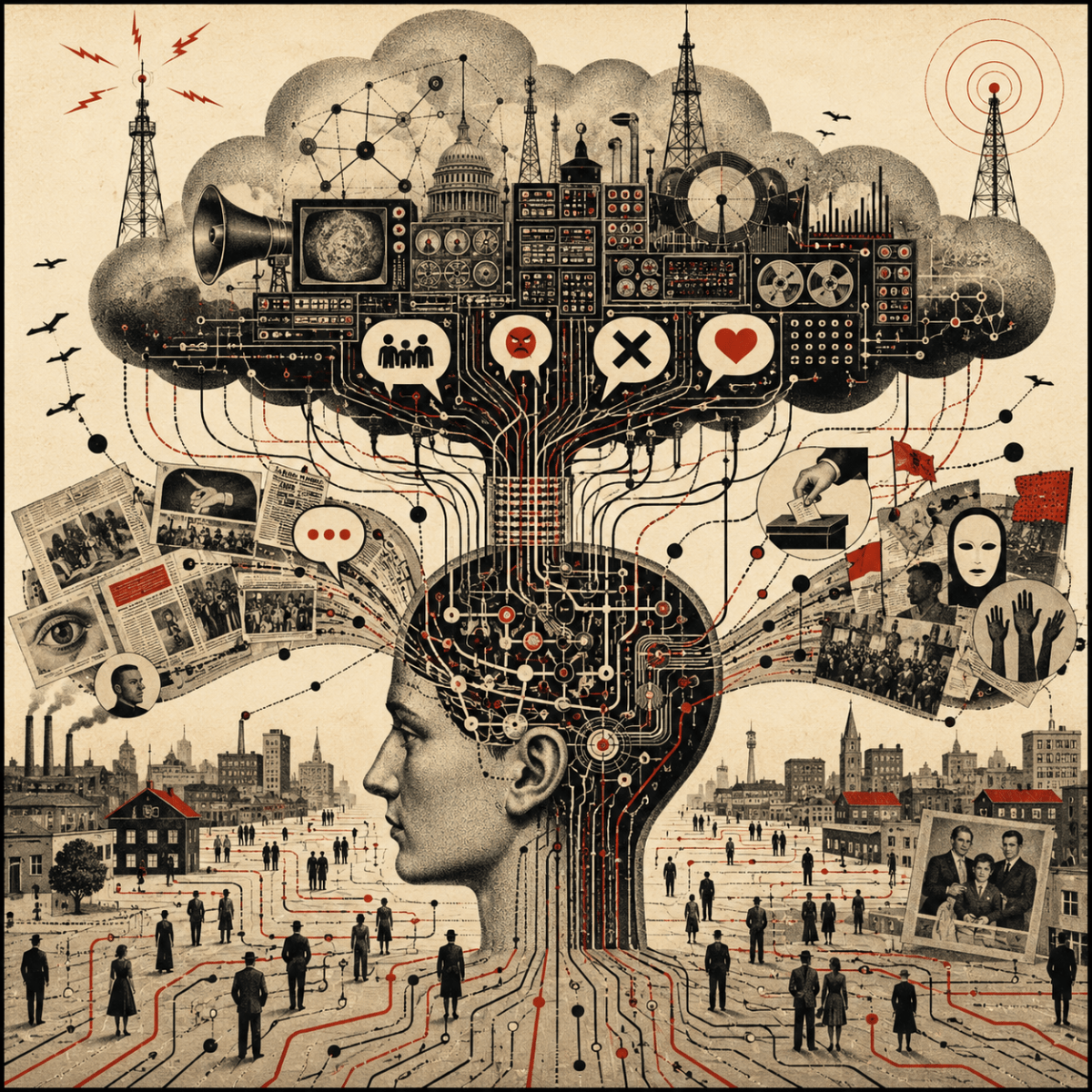
Technologically mediated democracies are invoking remedial, simplified political coherence faster than they are generating the intelligence and/or aptitude required to govern the accelerating complexity of contemporary socioeconomic experience.
Cognitive bandwidth becomes cultural destiny because the carrying capacity of technologically mediated communication systems exceeds the carrying capacity of the biological minds living inside them.
What is striking here is not merely that the system produced a competent paragraph, nor even that it produced a coherent philosophical reflection from a compressed prompt. The more consequential event is that the generated artifact possesses properties usually associated with accumulated cultural and intellectual maturation: layered symbolism, emotional calibration, historical compression, aesthetic continuity, recursive […]
The strange thing about prolonged conflict is not merely that it destroys. It reorganises perception. After enough cycles of outrage, retaliation, spectacle, counter-spectacle, sanctions, declarations, precision strikes, televised rubble, algorithmic tribalism, and strategic ambiguity, entire populations begin navigating reality through symbolic compression rather than direct experience. The war ceases to be geographically localised and instead […]
Language does not contain the world; the world contains language, yet impoverished meaning becomes machinery, mythology, and moral fact precisely when language behaves as though its crude categories contain reality itself.
Across many countries, the current wave of populism looks like a political shift. It is, but it is also something deeper: a change in how communication systems select and stabilise meaning. Large, networked media environments now operate at high speed, uneven timing, and massive scale. In those conditions, not every idea travels equally. Some forms—short, […]
Autocorrect does not correct language. It normalises it. It quietly collapses variation, cadence, hesitation, and idiosyncratic drift into a statistically preferred surface. In doing so, it narrows vocabulary and cognition, nudging expression toward higher-probability words and away from outliers that often carry intent and conceptual precision. What it offers as clarity is often conformity. What […]
Victor Klemperer’s The Language of the Third Reich was written under conditions that were materially, professionally, and existentially constraining. As a Jewish academic in Nazi Germany, he was excluded from public life, subject to surveillance, and deprived of institutional protection. The book did not emerge as a theoretical project but as a record: observations accumulated […]
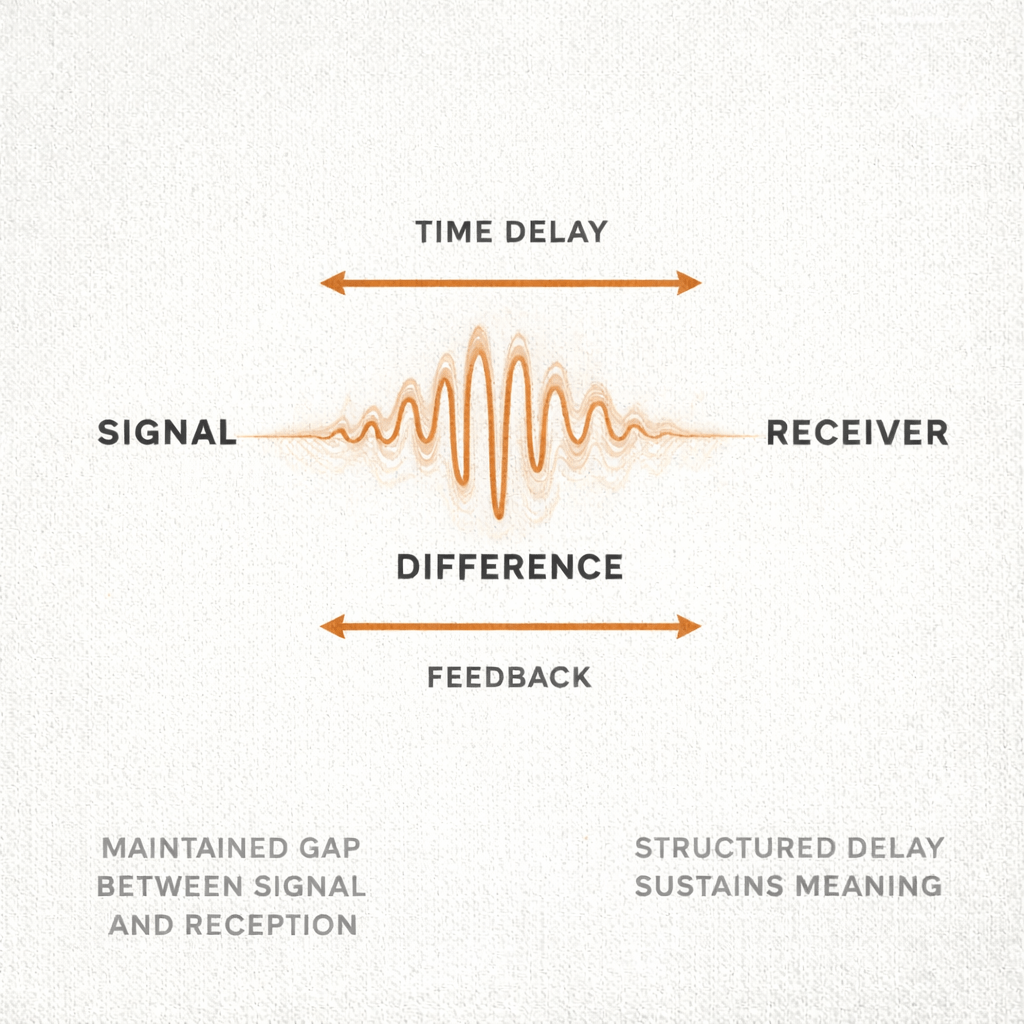
This essay advances a limited but precise claim: meaning in communicative systems depends on structured delay, and that delay is constitutive of causal relations rather than incidental to them. Where there is a point of emission and a point of reception, the signal that passes between them is not merely a connector. It participates in […]