Technocratic complexity and populist caricature are parts of the same feedback loop. Each produces the conditions that sustain the other.

Technocratic complexity and populist caricature are parts of the same feedback loop. Each produces the conditions that sustain the other.

The strangest thing about meaning is that it does not arise from certainty but from its absence. Language works because something always escapes complete description. What remains unsaid is not a failure of communication. It is the condition that makes communication possible.

Meaning is not stored in words, but sustained in the relations that survive their transformation.

It is a strange and quietly dangerous habit of our age to treat peace, language, and meaning as though they arrive fully formed at the end of history, fixed as semiotic anchors to be engineered, stabilised, and installed, rather than as fragile continuities that persist only because the relations that give them form are never […]
Meaning arises and endures only because experience and symbolic encoding remain out of phase, and when technology collapses that difference into immediacy and semiotic isomorphism, thought and behaviour collapse into preordained reflex, short-circuiting cognitive voltage into volatility, simplicity, and coercive transmissibility, turning language into a direct instrument of behavioural modulation.

I no longer believe the world can be healed by better arguments, smarter policies, cleaner data, or more sophisticated machines. These things mostly just turn the volume up on whatever is already broken. The deeper condition is non-closure: the simple fact that complex systems do not stabilise by resolving tension, but by holding it in […]

Ludwig Wittgenstein argued that the limits of language are the limits of the world, not as metaphor but as structural fact: what cannot be said cannot be thought in any stable form. Bertrand Russell pursued logical atomism to anchor meaning in precise correspondence, seeking a syntax that could mirror reality without residue. Charles Sanders Peirce […]

This is not about asking a model to generate ideas for you. It is about placing your own thinking into a responsive medium so it can be worked. You bring partial arguments, intuitions, constraints, and unresolved tensions. The model reflects them back through selective amplification: adjacent phrasings, shifts in emphasis, alternative structures. That amplification makes […]
My position is that the most consequential features of language, meaning, and coordination cannot be exhaustively defined without being distorted, and that this is a structural necessity rather than a theoretical shortcoming. Certain terms must be taken as primitive, not out of convenience, but because definition is itself a secondary operation, already dependent on relational […]
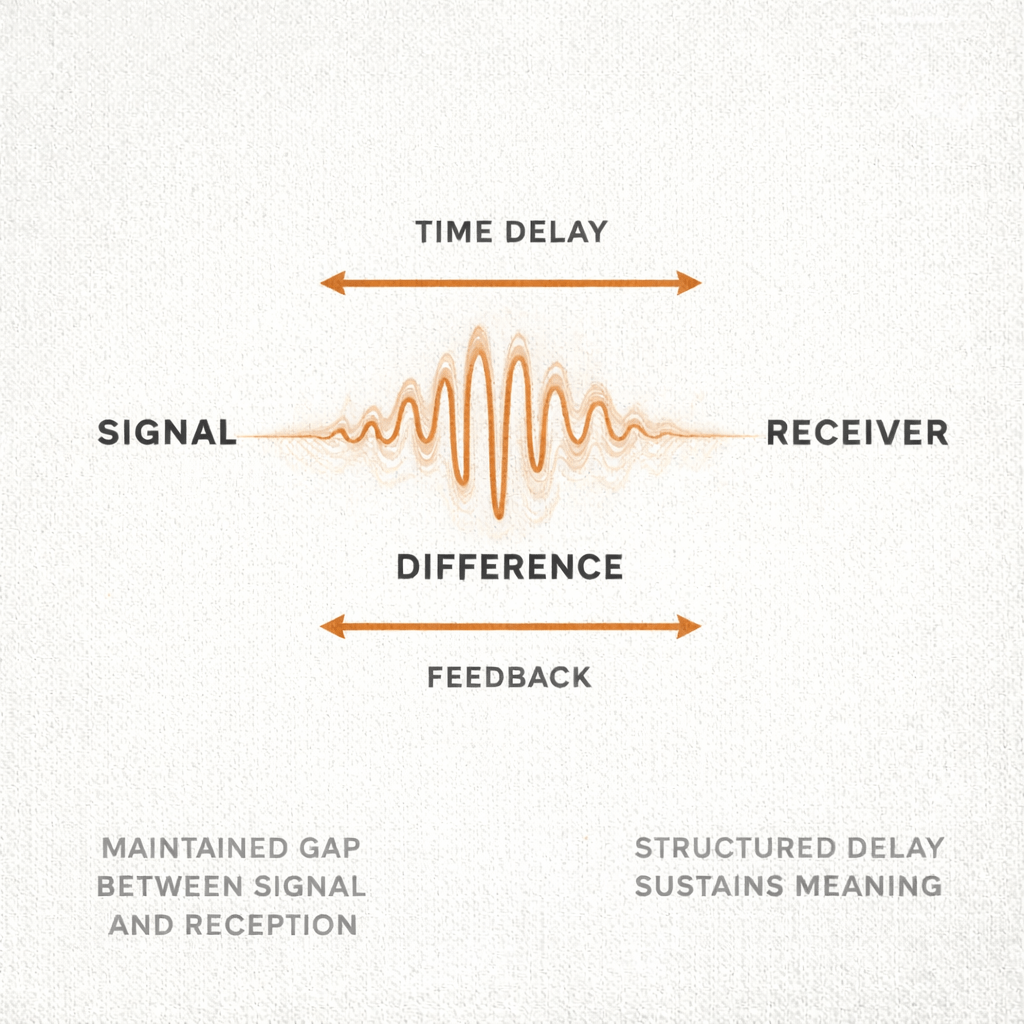
This essay advances a limited but precise claim: meaning in communicative systems depends on structured delay, and that delay is constitutive of causal relations rather than incidental to them. Where there is a point of emission and a point of reception, the signal that passes between them is not merely a connector. It participates in […]

Technologically mediated communication intensifies what language has always done: it isolates, divides, and distances us from one another, and from ourselves, as a necessary precondition for meaningful communicative experience to arise at all. Given the nature of the world, I carry a quiet regret at not having known more people more fully, even while understanding […]
Meaning does not exist in words, ideas, or intentions taken in isolation. It arises from a relational system in which elements acquire significance only through their differences from one another over time. Words are defined by other words; references defer to further references; interpretation always lags expression. That lag is not an accident or a […]

