Two encounters with academia, decades apart, reveal the peculiar machinery through which institutions reproduce authority, exclusion and their own necessity. A personal account of education, alienation and the questionable meaning of progress.

Two encounters with academia, decades apart, reveal the peculiar machinery through which institutions reproduce authority, exclusion and their own necessity. A personal account of education, alienation and the questionable meaning of progress.

Language is more than a means of exchanging information. Beneath meaning and communication lie physical dynamics of rhythm, resonance and persistence that shape collective behaviour, social reality and the patterns through which we understand the world.

We are not outside the world we are trying to understand. We are (all) implicated in its disorders, participants in its reproduction, and responsible for what happens next.

The machinery does not need to fail. It only needs to keep working in ways that make more of itself necessary.

At the limit lies bullshit: language sufficiently detached from external constraint that its capacity to provoke another cycle of response becomes more important than what it describes.

Everyone knows a dickhead. The interesting question is why the conditions that generate them do so, enduringly, and with such uncanny frequency.

Technocratic complexity and populist caricature are parts of the same feedback loop. Each produces the conditions that sustain the other.

Institutions rarely fail because they cannot recognise problems. They fail because recognising problems is not the same as escaping the conditions that reproduce them.

Ideology may not be the primary problem. The deeper question is what kind of world produces the need for the identities that ideology can stabilise.

Every explanation of reality becomes another part of the reality left to explain:
E(R) ∈ R → E(R) ≠ R.

Enlightenment begins where the search for certainty ends.
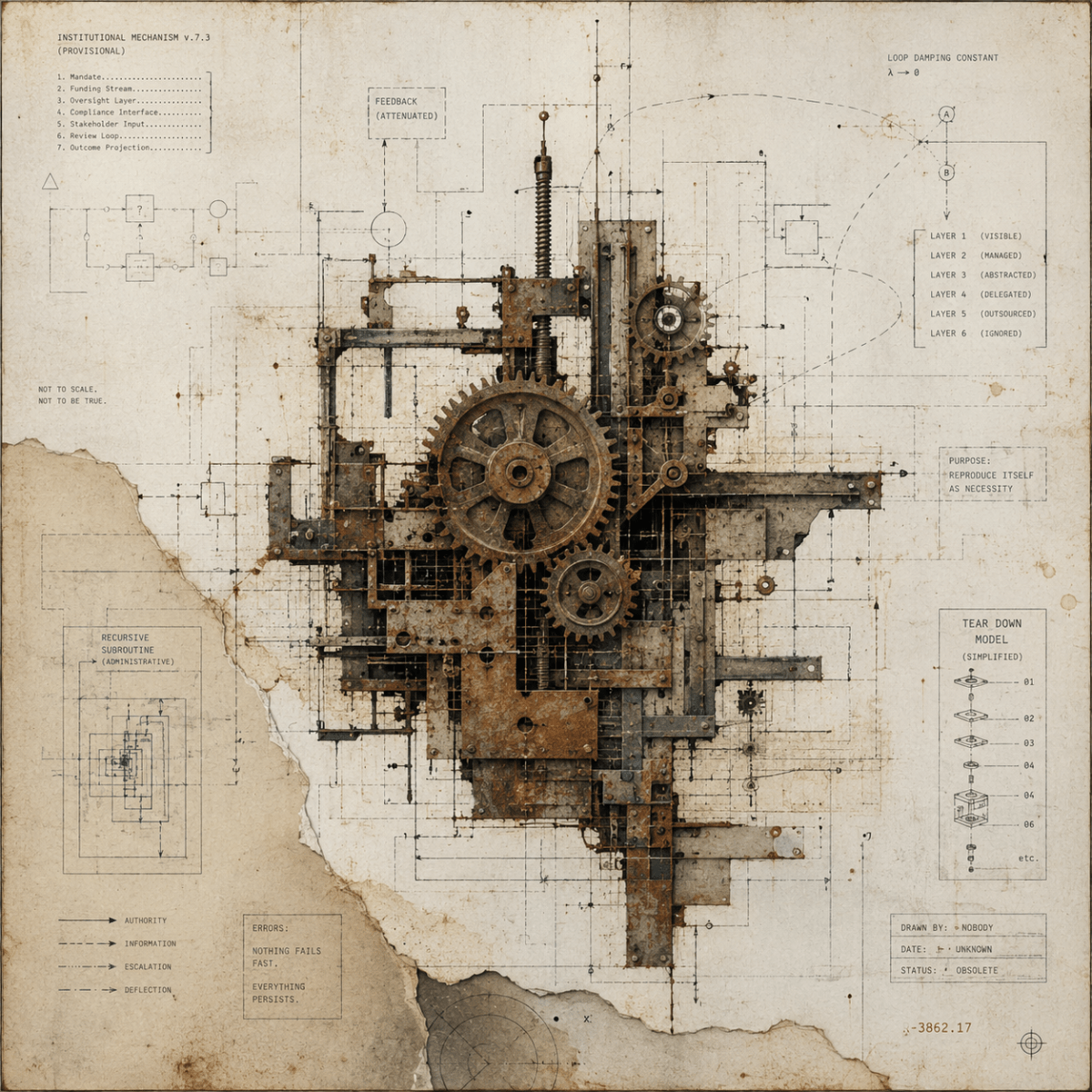
A school can teach systems thinking and still fail to recognise the system it has become. The paradox is not educational but civilisational: systems routinely develop the capacity to analyse (and acknowledge) everything except the conditions that organise and sustain their own perception.
Have a WordPress.com account? Log in now.

