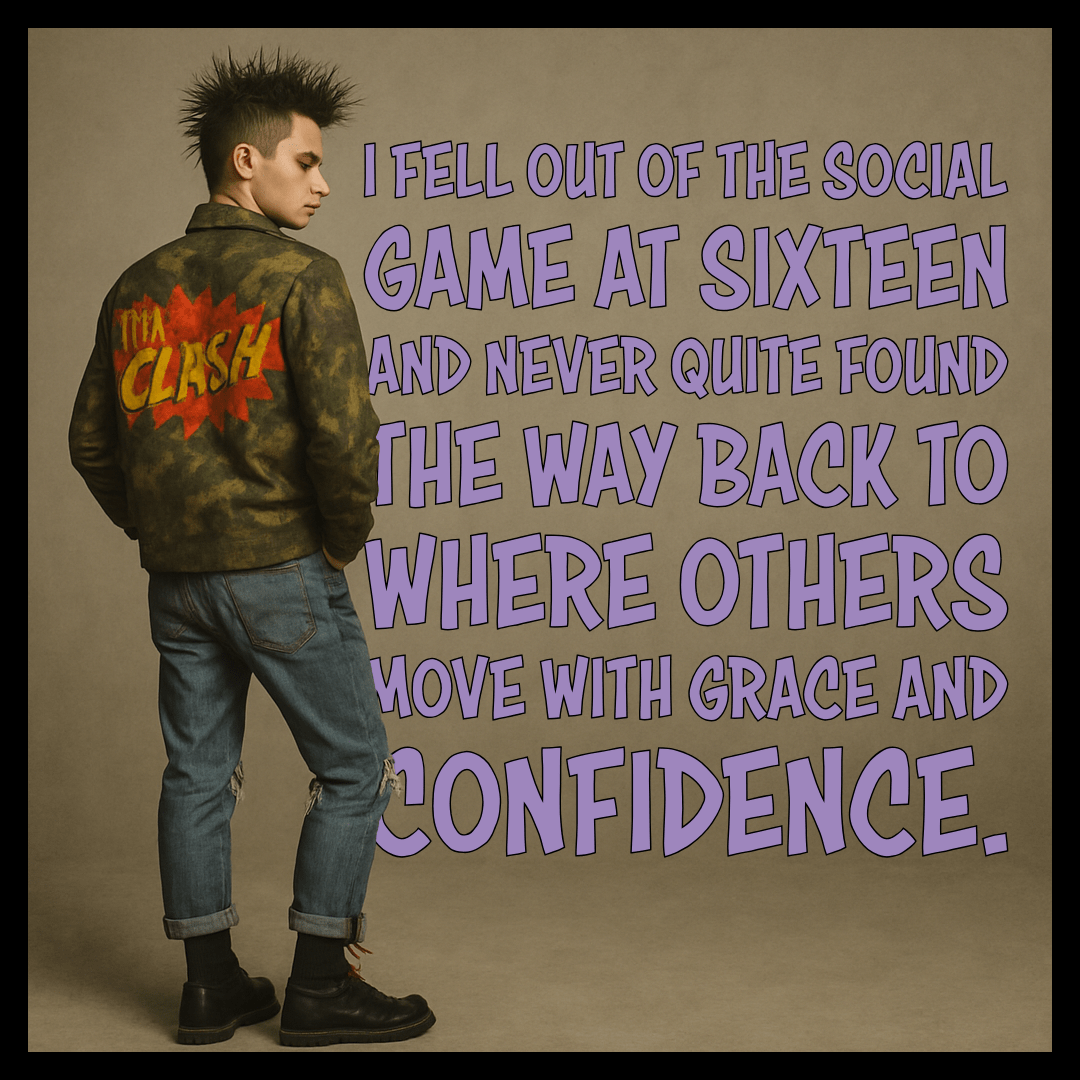
I grew up inside fracture. Not the cinematic kind, not the kind that produces easy narrative arcs of redemption, but the slow, dislocating kind that dissolves continuity. Family breakdown did not make me resilient or strong. It pushed me sideways, out of the main flow, and then quietly out of sight. By my late teens, I had slipped off the social radar altogether. Not simply rebellious or self-destructive, not tragic, not dramatic, just absent. The thing that kept me alive, in the most literal sense, was motion. Long, punishing hours of exercise. Repetition. Breath. Strain. The body carrying the mind when the mind had nowhere to stand. That physical discipline bought me time. Time became space. Space became study. Not academic study in the credentialed sense, but sustained immersion across language, systems, cognition, culture, politics, technology. I did not specialise. I integrated. Years accumulated. The synthesis sharpened. And slowly it became obvious that what passed for intellectual life inside institutions was largely performance. Clever, yes. Sophisticated, often. But thin. Procedural. Self-referential. A game of symbols played atop a reality it no longer interrogated. I had been ejected from the system early, and in that exile, I learned how the system actually worked.
What I came to understand is that marginalisation is not an accident. It is structural. Large-scale systems require surplus populations, excess suffering, peripheral minds, and invisible labour in order to maintain their internal coherence. Exclusion is not failure. It is function. Poverty is not a flaw in wealth. It is its enabling condition. Alienation is not a bug in social order. It is the stabilising shadow that allows hierarchy to persist without collapsing under its own contradictions. The system needs distance, friction, silence, and sorrow to keep reproducing itself. It needs people pushed far enough away that their cognition can deepen, but not so far back in that it must listen to what they see. This is why genuine insight so often emerges from the edges and almost never from the centre. Not because the marginalised are nobler, but because they are unconditioned. They are not calibrated to protect the machinery. Their perception has not been smoothed into compliance. And so what looks, from inside the system, like failure or misfortune is, in structural terms, a necessary sacrifice zone. I do not narrate this as grievance. I narrate it as anatomy. This is how civilisation keeps itself standing: by distributing coherence upward and entropy downward, by exporting complexity to the margins, by turning exclusion into a reproductive mechanism. Once you see that, the sorrow is no longer personal. It becomes architectural.
 Daedelus Kite