
The Wiener–Khinchin theorem describes a quiet inevitability: when a system repeats itself, even imperfectly, that repetition condenses into structure. Time leaves a trace. Signals that return, echo, or correlate with their own past do not merely accumulate; they reorganise into a spectrum, a distribution of emphasis and weight. What looks like flux from within time reveals order when viewed sideways, as frequency. The theorem does not impose meaning; it shows how communicative invariance emerges wherever recurrence persists, as patterns that remain stable across time come to function as meaning within the system. Seen this way, meaning is not a message but a residue of alignment. It is the spectral density formed by what keeps happening together. Clarity corresponds to narrow peaks of recurrence, habits that stabilise and hold. Ambiguity is not absence but abundance: overlapping harmonics produced by many partial alignments sharing the same field. Where recurrence is singular, meaning sharpens; where recurrence multiplies, meaning thickens. The theorem offers no comfort and no judgement. It shows that coherence is recurrence made legible, and that complexity persists when multiple recurrent patterns coexist without converging into a single dominant rhythm.
Reference
Wiener, N. (1930). Generalized harmonic analysis. Acta Mathematica, 55, 117–258.
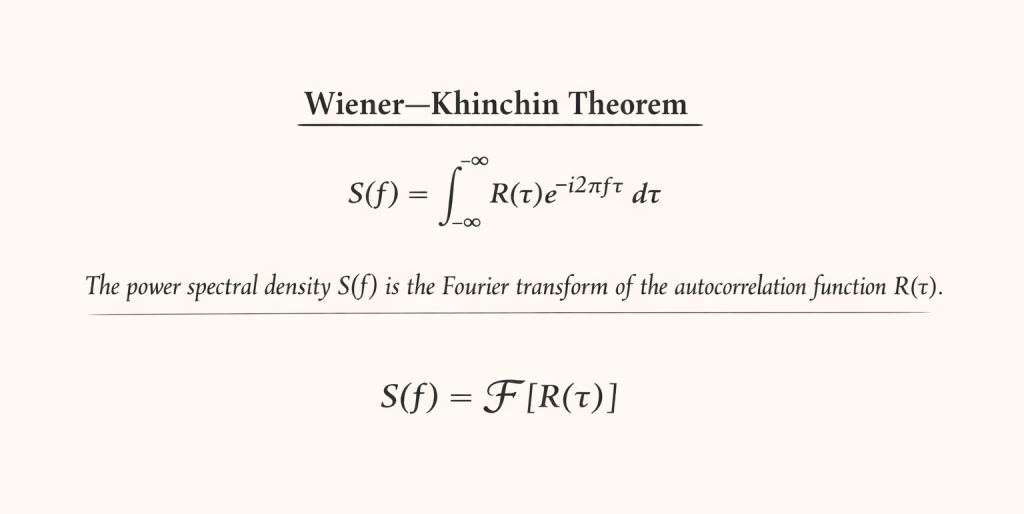
The Wiener–Khinchin theorem establishes that the autocorrelation (the degree to which a signal reinforces its own past over time) of a signal is mathematically equivalent to its frequency spectrum, meaning that how often a pattern repeats in time determines which patterns stand out when the system is viewed as a whole. Repetition in time becomes emphasis in attention. It matters because it shows that structure emerges from recurrence alone, not from intention, truth, or quality. Applied to collective behaviour, recurrent signals that align with themselves across many contexts lock into shared phase and amplify each other, while alternatives fade because they fail to synchronise, not because they lack merit, but because they do not recur often or consistently enough to stabilise a shared rhythm of recognition.
Appendix: The Theorem
1. What kind of problem this theorem is about
We start with a signal over time.
A signal is just something that changes.
It could be sound pressure in a microphone, voltage in a wire, brightness in a video, clicks on a website, words appearing in a conversation, or attention rising and falling.
Time matters because the signal unfolds step by step, not all at once.
The core question is:
If I watch something change over time, how can I tell whether there is structure in it, even if it looks noisy?
—
2. Two ways to look at the same thing
There are two fundamentally different viewpoints.
The first is the time-based view.
You watch the signal as it unfolds. You ask what happens now, what happens next, and how the present relates to the past.
The second is the pattern-based view.
Instead of watching moment by moment, you ask what kinds of repetition exist, what rhythms are present, and what tendencies keep reappearing.
Both views describe the same reality from different angles.
—
3. Correlation: how a signal relates to itself
Correlation means similarity over delay.
Take a signal and make a copy of it.
Slide the copy forward or backward in time.
At each slide amount, ask how similar these two versions are.
If they line up well, similarity is high.
If they do not, similarity is low.
This is simply matching a thing against a delayed version of itself.
—
4. What autocorrelation really is
Autocorrelation is that process done systematically.
Zero delay means comparing the signal with itself exactly.
Small delay asks whether the signal tends to resemble its recent past.
Large delay asks whether patterns return after longer gaps.
Autocorrelation answers one question:
Does this signal tend to return to similar states over time?
—
5. Frequency: repetition speed
Now shift perspective.
Instead of asking when something happens, ask how often something repeats.
A frequency is just a rate of repetition.
Fast repetition means high frequency.
Slow repetition means low frequency.
This is familiar from sound: low notes change slowly, high notes change quickly.
—
6. Spectrum: how much of each repetition exists
A spectrum is a breakdown.
It tells you how much slow repetition exists, how much medium repetition, and how much fast repetition.
The spectrum does not say when things happened.
It says what kinds of repetition exist at all.
—
7. The bridge between time and pattern
Autocorrelation belongs to the time view.
The spectrum belongs to the pattern view.
The Wiener–Khinchin theorem states that if you know how a signal relates to itself over time, you already know its pattern structure.
The spectrum of a signal is fully determined by its autocorrelation.
—
8. Why this is non-obvious
It is natural to assume that watching time gives time information and watching patterns gives pattern information.
The theorem shows this separation is false.
Repeated similarity over time inevitably condenses into structure in the pattern view. Even imperfect repetition accumulates.
—
9. What happens with noise
Noise appears random, but random does not mean structureless.
If a system repeats behaviours, even loosely, those repetitions leave a trace. Coincidences pile up. Weak regularities reinforce.
Order is not imposed. It emerges automatically from recurrence.
—
10. Why this matters beyond engineering
This is not limited to electronics.
Any system that persists, recurs, and remembers itself imperfectly behaves this way. Language, habits, institutions, media cycles, and attention all operate through recurrence.
When a system keeps looping, it produces structure whether it intends to or not.
—
11. The deepest point
The theorem does not say that meaning is created.
It shows that if things keep happening together over time, structure becomes unavoidable.
Meaning here is communicative invariance over time.
Not intention.
Not content.
Just persistence.
—
12. One-sentence summary
A system that repeatedly encounters its own past cannot avoid forming structure, and the Wiener–Khinchin theorem states that time-based recurrence and pattern-based order are two faces of the same thing.
 Daedelus Kite
2 replies on “Wiener–Khinchin theorem”
LikeLike
LikeLike