Civilisations rise, lose their footing, and reorganise themselves with uncanny regularity, yet somehow the whole contraption keeps going. Not because anyone has finally solved the world, but because the system keeps producing signals about where it has slipped, and minds, cultures, and institutions spend their lives trying to read them.
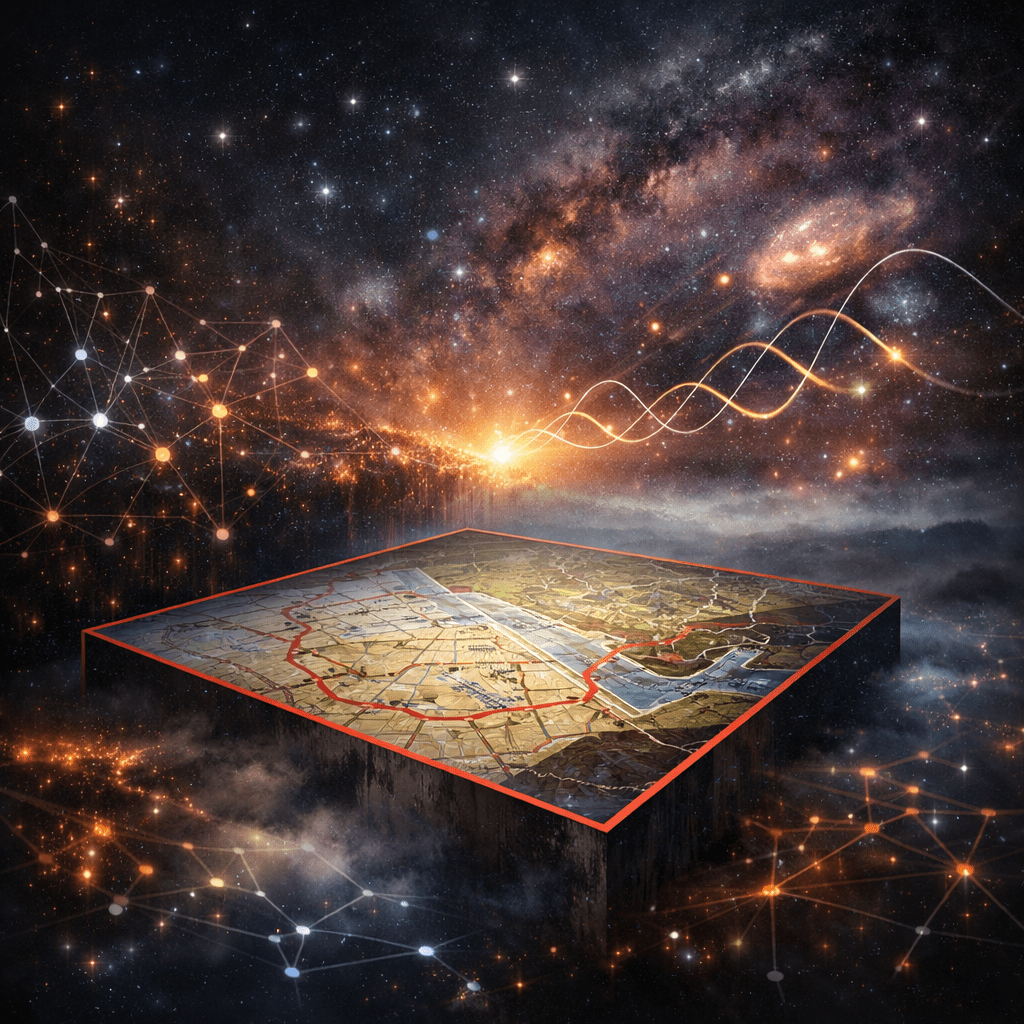
Every mind begins by leaving most of the world out. To think at all is to draw a boundary, carving a manageable picture out of something vastly larger. A mind does not contain the world. It carries a map.
Maps work because they exclude.
Each map creates a small zone of coherence from one position while everything else remains dispersed beyond it. Words behave the same way. Meaning rarely sits inside the word itself. It appears in the relations between uses, contexts, and signals moving through the wider system.
A difference always exists between reality and the maps used to interpret it.
That difference is not a defect. Systems cannot fully describe themselves from within themselves. The world always exceeds the descriptions used to stabilise it, and the gap becomes the medium through which learning and adaptation occur.
Misunderstanding belongs to this structure.
Signals move with delay. By the time something is perceived, interpreted, and communicated, other consequences are already unfolding elsewhere. What we call misunderstanding is often just the system operating slightly out of step with itself.
And that slight misalignment is productive.
Perfect alignment would produce silence. Small offsets between signals create patterns that stabilise, repeat, and develop further complexity. Coherence grows from these rhythms rather than from perfect agreement.
Prediction lives in the same space. Forecasts, expectations, and narratives feed back into the systems they describe. Markets react to forecasts. Audiences react to stories. Political actors react to expectations. Observation and participation are entangled.
Meaning therefore spreads less like a fixed statement of truth and more like a pattern moving through a field.
Ideas gain influence because they circulate and repeat across networks of communication. What travels efficiently often becomes what a culture takes to be meaningful. Words, stories, and symbols compress complexity so people can coordinate action despite seeing only fragments of the whole.
Human cultures quietly metabolise the difference between world and map.
Religions, sciences, institutions, and everyday habits convert uncertainty into orientation. Ambiguity becomes structure. Instability becomes guidance for action. Misunderstanding is not simply removed. It is processed.
Every perspective clarifies by excluding alternatives. Consciousness itself follows the same rule. To see from one vantage point is to lose access to countless others.
No single system contains the whole.
Yet the whole persists through relations between parts that each contain only fragments. The system holds itself together through these partial mappings, each capturing just enough structure for the larger pattern to continue.
Minds produce maps.
Maps produce misunderstandings.
Yet the system continues through them.
Individuals, institutions, and cultures operate through partial models interacting across time. Their relations generate patterns coherent enough for shared life even though no single perspective contains the total structure.
Truth, when it appears, behaves less like a final destination than like a small vessel moving across a much larger sea of interpretation and error, remaining afloat because surrounding signals momentarily stabilise its course before the wider system shifts again.
The gap between reality and representation never disappears.
Civilisations lose their footing, reorganise, and continue. Signals arrive late, interpretations drift apart, models fail, and new ones form. Minds, cultures, technologies, and societies repeat the same process, falling out of step and finding a rhythm again.
The system survives not because it finally understands itself, but because these partial maps are enough to keep it going.
Categories
Minds, Maps, Metabolising Misunderstanding
 Daedelus Kite