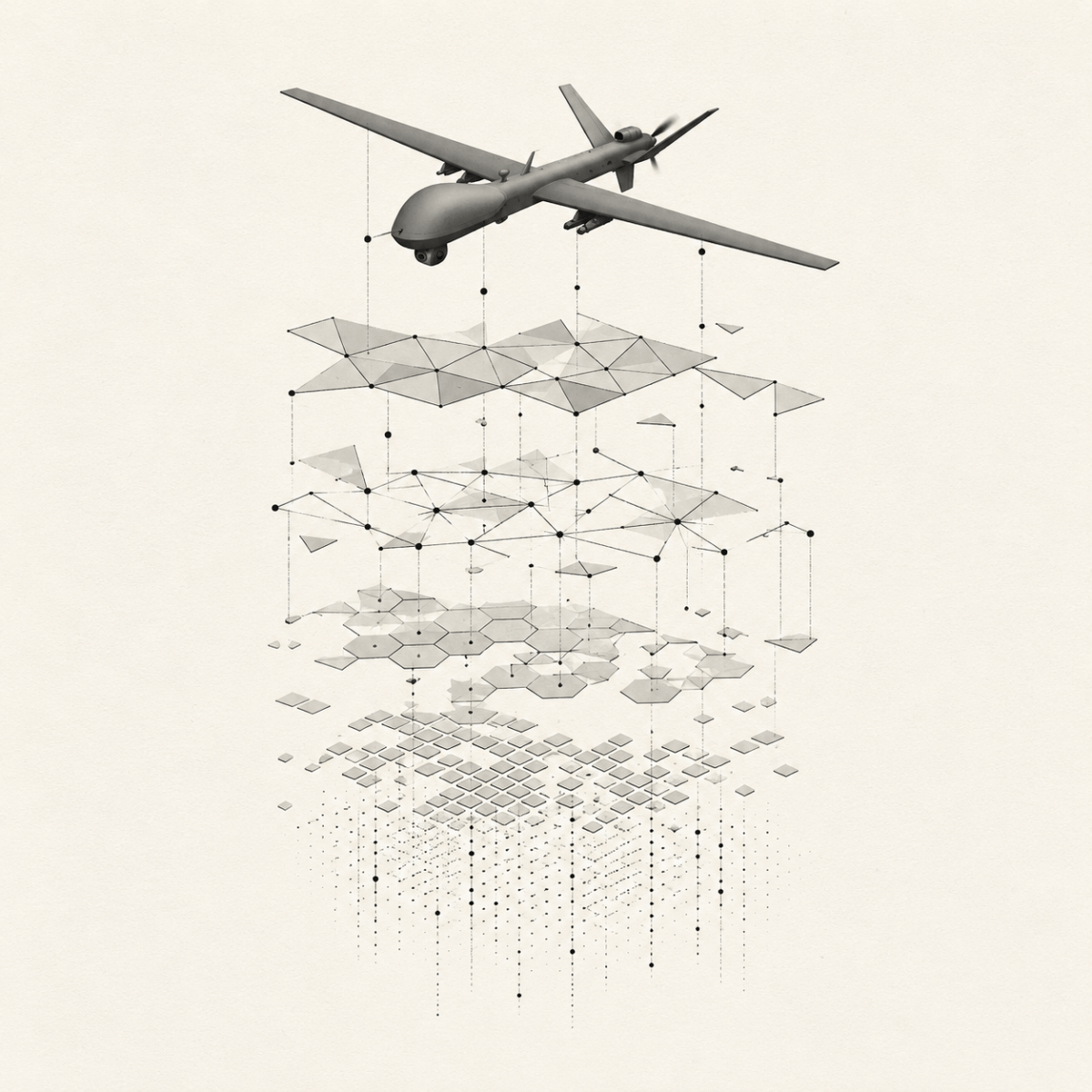
The drone turn illustrates a broader problem: automation does not simplify warfare so much as relocate its complexity.
For centuries, command and control struggled with distance, communication delay, logistics, and incomplete information. Modern digital systems solve some of those problems while creating entirely new ones. Drones, autonomous sensors, satellite networks, electronic warfare systems, AI-assisted targeting, cyber operations, and real-time data fusion generate volumes of information far beyond the capacity of any individual or institution to fully comprehend. The battlefield becomes not merely contested terrain but a contested information environment.
This produces a paradox. Greater visibility can reduce understanding. Commanders increasingly inhabit a world of dashboards, feeds, alerts, predictive models, and machine-generated recommendations. Every additional sensing capability creates additional coordination requirements, verification burdens, failure modes, and opportunities for deception. The system gains information while losing coherence. Complexity accumulates faster than human comprehension.
The consequence is that command and control increasingly becomes a problem of managing the management system itself. Decisions are no longer constrained primarily by a lack of information but by the difficulty of determining which information matters, which relationships are causal, and which signals are artefacts of the monitoring apparatus. The tools designed to reduce uncertainty become part of the uncertainty they are intended to eliminate.
From a cybernetic perspective, the drone revolution may therefore be less about autonomous weapons than about recursive control. Every new layer of observation requires another layer of interpretation, coordination, and governance. The battlefield becomes a nested hierarchy of feedback loops attempting to regulate other feedback loops. Complexity does not disappear. It propagates upward through the command structure, where it reappears as ambiguity, delay, and increasingly fragile decision-making.
Categories
cmd & ctrl, we have a problem
The drone is only the visible object. The real event is the combinatorial explosion of sensors, signals, decisions, delays, targets, countermeasures, and feedback loops.