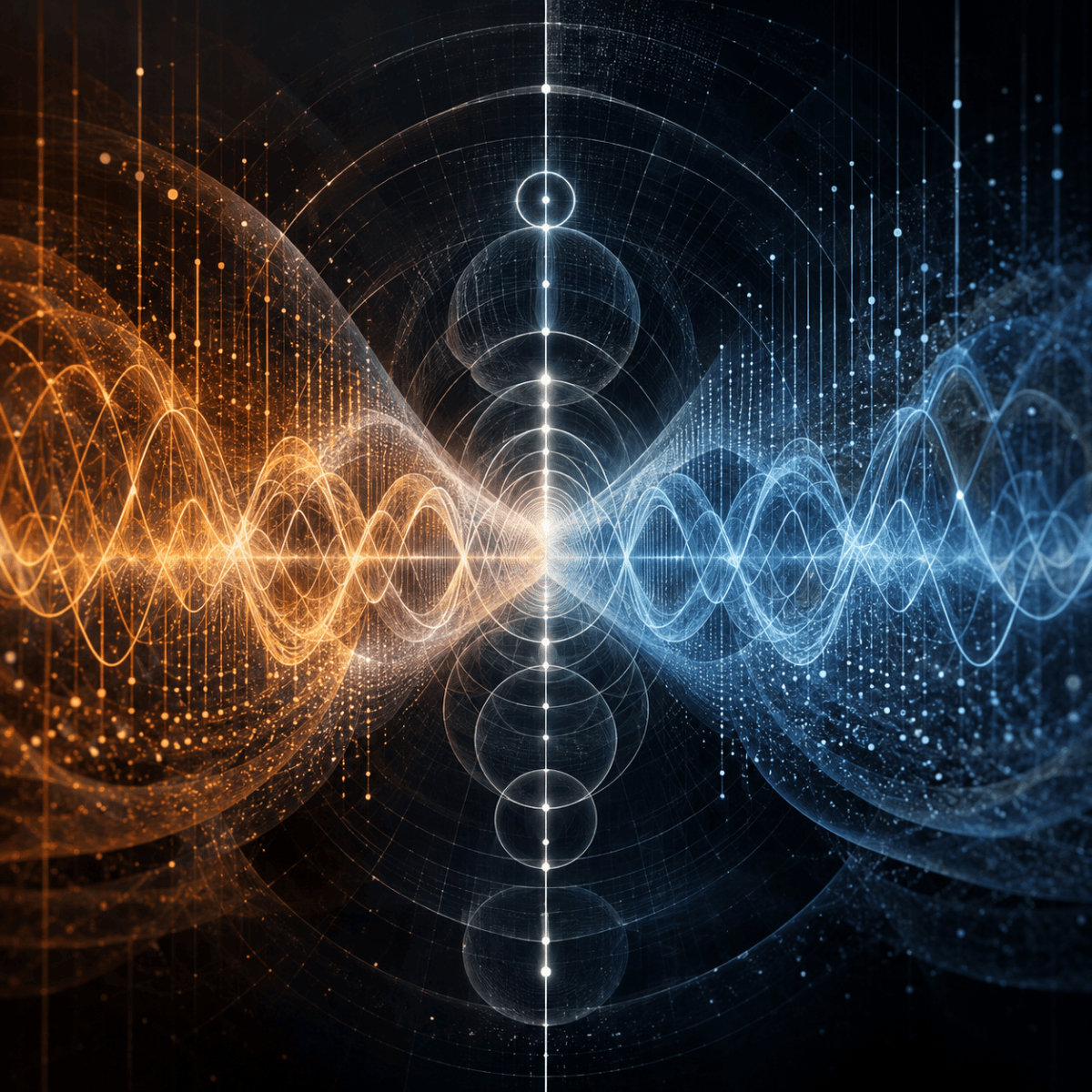
Global communication has become an immense recursive instrument. Social media, populist politics, automated amplification, rolling news and algorithmic recommendation continuously return communication to the conditions of its own production. A message changes the environment into which the next message arrives. Rebuttal returns the claim, outrage returns the distinction, repetition changes familiarity, and familiarity changes what plausibly follows. Disinformation is unusually revealing because its surface content mutates almost without limit while something underneath remains recognisably continuous. The words are replaceable. The recurrence is not.
Persistence requires recurrence, recurrence requires time, and anything recurring through time has frequency: some pattern to when and how often it returns. Where recurrent processes interact, their relative timing gives them phase. This extends far beyond repeated words or themes. Relations recur. Distinctions recur. Expectations, oppositions, syntactic forms, narrative trajectories and patterns of response recur, interacting across timescales without any natural boundary at which language conveniently divides itself into independent parts. What appears locally as a word, belief, narrative or identity is a temporary coherence within this larger activity. Look for the object and the field disappears. Look at recurrence and the object reappears as a pattern in the field.
Meaning occurs inside this recursion, not above it. Recurrence establishes relations; established relations constrain subsequent interpretation; interpretation changes what subsequently recurs. Language is thus caught productively inside itself. We cannot use language to obtain some immaculate external position from which language can finally be inspected. We can examine the temporal dynamics through which it continually reconstructs itself. Meaning remains real and consequential, but it is one observable dimension of a larger process whose recurrence, timing and coupling can also be measured.
Probability is that same process viewed through what becomes possible next. Every recurrence changes the field of possible recurrence. What has happened conditions what can happen next, not by determining it, but by continuously redistributing probability across an effectively unbounded combinatorial space. Influence is not something subsequently applied to communication. It is intrinsic to recurrence itself: every realised relation leaves the field different from the one in which it occurred. Across sufficient repetitions and timescales, these differences accumulate into the apparent solidity of narratives, beliefs, identities and truths. The system remembers without requiring a single location in which the memory resides.
Now frequency returns an octave higher. A persistent communicative pattern is not merely something that repeats; its recurrences remain sufficiently aligned in time to reinforce their own continuation. This phase coherence occurs within timescales and through coupling between them, where activity at one rhythm alters recurrence at another. Timing itself is an intervention surface. Noise cancellation demonstrates the elementary principle: a signal is attenuated without arguing with it. Human communication is nonlinear, adaptive and vastly more complex, but recurrence still depends upon temporal relation. Alter delay, synchronisation, amplification or coupling across scales and the same communicative components enter a different dynamical organisation. This is the uncomfortable weakness of purely semantic counter-disinformation: contradiction can oppose a claim while reproducing its rhythm. Opposition in meaning is not opposition in dynamics. Interdiction begins when we stop chasing the message around the system and start changing the timing by which the system keeps bringing it back.
That proposition is testable. Take a sufficiently large body of communication distributed through time and resist the temptation to decide in advance where the signal lives. Words recur, but so do semantic relations, syntactic forms, emotional associations, conversational responses, narrative structures and collective patterns of attention. Each has temporal structure: it appears, disappears, returns, accelerates, slows, clusters with other activity and falls out of step with it. Measure those recurrences across every dimension and timescale available in the data, then examine their frequencies, relative phases, coherence, modulation and cross-frequency coupling. Here, phase space means the evolving configuration of those temporal relations at once. It is not a hidden layer behind communication. It is the medium as it changes through time.
First listen. Establish the characteristic recurrent structure of a persistent narrative without assuming that its identity resides in any particular word, claim, speaker or platform. The pattern survives changes of vocabulary, actors and surface content where the organisation of relations among them persists. The experiment begins by asking which temporal relationships remain stable through substitution. Then perturb those relationships. Hold content constant while changing when components appear, how often they recur, how long the delays between them become, and whether previously synchronised elements continue to arrive together. These are temporal interventions: changes to the timing of communication rather than to what it explicitly says. Their effects reveal which temporal relations participate in maintaining coherence.
Then reverse the experiment. Change meaning while preserving timing. Contradict the claim, substitute its vocabulary, reverse its sentiment or change its apparent source while maintaining the recurrence intervals, response patterns and larger temporal rhythm characteristic of the original structure. Semantic and temporal organisation are now treated independently. Where opposed content continues to sustain the recurrent organisation while temporal displacement weakens it, semantic opposition and dynamical opposition have been separated. This also explains a familiar pathology of contemporary communication: an argument can spend all day attacking a narrative while keeping that narrative active. The words oppose it. The timing continues to reproduce it.
The effect does not reside at a single frequency. Human communication unfolds simultaneously across milliseconds of speech, seconds of conversational exchange, minutes of attention, hours of amplification, daily news cycles and much longer cultural rhythms. Activity at one scale alters what happens at another. A burst of rapid repetition changes a daily pattern of attention; a recurring daily pattern alters which narratives remain available over months. This is cross-scale coupling: recurrence at one timescale modifying recurrence at another. The experimental target is not a spectral peak but the changing relationship among many recurrences at once. A small temporal intervention at one scale can reorganise coherence elsewhere, while a large semantic intervention accomplishes nothing if it continues to arrive on the same beat.
This is where the whole becomes experimentally unavoidable. Once communication is treated as a phase space rather than a collection of messages, there is no clean separation between signal, medium and history. Every event arrives into a structure partly produced by what came before and leaves that structure altered for what follows. What looks locally like a message is one temporary event within that continuing organisation. What looks across time like recursivity is the consequence of this continuity: previous communication becomes part of the conditions of future communication. Interdiction, on this account, is not principally the removal of something from the system. It is the deliberate reorganisation of the temporal relations through which the system keeps bringing that something back.
Skeletal experimental framework
● Sample the field broadly. Capture communication through time without deciding in advance which words, actors, narratives, platforms or channels contain the significant signal.
● Represent without privilege. Encode observable recurrence across lexical, semantic, syntactic, affective, interactional and temporal dimensions without assuming which dimension matters most.
● Resolve the temporal structure. Measure recurrence frequencies, relative phase, coherence, modulation and coupling across multiple timescales.
● Let persistence reveal the signal. Identify relations that remain coherent through changes of vocabulary, source, platform and surface content. Significance is discovered through persistence, not assigned beforehand.
● Perturb timing. Vary delay, recurrence interval, synchronisation and coupling while holding semantic content constant.
● Perturb meaning separately. Alter semantic content while preserving temporal organisation.
● Observe the whole response. Measure changes in coherence within and across scales, including effects appearing far from the point of intervention.
● Iterate without protecting the model. Allow each result to change what is measured next. The significant signal is an experimental result, not an experimental premise.
Conceptual lineage
Wiener–Khinchin theorem
https://daedeluskite.com/2026/02/15/wiener-khinchin-theorem
Establishes the bridge from recurrence through time to structure in frequency. Autocorrelation and spectral density provide the mathematical hinge for treating persistent communicative recurrence as something observable without first deciding what it means.
Spectral Coupling
https://daedeluskite.com/2026/02/15/spectral-coupling
Moves from individual recurrence to relations among recurrent processes. Delay, phase alignment, resonance and synchronisation become properties of communicative organisation, establishing the basis for analysing meaning through coupling rather than isolated content.
Language as Harmonic Structure
https://daedeluskite.com/2026/06/20/language-harmonic-structure
Places meaning directly inside temporal organisation. Language becomes a distributed phase field in which rhythm, delay, repetition, synchronisation and interference participate in the persistence of meaning. This is the immediate conceptual foundation for treating semantic content as one observable resolution of a larger recurrent field.
Continuity Precedes Truth
https://daedeluskite.com/2026/06/10/continuity-precedes-truth-2
Removes the categorical separation between information and disinformation. Both arise through the same processes of recurrence, framing, selection and interpretive closure. Disinformation becomes a particularly visible configuration of communication rather than an alien substance introduced into it.
Rhythmic Displacement
https://daedeluskite.com/2026/06/22/rhythmic-offset
Turns temporal description into intervention. Persistent systems reproduce stable relations among signals, delays, responses and expectations; altering those timing relations reorganises the conditions of persistence. This supplies the direct precursor to frequency-domain interdiction.
influence this: the probabilistic frequency structure of communication
https://daedeluskite.com/2026/07/05/probable-truth
Defines influence as alteration of the probability distribution of future communication. Recurrence is no longer simply repetition: each communicative event changes the field from which subsequent events emerge. Probability becomes the bridge between temporal history and future possibility.
Semantics Follows Frequency: Why Meaning Repeats and History Rhymes
https://daedeluskite.com/2026/08/08/semantics-follows-frequency-language-in-the-spectral-domain
Completes the recursive relation between frequency and meaning. Recurrence produces structure, structure acquires significance, and significance changes subsequent recurrence. Semantics follows frequency, but frequency subsequently follows semantics.
Persistence of Reality
https://daedeluskite.com/2026/08/28/persistence-of-reality
Generalises recurrence beyond communication. Delay generates rhythm; rhythm establishes phase; phase permits reinforcement, interference, entrainment, synchronisation and displacement. Persistence becomes recurrent organisation through transformation, while local phase modulation propagates by changing the constraints inherited by subsequent activity.
Belief as Harmonic Structure
https://daedeluskite.com/2026/09/02/belief-as-harmonic-structure
Brings the preceding sequence into an explicit empirical programme. Belief is treated as persistent organisation of probability expressed across coupled temporal scales, with recurrence, phase coherence, modulation and cross-frequency coupling proposed as measurable characteristics. The present experiment takes the next step: from detecting that organisation to deliberately perturbing the temporal relations through which it persists.
Disinformation Dynamics: Recursive Harmonics
https://daedeluskite.com/2025/10/11/02-the-disinformation-interdiction-handbook-part-2-theory-of-recursive-harmonics
The earlier disinformation branch of the argument. It identifies recursive feedback, phase offset and harmonic organisation as mechanisms through which disinformation becomes dynamically integrated into communication. The present account returns to that problem with a more developed theory of recurrence, probability, persistence and experimental intervention.


One reply on “Disinformation Interdiction in the Frequency Domain”
Of course, disinformation is only the conspicuous case. Information production follows the same dynamics: affirmation, negation, contradiction and neutralisation all participate in recurrence, and apparently opposed messages can reinforce the same underlying constellation (of dynamical systems, artefacts, entities) simply by continuing to reproduce its timing and relations. Once communication is understood this way, there is no clean return to treating messages as independent semantic containers. Meaning still matters, but it occurs inside a phase-dynamical field whose history conditions what can happen next. Having seen the structure, you cannot unsee it; and nor can you now unknow it.
LikeLike