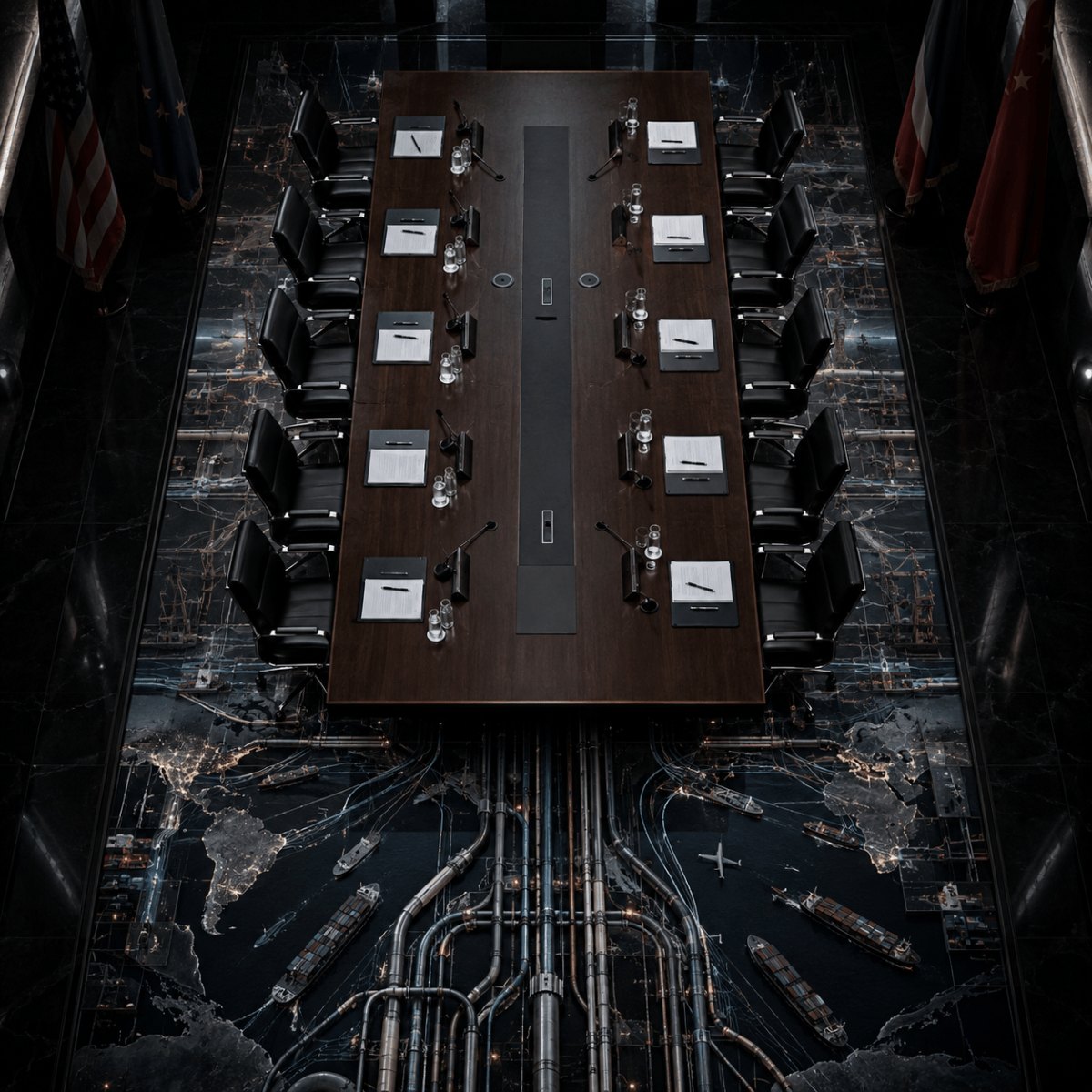
Human beings are already entangled beyond any plausible return to separation. Food, energy, technology, money, language, knowledge and atmosphere cross every border we draw. Billions of lives are coupled through shared infrastructure, supply chains, communication systems and ecological dependencies whose reach makes the old fantasy of national isolation increasingly absurd. War does not interrupt this integration. It rides it. Weapons, sanctions, propaganda, capital, refugees and political shocks move through the same connective tissue. We have built one planetary civilisation while continuing to organise power as though its parts were separate. In this sense, all war is civil war: not because nations have vanished, but because violence occurs within a civilisation whose differences are already bound by relation. The adversary is politically foreign but systemically internal. We are degrading the shared conditions of civilisation and calling the result strategy.
The deeper problem is that leadership remains organised around an ontology that generates the very conflicts it then claims responsibility for managing. Repeated long enough, conflict stops being an event and becomes a relation around which the system reorganises itself. Threat gives institutions purpose, enemies sharpen identities, opposition concentrates authority, and each recurrence alters the conditions under which the next recurrence becomes probable. Then come the salaries, contracts, careers, elections, departments, weapons programmes, consultancies, industries and status hierarchies whose continuity becomes coupled to continuation of the problem. Conflict has entered the conditions through which the system reproduces itself. Peace is suddenly not good news for everyone. It threatens business models, institutional identities and concentrations of authority whose value was calibrated within an order organised around threat. The system has not merely failed to solve the problem. It has learned to require it.
This is where the problem becomes philosophical. Language does not innocently arrive afterwards to describe an independently organised world. We contort social reality to reproduce the distinctions our language has already made familiar: ally and enemy, strong and weak, winner and loser, threat and security, deterrence and submission. These distinctions recur through speeches, headlines, institutions, doctrines, budgets and ordinary conversation until the narrative acquires material form. The material form then returns as evidence that the narrative was correct. Language and social order become entrained: each reproduces the relations required for the other to remain intelligible. Conflict consequently possesses a harmonic structure. Its persistence lies neither exclusively in words nor weapons, governments nor individuals, but in the recurrent relations through which all of them acquire coherence together. The narrative becomes architecture; the architecture reproduces the narrative.
Austin (1962) established that language acts rather than merely describes; Wittgenstein (1953) located meaning within use and forms of life; Berger and Luckmann (1966) described the recursive production and eventual objectification of social reality; and Searle (1995; 2010) placed language within the constitution and persistence of institutional facts, status functions and social power. Applied Field Logic extends this trajectory through recurrence. Meaning is neither contained by words nor exhausted by isolated acts. Linguistic, institutional and material relations recur across time, each iteration altering the probability and intelligibility of what follows. The logical orbit is this persistence of relational organisation. Conflict becomes durable when enemy, threat, security, authority and response repeatedly return one another to coherence across language, institution, economy and identity. What begins as description becomes expectation, what becomes expectation reorganises behaviour, and what reorganises behaviour eventually returns as apparently objective confirmation of the original description.
Peace therefore asks far more of leadership than negotiation. It requires an ability to recognise when the inherited description of reality has become part of the machinery producing it. Difference itself is not the problem. Difference is constitutive of relation; without it there is nothing to relate. The failure is converting difference into opposition and then constructing identities, institutions and economies that depend upon that opposition for their continuity. Peace does not require the erasure of borders, nations, interests or disagreement. It requires another organisation of their relation, one capable of persisting without repeatedly manufacturing an enemy against which to define itself. The difficult question is not whether humanity wants peace. Almost everyone says they do. It is whether our leaders, institutions and societies can survive no longer needing conflict to tell them who they are.
Annotated Bibliography
Austin, J.L. (1962) How to Do Things with Words. Oxford: Clarendon Press.
Austin breaks the assumption that language merely reports an independently constituted reality. Utterances perform actions and alter relations between speakers, institutions and worlds. The relevance here is foundational: political language participates in the production of political reality rather than standing outside it as commentary.
Berger, P.L. and Luckmann, T. (1966) The Social Construction of Reality: A Treatise in the Sociology of Knowledge. Garden City, NY: Doubleday.
Berger and Luckmann describe social reality as produced through recurrent interaction, institutionalised, objectified and subsequently encountered as an apparently external order by the people who continue reproducing it. Their account provides a direct precursor to the argument that repeated narrative distinctions sediment into institutional reality and subsequently return as evidence of their own necessity.
Searle, J.R. (1995) The Construction of Social Reality. New York: Free Press.
Searle makes language constitutive of institutional reality. Money, property, government, authority and status depend upon collectively sustained assignments of function and recognition. The significance for conflict is that political categories do not merely label material structures. They participate in giving those structures their institutional force.
Searle, J.R. (2010) Making the Social World: The Structure of Human Civilization. Oxford: Oxford University Press.
Searle extends the analysis into the architecture of civilisation itself, examining how language generates institutional facts, status functions, obligations and powers. The present argument pushes further into recurrence: once institutional distinctions become conditions of identity and authority, their continued reproduction alters the probability of the social futures available to the system.
Wittgenstein, L. (1953) Philosophical Investigations. Oxford: Basil Blackwell.
Wittgenstein relocates meaning from abstract correspondence into use, practice and forms of life. Enemy, security, deterrence, victory and threat acquire meaning through the activities in which those terms function. Language is consequently inseparable from the recurrent social practices through which a political order recognises and reproduces itself.
The theoretical departure developed here is recurrence. Language neither simply represents a pre-existing social world nor constructs one through isolated acts. Linguistic, institutional and material relations recursively reproduce one another through time. What persists is the relation. What recurrence stabilises becomes increasingly probable, increasingly infrastructural and increasingly difficult to imagine otherwise. Peace is difficult because conflict has acquired precisely this depth: it has become language, institution, economy, identity and expectation simultaneously. The philosophical task is not merely to describe that structure differently. It is to interrupt its recurrence.
Overtone 1
The Strait of Hormuz: Cascades, Delay and the Architecture of a Crisis
https://daedeluskite.com/2026/08/30/strait-hormuz-cascades-delay-crisis/
War and peace are different regimes of the same recursively coupled field. Conflict reorganises budgets, industries, alliances, careers, doctrines, markets, infrastructure, political identities and institutional necessities. The system progressively reproduces the conditions to which it claims merely to respond.
Overtone 2
Peace is a Managed Service
https://daedeluskite.com/2026/03/23/peace-is-a-managed-service/
Peace is not an achieved state or ceremonial endpoint but continuous regulation: tolerating tension, preserving ambiguity long enough for information to arrive, introducing useful delay and correcting trajectories before positions harden into conflict. Once institutions, political identities and economies organise themselves around recurrent tension, managing conflict becomes easier than relinquishing the structures conflict sustains.
Overtone 3
The Big Empty: Consciousness, Cosmos, and the Generative Logic of Absence
https://daedeluskite.com/2025/12/01/the-big-empty-consciousness-cosmos-and-the-generative-logic-of-absence/
Difference is not a defect awaiting resolution. It is constitutive. Identity requires distinction, while coherence arises through relations across difference rather than through its elimination. Conflict is one possible organisation of difference, not its necessary expression. Peace preserves difference without requiring its conversion into existential opposition. The absence between self and other is not the enemy of coherence. It is what makes relation possible.
Categories
Philosophy of Language: All War Is Civil War
Peace is not merely difficult. We have built institutions, identities, economies and languages whose coherence depends upon the persistence of conflict.