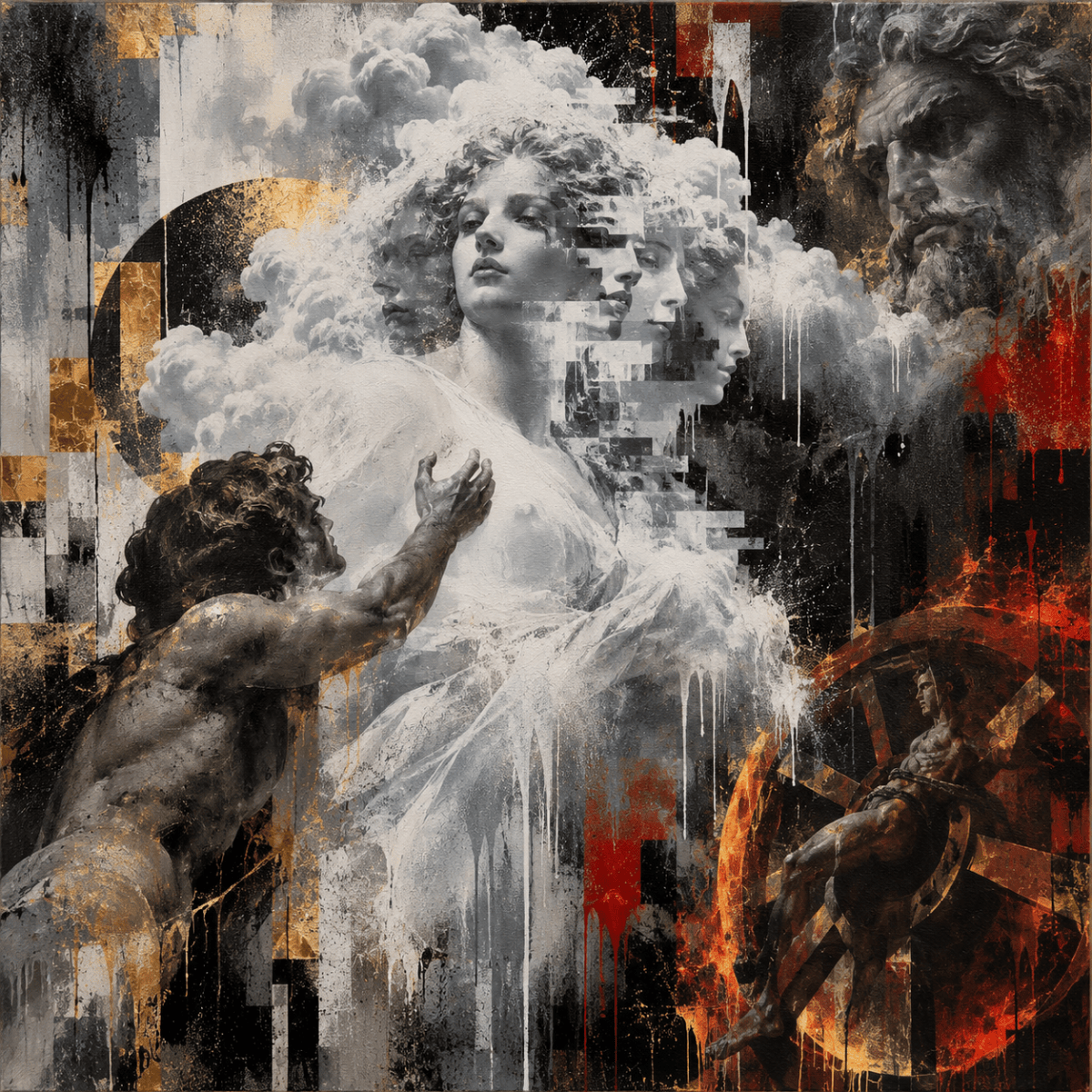
In Greek mythology, Ixion murdered his father-in-law and was shunned for the crime. Zeus nevertheless purified him and brought him to Olympus, where Ixion repaid the favour by attempting to seduce Hera, Zeus’s wife. Zeus responded with a peculiar test: he fashioned Nephele, a cloud in Hera’s likeness, and presented the simulation to Ixion. Ixion desired the representation, mistook it for what it represented and acted accordingly. The encounter produced consequences of its own: Nephele bore Centauros, associated in the mythic genealogy with the centaurs. Ixion was eventually bound to a perpetually turning fiery wheel, condemned to rotate without arrival or release. There is an uncomfortable amount of modernity packed into this ancient story: desire captured by simulation, representation generating material consequences, and finally permanent attachment to the machinery of those consequences. The important part of the wheel is not merely that it turns. It is that there is no way off.
Technological civilisation has acquired something of the same structure. This does not make technology secretly useless; it does extraordinary things, and that success is precisely what makes the predicament difficult. Technical solutions alter the conditions in which subsequent problems appear. New systems bring infrastructure, maintenance, security, supply chains, energy requirements, material requirements and dependencies of their own. Some problems disappear. Others are displaced or newly produced. Banking, healthcare, government, employment, communication, logistics and increasingly ordinary social participation now depend upon technical infrastructures that individuals have little practical capacity to abandon (Welby and Tan, 2022). There is no intact pre-technological civilisation waiting behind us should we decide the experiment has become tiresome. Nor are benefits and costs necessarily experienced in the same place, at the same time, or by the same people. UNCTAD documents this asymmetry at global scale, including environmental burdens disproportionately carried by developing economies (UNCTAD, 2024). Meanwhile the end user inherits an accumulating ecology of devices, accounts, passwords, updates, interfaces, subscriptions, security requirements and compulsory adaptation. None alone constitutes captivity. Their integration into the ordinary conditions of participation is what closes the door.
The deeper constraint is material. Digital systems do not float above the world: computation requires energy, devices require minerals and manufacturing, networks require physical infrastructure, and discarded equipment becomes waste (OECD, 2024; UNCTAD, 2024). Technology can reduce particular burdens, improve efficiency, reorganise costs and provide new means of managing its own consequences. What it cannot do is exempt itself from the material and energetic conditions that make it possible. And here Nephele and the wheel meet again. The immaculate representation eventually encounters matter. The cloud requires machinery; the simulation requires infrastructure; the abstraction acquires consequences that must themselves be managed through further technical systems. We have built systems whose continued operation supports the conditions under which further technological development occurs, while that development creates further things to operate, secure, supply, cool, maintain and eventually replace. Ixion’s punishment was not simply endless motion. It was permanent attachment to the mechanism. There is no clean external position from which technological civilisation simply steps off its wheel. Technology keeps solving the problems technology creates, tightening our dependence on systems whose costs accumulate faster than our capacity to escape them.
References
OECD (2024) ‘Review of relevance of the OECD Recommendation on ICTs and the Environment’, OECD Digital Economy Papers, No. 370. Paris: OECD Publishing. doi: 10.1787/216766c6-en.
United Nations Conference on Trade and Development (UNCTAD) (2024) Digital Economy Report 2024: Shaping an Environmentally Sustainable and Inclusive Digital Future. Geneva: United Nations. UNCTAD/DER/2024.
Welby, B. and Tan, E.H.Y. (2022) ‘Designing and delivering public services in the digital age’, OECD Going Digital Toolkit Notes, No. 22. Paris: OECD Publishing. doi: 10.1787/e056ef99-en.
 Daedelus Kite
One reply on “Ixion’s Wheel: Technology and the Machinery of No Return”
There is another turn in the mythology worth following. The centaur is not simply the result of Ixion’s transgression but the second-order consequence of a deception. Nephele is already a simulation, a cloud given Hera’s likeness, and from Ixion’s encounter with that representation comes Centauros, who in Pindar’s account mates with the mares of Magnesia and produces the centaurs. The deception does not end with Ixion. It propagates. Representation produces a real relation, the relation produces offspring, and the offspring carries the original misrecognition forward into another hybrid form. The centaur is not merely half human and half horse. It is what the deception becomes once it has entered the world and begun generating consequences beyond its original purpose.
Which makes the modern technological use of the term unusually apt. In computing and artificial intelligence, a “centaur” describes a human-machine team, a coupled system in which human judgement and computational capability are made to work together. In the context of Ixion’s wheel, that matters because the hybrid does not appear at the beginning of the process. It arrives downstream, after the simulation, after the misrecognition, after the machinery is already turning. The centaur is what emerges when an artificial relation begins producing new conditions of its own: not an escape from the wheel, but another form generated within it, extending the system by becoming a further condition of dependency.
LikeLike