Donald Trump’s administration increasingly resembles a central casting agency in which the controversy generated by a questionable appointment becomes part of its political and commercial value. The media attention surrounding Kimberly Guilfoyle, appointed US ambassador to Greece, illustrates a deeper problem than the suitability of any individual for public office. Appointments confer authority, but they also generate allegiance, resentment, argument and attention. In this arrangement, apparent incompetence is not simply an institutional liability. It becomes a productive resource. Supporters defend, opponents condemn, the media amplifies, and each response renews the importance of the authority that made the appointment. The participants need not understand the arrangement for it to persist. What appears to undermine government can simultaneously sustain the political organisation responsible for governing. This is also the disturbing commercial logic beneath the spectacle. Attention becomes currency, antagonism becomes enterprise, and conflict becomes a market whose participants continually reproduce one another. Politics increasingly serves the business of maintaining the competition, rather than the competition serving the public. The distinction between success and failure depends on what the system is actually reproducing. Central casting has not necessarily failed at its most consequential function. It has assembled a production in which even the critics help keep the principal character on stage.
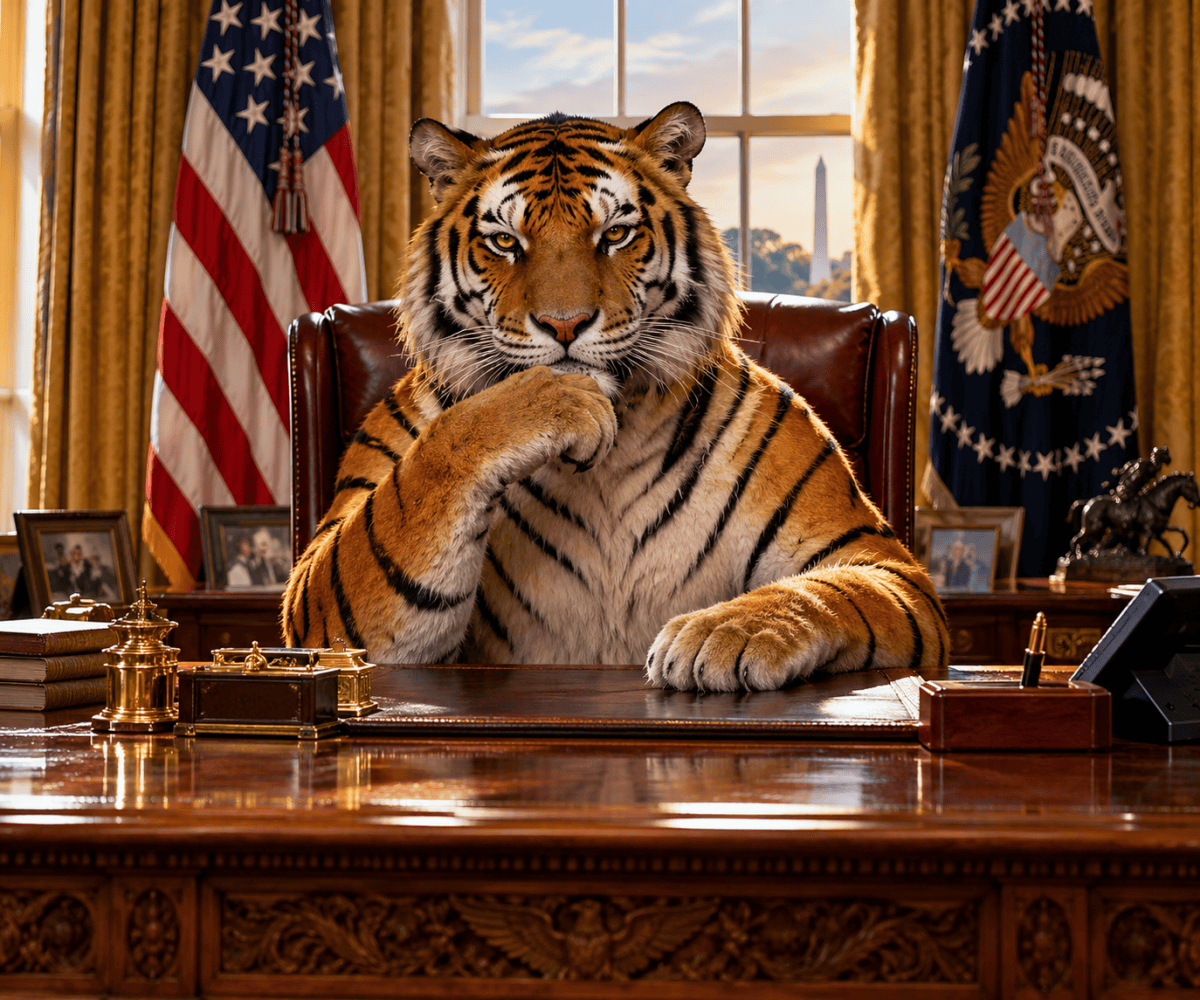
The same machinery becomes considerably uglier when human tragedy enters the production. William Chapman, a 23-year-old British man, died after entering a tiger enclosure at Yorkshire Wildlife Park. His devastated family appealed for distressing footage of the attack to stop circulating. Trump shared the footage with millions of followers, then posted an AI-generated fantasy of himself wrestling and embracing a tiger, apparently echoing gestures from the actual encounter. A young man dies; an imaginary president triumphs. A family asks for dignity; the spectacle demands attention. The contrast reveals a disturbing failure of judgement beneath the performance of extraordinary authority. Yet even the disgust this provokes becomes useful. Condemnation summons defence, defence invites further condemnation, and the resulting attention rewards the machinery responsible for its circulation. What ought to diminish authority instead becomes another opportunity to demonstrate allegiance. What should interrupt the performance becomes material for its continuation. The tiger has no part in these political arrangements, and William Chapman never chose to become their subject. He was a human being whose life mattered to those who loved him. Beyond the manufactured heroism and the arguments it generates, his family is left with an actual loss, one that no amount of attention can redeem.
References
Reuters (2026), 13 October. [Trump fires ambassador to Greece Guilfoyle after reports of misconduct](https://www.reuters.com/world/europe/white-house-says-us-ambassador-greece-guilfoyle-asked-to-resign-2026-10-13/).
Associated Press (2026), 14 October. [Coverage of Kimberly Guilfoyle’s departure from the Athens diplomatic post](https://apnews.com/).
ITV News (2026), 14 October. [Reporting on William Chapman and his family’s response](https://www.itv.com/news/).
Sky News (2026), 14 October. [Reporting on Trump’s tiger video and the family’s distress](https://news.sky.com/).


One reply on “Tyger, Tyger: Trump and the Fearful Symmetry of Civil Incompetence”
Anyone expecting World War III to arrive simply as nuclear Armageddon has misunderstood the changing nature of communication and conflict. A global struggle is already unfolding across information, economic and political systems, and the spectacle consuming American public life is one manifestation of a conflict that has been reorganising the world for decades. This observation is made with respect for William Chapman and his grieving family, and with the understanding that confronting the exploitation of human tragedy is necessary, even when doing so risks perpetuating the spectacle itself.
LikeLike