Language made civilisation possible, but its capacity to reproduce belief, identity and conflict offers no guarantee of survival. Planetary first aid begins with understanding what our communication does, not merely what it says.

Language made civilisation possible, but its capacity to reproduce belief, identity and conflict offers no guarantee of survival. Planetary first aid begins with understanding what our communication does, not merely what it says.

The world is changing, and institutions are working frantically to ensure that nothing fundamental changes. The result is a self-reinforcing cycle in which the machinery of (i.e. self-)preservation becomes an engine of destruction.

We have built a civilisation capable of transforming an entire planet, yet incapable of managing the consequences.

Institutions do not merely resist criticism. They regulate the conditions under which criticism can become intelligible, credible and consequential.

We have built institutions that teach people how to think, then reward them for knowing when not to.
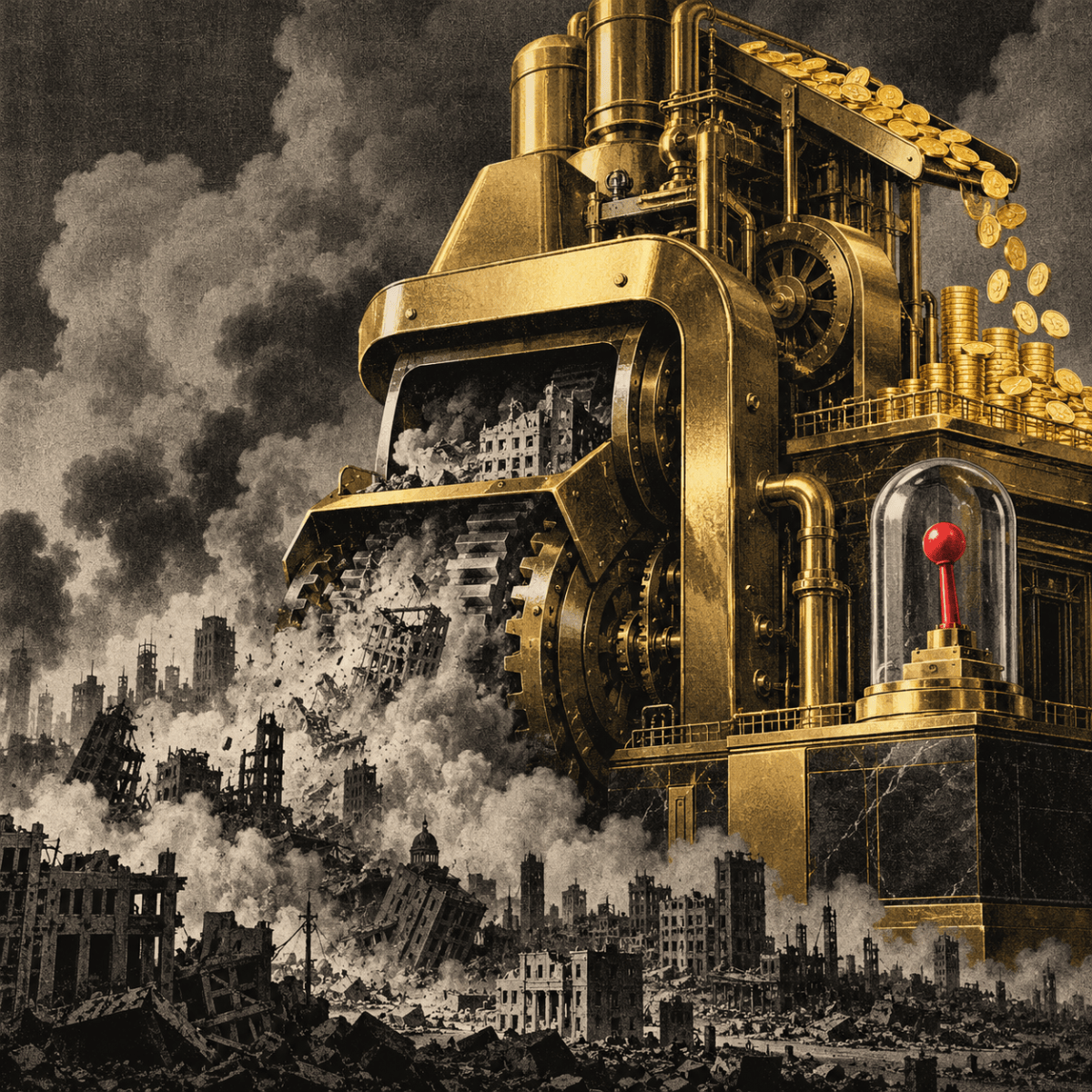
Civilisation has made its own destruction so profitable that its survival now constitutes a threat to the economy.

The paradox is how to preserve a planetary civilisation’s capacity for emergent self-regulation without irreversibly surrendering it to the political, economic and technological artefacts, entities and systems established to manage and control it.

We mistake the world we inherit for a world that must be this way. History, habit and collective belief conceal a more uncomfortable truth: our civilisation is simply what did happen, not what had to happen.

What happens when the people least equipped to recognise intelligence become responsible for selecting, rewarding and managing it?

When controversy becomes politically and commercially valuable, incompetence ceases to be merely a failure. Trump’s administration reveals how conflict reproduces authority, even at the expense of human dignity.

The paradox is that philosophy, a discipline nominally concerned with questioning assumptions, has become remarkably accomplished at preserving its own.

I went to a School of Cybernetics hoping to develop ideas about how systems organise and reproduce themselves. My experience instead prompted an unexpected examination of institutional authority, intellectual exclusion and the patterns through which institutions reproduce themselves.
Have a WordPress.com account? Log in now.

