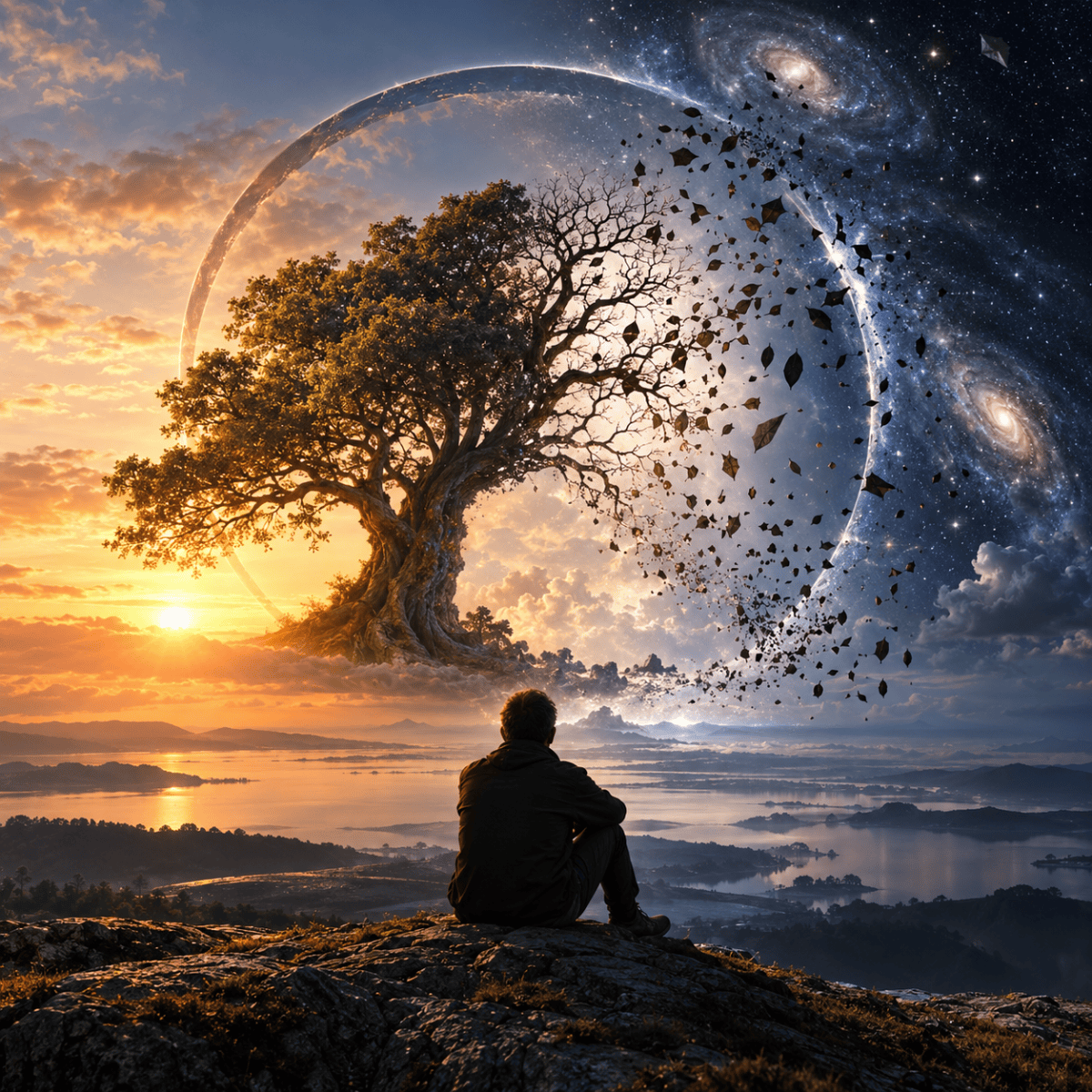
What if immortality is not something we acquire, but a consequence of something reality cannot escape? We generally imagine eternal life as an indefinite extension of our present existence, perhaps with a comfortable house in heaven, a ride-on mower, a Maserati and a private helicopter. Eternity, apparently, is suburban prosperity without the inconvenience of death. But this mistakes immortality for the preservation of our possessions, preferences and familiar identities. If reality is infinite in any meaningful sense, infinity need not consist of endless quantities of time, space or matter. Infinity is not simply an enormous quantity. It expresses something more fundamental: the impossibility of finally exhausting the relationships and possibilities from which existence emerges. Incompleteness precedes the things we ordinarily imagine continuing forever.
This is the significance of the Big Empty, the unpluggable hole at the centre of every apparently complete account of reality. Reality is constitutively incomplete. No system contains all the conditions of its own existence, and no description can finally enclose the relationships on which its validity depends. Mathematical incompleteness demonstrates a particular expression of this problem: sufficiently expressive, consistent formal systems cannot establish every truth expressible within their own rules. Its significance extends beyond mathematics because description itself is a relational activity. Every account depends on distinctions, boundaries and conditions that cannot all be contained within the account itself. When those conditions become objects of description, further distinctions arise. The boundary moves. This is not simply ignorance awaiting correction. It is the recursive structure of an existence that cannot be finally enclosed by any of its own expressions.
The consequences for physical theory, philosophy and human experience are profound. Reality is not a completed inventory of objects awaiting classification. It is an unbounded field of relational possibilities in which every existing configuration participates in generating further differences. Undecidability is not merely an inconvenience for mathematicians. It exposes the inadequacy of assuming that every meaningful question can be settled within a predetermined system of distinctions. Physical descriptions necessarily select boundaries, variables and relationships from a world whose conditions exceed those selections. No local system contains all the conditions of its own continuation. As differences interact through frequency, phase and delay, their combinations produce further distinctions, dependencies and possibilities. Some interfere, others become entrained, and particular harmonic structures persist. This is the logical orbit: identity emerging through recurrent relational structure rather than residing in an immutable substance. Unbounded combinatorial multiplicity is not simply a quantity of unrealised alternatives. It is constitutive of the world’s continuing capacity to become something it has never been before.
Consciousness makes this considerably more interesting. We ordinarily treat it as something possessed by an individual organism, confined to a brain and extinguished when that organism dies. Yet consciousness is a process of differentiation, recurrence, memory, anticipation and temporal integration. Its fine structure matters because consciousness is not merely the existence of a pattern, but the particular continuity of experience that pattern sustains. Identity emerges through relationships, not through the possession of an indivisible substance. The familiar distinction between the same consciousness and another consciousness becomes difficult when the relational structures through which experience persists are themselves capable of transformation and recurrence. If an equivalent configuration arose elsewhere, the question would not simply be whether the original individual had returned. It would concern the conditions under which subjective continuity, identity and difference become distinguishable at all. The problem is one of organised persistence across transformation, not the indefinite conservation of an object. Biological identity is one expression of this deeper relational continuity, not the measure of every form that continuity can take.
This raises an uncomfortable question about technological immortality. Transhumanist ambitions to extend biological life indefinitely, or preserve consciousness through computational means, approach mortality as a technical problem awaiting a sufficiently expensive solution. There is something appealing about that, particularly if the alternative is dying. Yet indefinite biological survival introduces enormous questions of resources, population, political power and access. Technologies of radical life extension developed within existing economic arrangements would be vulnerable to capture by those already possessing wealth and influence. Imagine a world in which the powerful accumulate centuries of ownership, authority and institutional control. We would have converted mortality, one of the few limitations shared across humanity, into another competitive advantage. The ride-on mower would survive, along with the mortgage on everybody else’s future.
But there is a deeper problem. What if dying is a necessary part of living, not simply biologically, but spiritually? A system that preserves its existing structure indefinitely does not necessarily preserve its capacity for transformation. Identity persists through change, not through the permanent conservation of a particular configuration. Death terminates an individual continuity, but it also changes the relationships through which further possibilities emerge. The dissolution of one persistent pattern alters the conditions under which others form. Consciousness participates in a reality whose generative possibilities cannot be finally enclosed. Indefinite preservation of the present self is not equivalent to participation in that greater continuity. Indeed, preserving a particular identity against transformation risks turning persistence into confinement. This does not make death desirable. It means that eliminating mortality and understanding existence are profoundly different undertakings. A longer life is not necessarily a deeper one, and an endless life is not necessarily an immortal one.
Contemporary commercial culture gives us little encouragement to consider that distinction. Much of the attention economy profits from keeping people agitated, insecure, distracted and emotionally vulnerable. A person who discovers sufficient meaning through contemplation, relationships or spiritual experience is not necessarily an enthusiastic customer for the next manufactured deficiency. Spirituality need not involve supernatural beliefs. It begins with recognising that individual existence participates in relationships extending far beyond anything the individual can possess or control. Such recognition interrupts the commercial cycle of dissatisfaction and temporary relief. There need be no conspiracy against spiritual experience. The incentives favour the cultivation of insecurity because insecurity sells. Our technologies increasingly exploit the vulnerabilities of consciousness while offering remarkably little understanding of what consciousness is. A peaceful customer, after all, is a commercial inconvenience.
The logic that lives is not a promise that we shall continue forever as the people we presently recognise. Biological death is real, but whether consciousness is necessarily extinguished with the organism, or whether its relational structure admits forms of continuity beyond biological existence, remains an unresolved question. Constitutive incompleteness changes how that question must be understood. Existence emerges through relationships rather than self-contained substances, and mortality cannot be reduced to the disappearance of an isolated thing. The end of an organism terminates a particular continuity without exhausting the possibilities of the relationships from which it emerged. Whether those possibilities include further subjective experience remains unknown, but the inability to establish such continuity is not equivalent to demonstrating its impossibility. The deeper mistake in our pursuit of immortality is assuming that death is the opposite of life. Death is the end of an individual living process, while life itself proceeds through emergence, transformation and dissolution. We may eventually discover how to keep ourselves alive for centuries without ever understanding what it means to be alive. And in our determination to preserve the self indefinitely, we risk mistaking the interruption of transformation for its ultimate achievement.
Key Takeaways
- Reality is constitutively incomplete. No finite system contains all the conditions of its own existence or continuation.
- Unbounded relational multiplicity, recurrence and harmonic structure provide the conditions through which persistent identities emerge.
- Immortality is not necessarily the indefinite preservation of biological existence, memory or personal identity.
- Technological immortality risks entrenching inequality while confusing prolonged survival with the meaning of existence.
- Death participates in life’s continuing transformation. Understanding consciousness requires confronting that relationship rather than merely attempting to abolish mortality.

