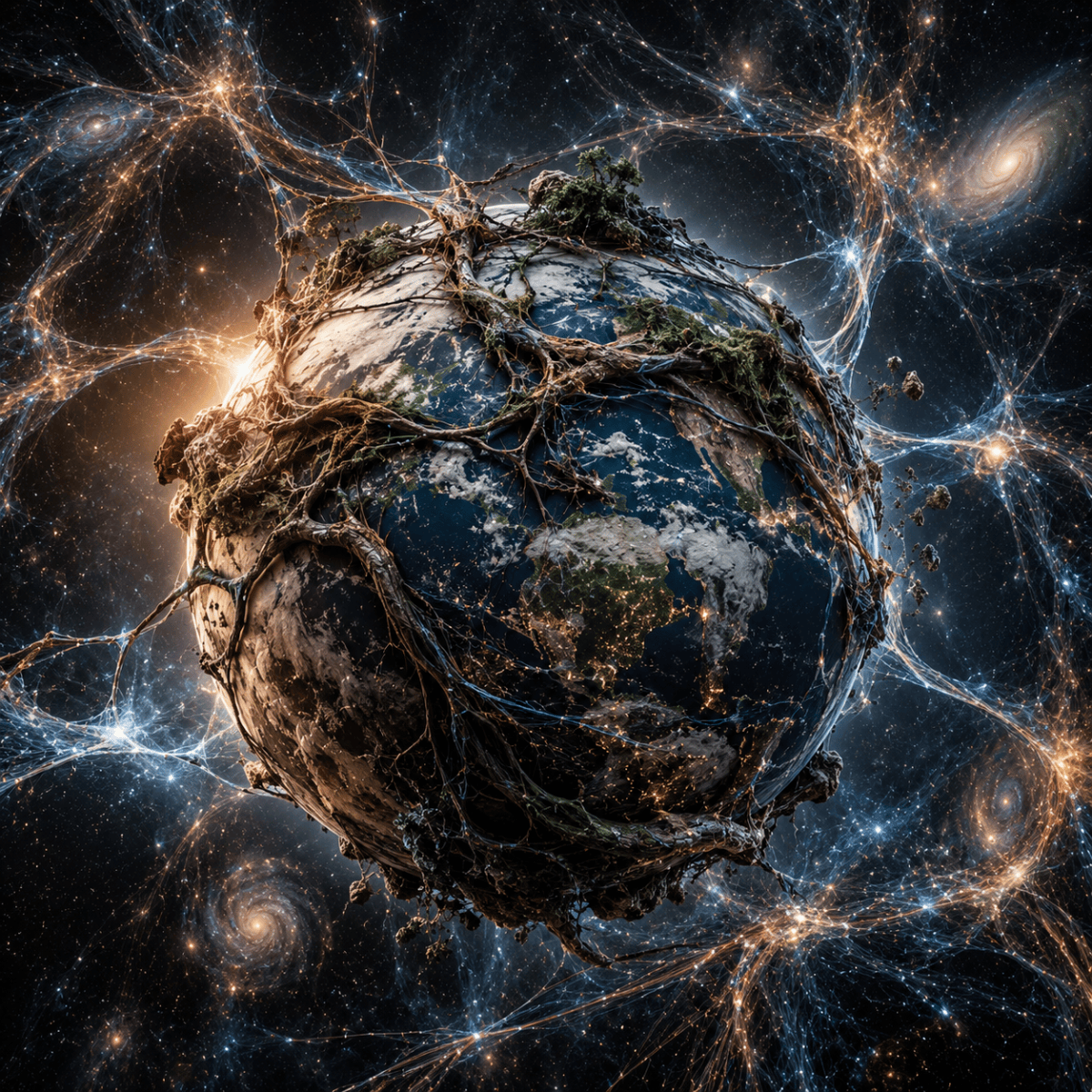
Technologically mediated communication has exposed humanity in a rather unflattering light. Beneath our magnificent intellectual pretensions, we’re mostly hormones, appetites, anxieties and insecurity, desperately seeking recognition while insisting we’re independent thinkers. We’re not especially different from other animals. We respond to threats, compete for status, seek belonging and become irrationally attached to whatever makes us feel safe. Reason frequently arrives afterwards, wearing a respectable suit and claiming retrospective responsibility. The internet has made this spectacle available for public inspection, revealing how easily our emotions, loyalties and convictions can be manipulated. Better still, we’ve developed an entire industry devoted to doing precisely that, complete with quarterly earnings reports. We have never had so much information about ourselves, nor such an extraordinary capacity to misunderstand what it tells us.
The deeper problem is that there’s nobody behind the curtain, including the person we imagine ourselves to be. What we call a self is a recurring pattern of memories, expectations, sensations and relationships, continually sustained and altered through interactions it cannot entirely control. The self participates in regulating these processes, but is also produced by them. The same is true collectively. Billions of people interact through technologies that accelerate emotional contagion, reinforce familiar interpretations and alter the possibilities of what happens next. Collective behaviour develops rhythms and momentum beyond the intentions of its participants, including those making fortunes from manipulating it. Individuals reproduce the conditions that shape them, while the consequences reshape what those individuals subsequently think, feel and do. Nobody stands outside this process, directing it from some privileged position. Our technological sophistication has given us a planetary system for amplifying human behaviour without a corresponding understanding of how that behaviour emerges. Eight billion nervous systems, each convinced somebody ought to be driving.
The implications extend beyond humanity, and become considerably stranger. The Gaia hypothesis drew attention to planetary feedback, while Earth-system science has established how living activity, atmospheric chemistry and geological processes continually alter the conditions of one another’s persistence. But why stop at the atmosphere? Electrical currents, magnetic fields, plasma, radiation and gravitational interactions connect processes across scales that have little respect for the boundaries we draw around things. Their rhythms, delays and differences determine which patterns reinforce one another, which interfere, and which disappear. A self-sustaining system does more than survive: its activity changes the conditions of what happens next, favouring the recurrence of its own pattern. Identity is not a property possessed by an isolated thing, but the temporary stability of interactions that help reproduce the conditions of their continuation.
The more interesting consequence concerns what makes that continuity possible. Every persistent identity, whether material, dynamical or psychological, depends on differences it cannot eliminate. Opposing tendencies constrain and enable one another, but their effects are neither identical nor interchangeable. Each changes the conditions under which the other operates, producing a continuing imbalance that both threatens the pattern and makes its renewal possible. The smallest self-sustaining unity is consequently not a perfectly consistent thing, but an unresolved relationship whose opposing conditions are inseparable. Regulation emerges through this tension, as reinforcement and interference continually redistribute the possibilities of what happens next. Observation and control belong to these interactions rather than standing outside them, while complete resolution would eliminate the differences necessary for further activity. From nervous systems to planetary environments and cosmic structures, continuity is sustained through relationships that reproduce themselves by changing. We keep searching for someone at the wheel, when the wheel, the driver and the road are all temporary expressions of the same unfinished process.
Categories
Eight Billion Nervous Systems and Nobody at the Wheel
From social media and human psychology to Gaia and cosmic self-regulation, an exploration of identity, feedback, emergence and the illusion of control.