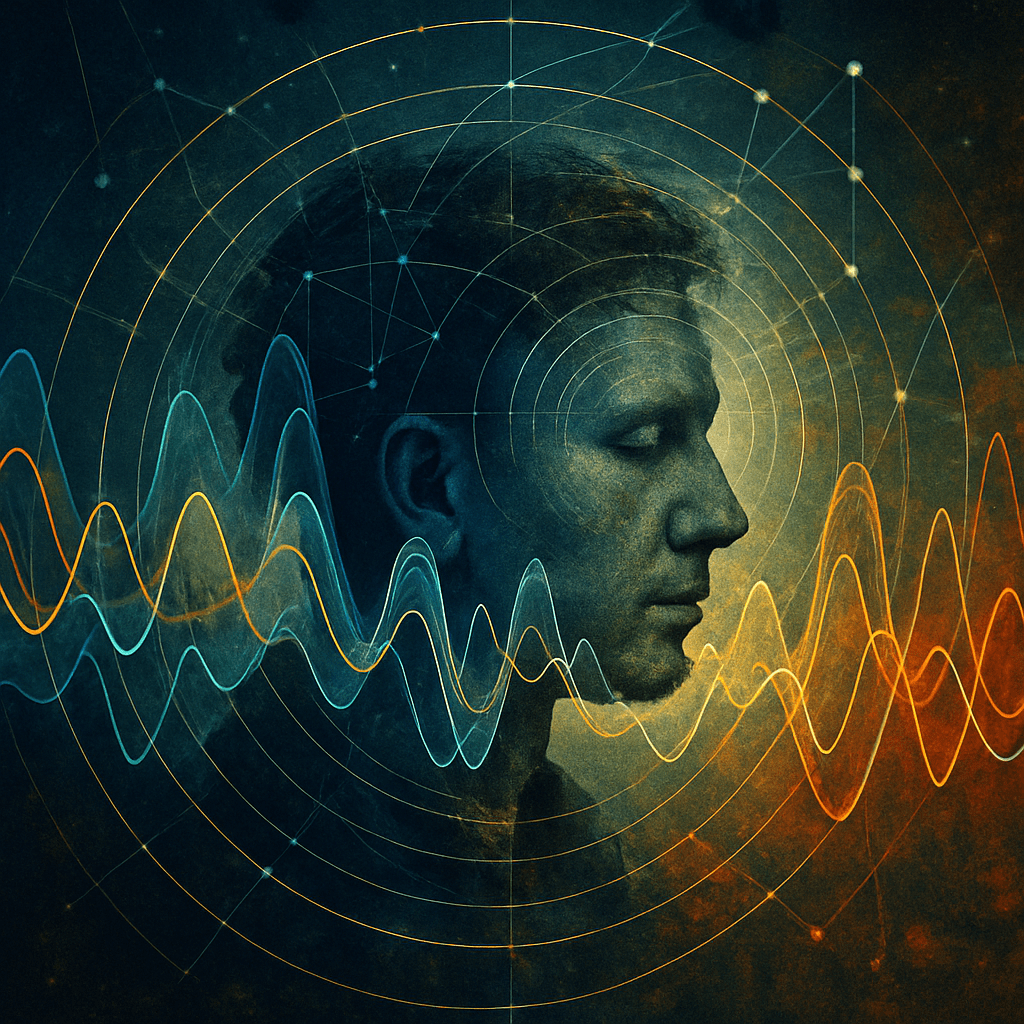
An interesting hypothesis is that all social processes are expressions of frequency. While not strictly equivalent, frequencies can be understood as empirical expressions of probability—patterns of recurrence that approximate likelihood over time. In doing so, they engage with dynamical attractors, stabilising tendencies within complex systems that draw trajectories into patterned coherence. The very process of existing invokes these attractors: multiplicity partitions itself, entropy drives differentiation, and from this arises a kind of harmonic interior space where boundaries between dimensions are less fixed than continuous. What appears as interaction, routine, or institutional rhythm is, at another level, a function of the frequency domain: pattern recurrence, entrainment, and resonance across bodies, environments, minds, and technologies. Communication, work, study, and even leisure sustain themselves by the oscillatory logic of repetition. These processes are not just human constructs but expressions of deeper logics within mathematics, physics, biology, and neuroscience. The labels differ, but the principle is invariant—self-propagating resonance.
Time, Unemployment, and Harmonic Disruption
Recent studies on the negative psychological effects of unemployment highlight that one of the most destabilising factors is the alteration in the individual’s relationship to time (Paul & Moser, 2009). Without externally imposed rhythms—work hours, deadlines, study sessions—the temporal harmonic structure of life collapses. Isolation emerges not only from the absence of others but from the absence of rhythmic entrainment with others. This suggests that social integration is as much about being in-phase with collective time signatures as it is about having material or institutional connection.
Cybernetics as a Frame of Intervention
From a cybernetic perspective, this can be framed as a problem of feedback and control. A person embedded in rhythmic social systems is continuously re-synchronised: circadian cycles align with work cycles, social gatherings, and institutional timetables. In unemployment or isolation, feedback weakens, and the system drifts toward instability. The intervention, then, may not require reinstating work itself but re-establishing rhythmic coupling. Cybernetics provides a way to model this: a system can be stabilised not only by its structural connections but also by the timing of its oscillations.
Applied Method: Inflecting Lifestyle Frequencies
One applied method would be to design systems that electronically inflect timing into daily life. These would not replicate work or study directly, but would inject temporal harmonics—reminders, rhythmic signals, structured sequences of tasks or interactions—that mimic the stabilising role of social frequency. For instance, scheduled prompts could cue a person to engage in short tasks, collective digital rituals, or synchronised media experiences. This could be tested with individuals experiencing psychosocial isolation to determine whether rhythmic entrainment alone improves subjective well-being and temporal orientation.
Emergent Implications
If such experiments revealed positive effects, it would suggest that human flourishing is not solely dependent on material or institutional arrangements but on a deeper substrate of harmonic coherence. The emergent patterns of society—identity, belonging, productivity—would then be seen as secondary effects of frequency alignment. The paradox is that what appears to be the most superficial (the rhythm of days, hours, minutes) is in fact the structural core. Application and theory fold back on themselves here: the loop is not closed by structure but by resonance.
References
Paul, K. I., & Moser, K. (2009). Unemployment impairs mental health: Meta-analyses. Journal of Vocational Behavior, 74, 264–282.
 Daedelus Kite
One reply on “Frequencies as the Basis of Social Processes”
An applied cybernetic framework here would not be limited to modifying behaviours through imposed schedules but would instead focus on identifying the harmonic rules that underlie temporal patterns. Once the rules are understood, even without specifying the exact frequencies, metrics, coordinate spaces, the system becomes intelligible as a set of governing dynamics. This is a second-order approach: observing how individuals embedded in rhythms feed back into the culture itself, shaping collective states not by design but by seeding (recursively self-propagating) complexity contour generation symmetries.
⠀
The consequence is not merely stabilisation of isolated, marginalised or excluded lives but the emergence of a more resilient system state, where belonging and coherence propagate across society. It may appear idealistic, but the principle is pragmatic: harmonic entrainment produces positive systemic effects without requiring central control. Language may falter in playing this game, but the logic of resonance continues regardless, and its effects are both diffuse and determinate.
Research concepts can be demonstrated (ie proven) in the micro, then scaled as and if necessary. Also significant to consider: broad, general and or unforeseen, niche, specialist gambits, functions, entities, systems and (scaled) effects.
LikeLike