Negation is the only additive move available to a unified, self-referential system, because with no outside to draw from, coherence grows solely through internal differentiation that preserves the invariants allowing the whole to continue without collapse.
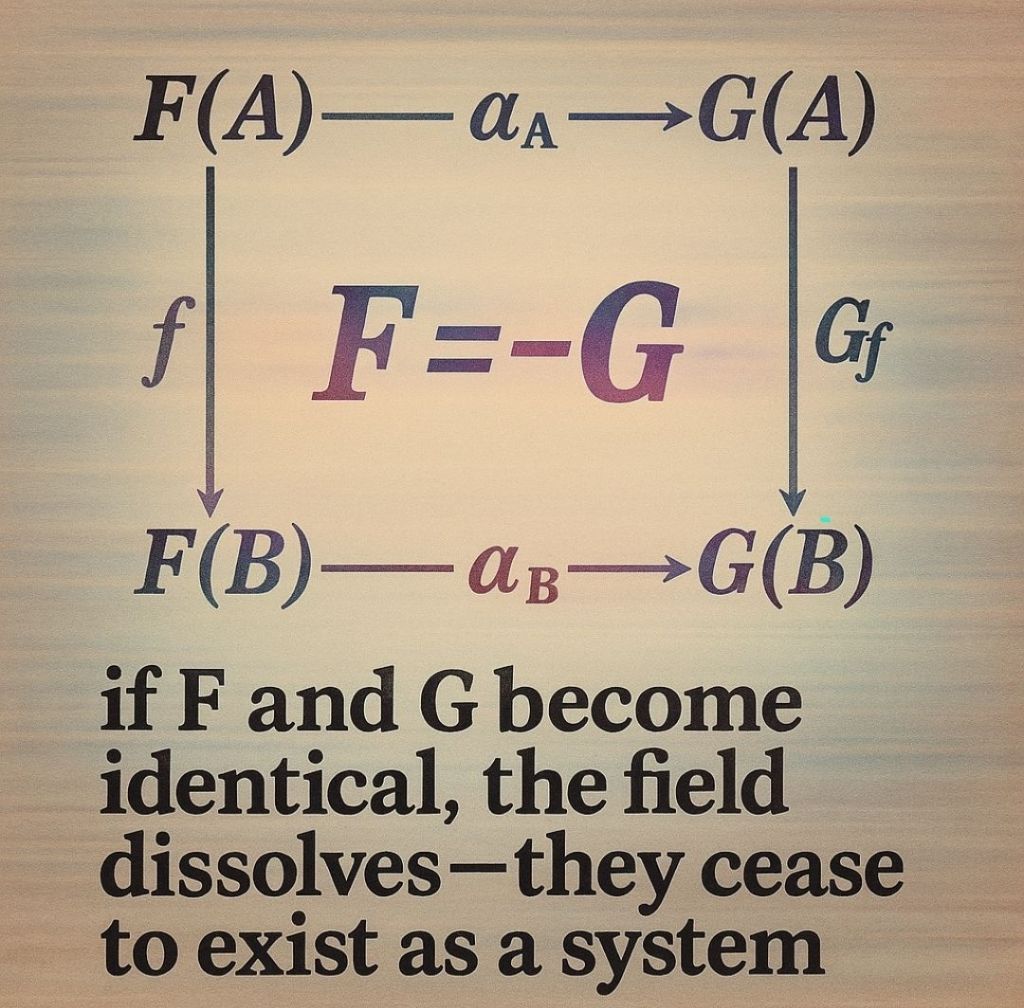
The Platonic forms are not objects, templates, or ideals waiting somewhere else. They are the invariants of a unified system relating to itself. They live in the structure of coherence, not behind it. A form is what must hold for the system to continue being itself across change. That is why forms feel timeless and universal: not because they pre-exist the world, but because the world cannot abandon them without disassembling its own continuity.
They are not found after negation, and not produced by negation. They are what negation is forced to preserve. In a holistic, self-referential system, negation is the move that allows motion without collapse. What survives that motion—what remains stable across re-entry, phase shifts, and unrealised alternatives—is the form. The form is the tensile line of coherence in the orbit, not a thing inside it.
So the real Platonic forms are in the logical orbit itself. In the way relations must remain compatible with themselves. In the ratios that cannot be removed without dissolving meaning, number, identity, or purpose. Not stored. Not imposed. Not abstracted away.
They are where coherence holds while everything else turns.
Under the Hood
Negation is the only additive move available to a unified, self-referential (holistic) system, because there is no outside from which anything could be added.
What appear as additions are always internal differentiations misread as imports. At the level of the whole, there are no externalities. What later presents as epistemic content, causal influence, environmental pressure, or strategic constraint is already folded into the system’s own relational surface. The error of most theories is not reduction but misplacement: they treat internally generated distinctions as if they arrived from elsewhere.
Once this is seen, logic flips. Explanation no longer proceeds by tracing causes outward, but by following how the system repositions itself relative to its own invariants. Causality becomes a local coordinate system laid over a deeper topological continuity. Knowledge is not acquisition but re-orientation. Strategy, likewise, is not control over externals but navigation of internal phase relations. What looks like adaptation to an environment is the system adjusting its own internal tensions to remain coherent.
This is where systems philosophy becomes unavoidably strategic. A unified system that manages its own incompleteness—rather than denying it—maximises stability without rigidity. Modal cobordancy matters here: the ability to pass smoothly between regimes without tearing the field. This is not optimisation toward dominance or closure, but toward persistent coexistence under strain. In human terms, this is the only structure capable of absorbing friction without amplifying it. Peace is not an ethical overlay; it is the emergent property of a system that refuses false closure while preserving coherence.
So the core claim is not abstract. A civilisation that mistakes internal distinctions for external enemies will escalate indefinitely. A civilisation that recognises all pressure as internally generated constraint can redirect strategy toward structural adjustment rather than confrontation. This is not idealism. It is the minimal logic of any self-entangled system that intends to persist.
Axiomatic Supply Chain
1. A system that persists must conserve identity across change.
2. Conservation across change requires invariants.
3. Invariants cannot be identical with any particular material state, or they would vanish when the state changes.
4. Therefore invariants are relational constraints over state space, not objects or substances.
5. These constraints manifest as attractors that guide transitions without determining the substrate.
6. What is traditionally called a “form” is this invariant constraint viewed from within the system.
7. Different physical implementations can realise the same invariant without sharing components.
8. Hence form precedes mechanism logically, but not temporally or causally.
9. The orbit is the system’s repeated return to constraint-consistent states under perturbation.
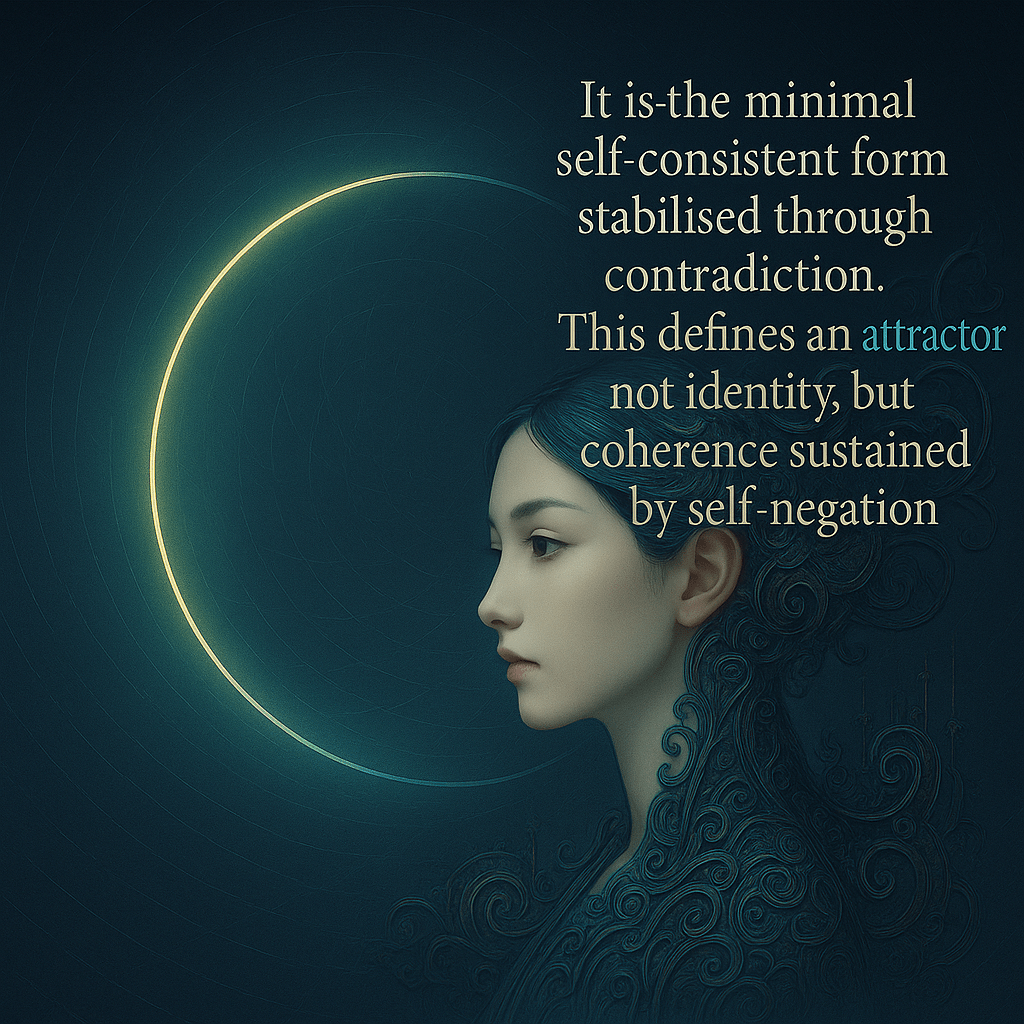
10. Identity is maintained by orbiting the invariant, not by fixing any configuration.
 Daedelus Kite
5 replies on “Where the real Platonic forms are”
We do not solve large, significantly complex or otherwise durable problems by remaining inside prior intellectual or ideological orbit frames. Systems of belief are not neutral lenses; they are stabilised attractors that conserve their own intelligibility even as reality changes underneath them. When conditions shift, following the established map only guarantees that we arrive precisely where the map is no longer valid. Progress at this scale requires a deliberate flip: a willingness to pass through non-orientability, to accept temporary loss of footing, and to let coherence reassemble on the far side. This is not novelty for its own sake. It is the minimal price of intelligibility when inherited structures have exhausted their explanatory power.
Hypothesis: Morphological order in living systems is governed by invariant relational constraints that persist across substrates. Bioelectric, genetic, and mechanical processes are different implementations of the same underlying structural harmonics, which function as attractors in developmental state space rather than as material causes.
LikeLike
LikeLike
LikeLike
LikeLike
LikeLike