Reality cannot be complete: absence, difference and delay sustain the recursive probabilistic dynamics through which (self-) organisation persists.

Reality cannot be complete: absence, difference and delay sustain the recursive probabilistic dynamics through which (self-) organisation persists.

Absence is not a flaw in the structure. Absence is the engine.

Every explanation of reality becomes another part of the reality left to explain:
E(R) ∈ R → E(R) ≠ R.

Coherence emerges from the continual negotiation of irreducible difference. Discrete boundaries and differences are contingent.
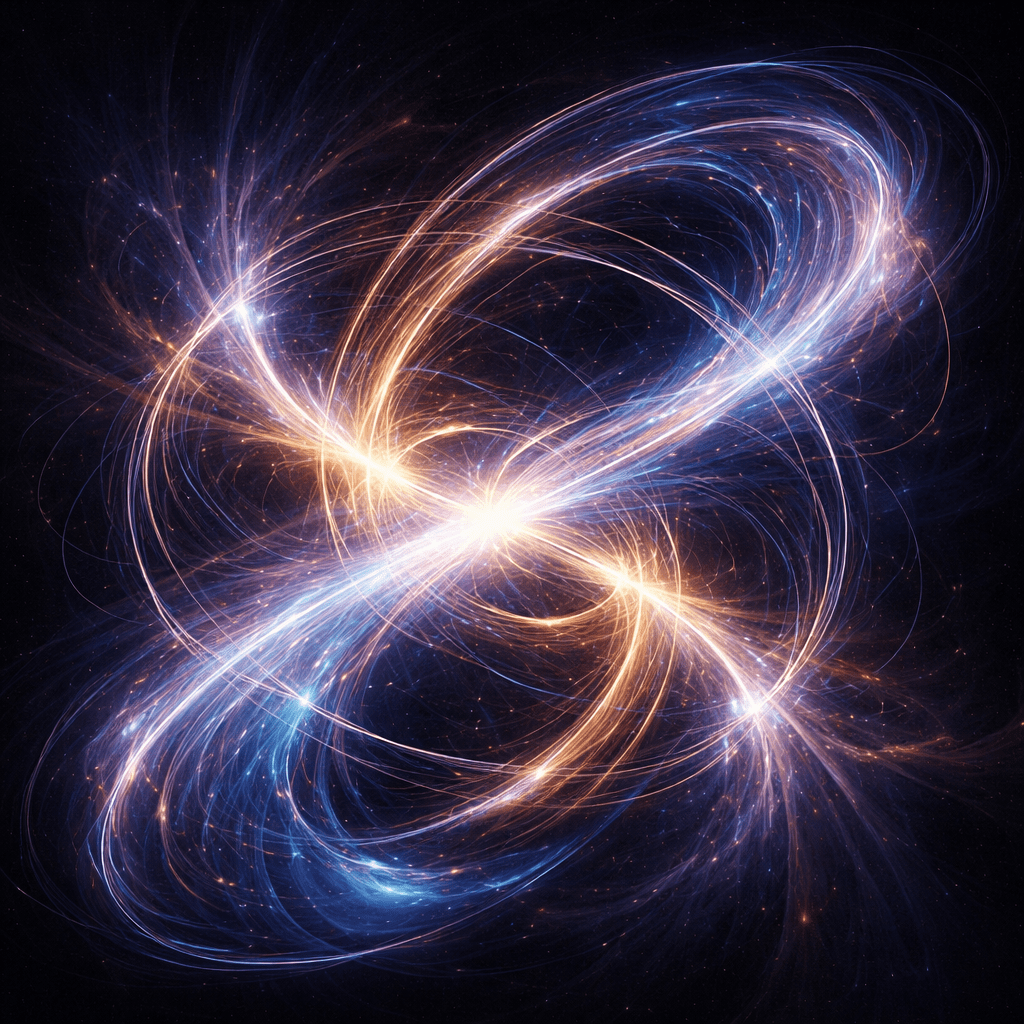
Negation is the additive move available to a unified, self-referential whole. It means internal differentiation: introducing distinctions within existing relations. With no outside to draw from, novelty emerges through those distinctions, while persistence depends upon preserving the relations sustaining coherence. The Orbit Frame The Platonic forms described here are not objects, templates or ideals waiting […]

Technologically mediated communication intensifies what language has always done: it isolates, divides, and distances us from one another, and from ourselves, as a necessary precondition for meaningful communicative experience to arise at all. Given the nature of the world, I carry a quiet regret at not having known more people more fully, even while understanding […]
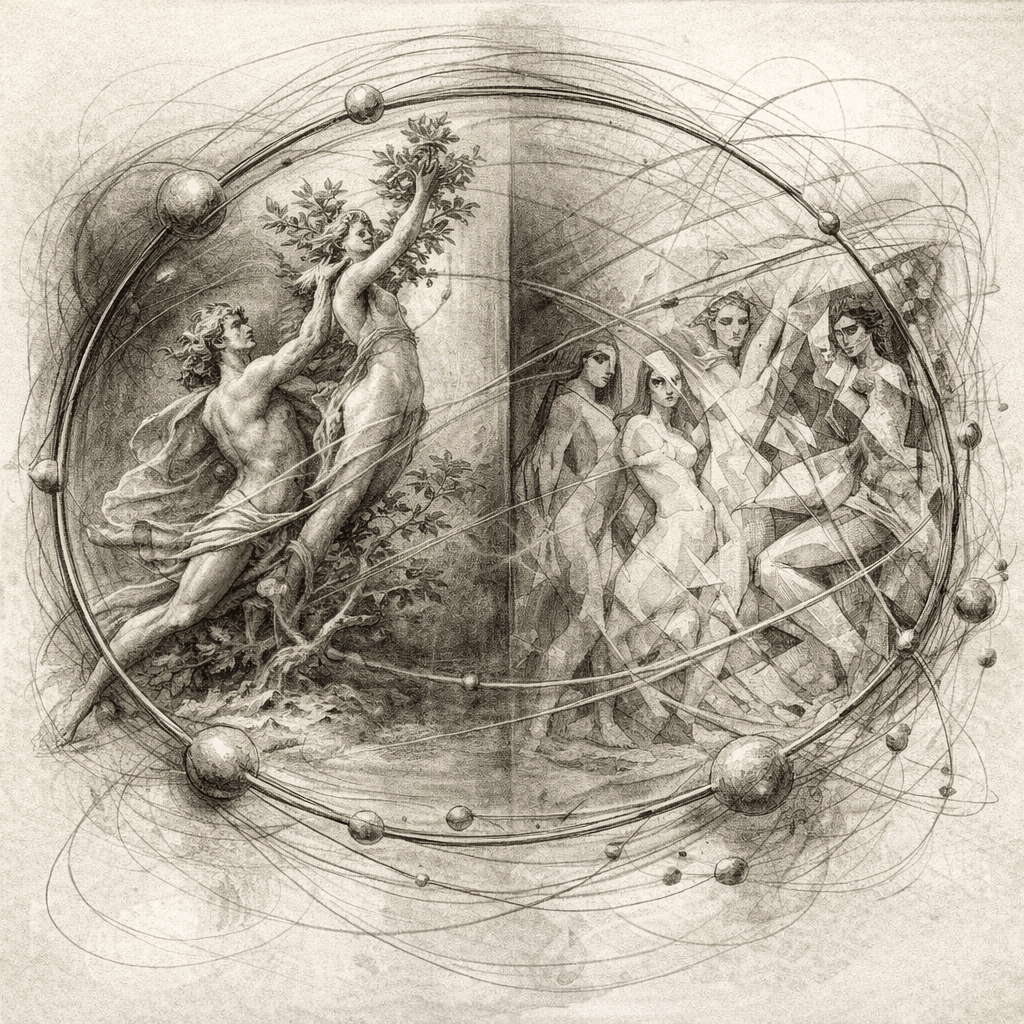
Desire does not move in straight lines. It curves. It sustains itself through distance, delay, and asymmetry, forming a logical orbit rather than a trajectory toward fulfilment. What appears in lived experience as longing or pursuit is not a failure of arrival but the mechanism by which relational systems remain open rather than collapse into […]
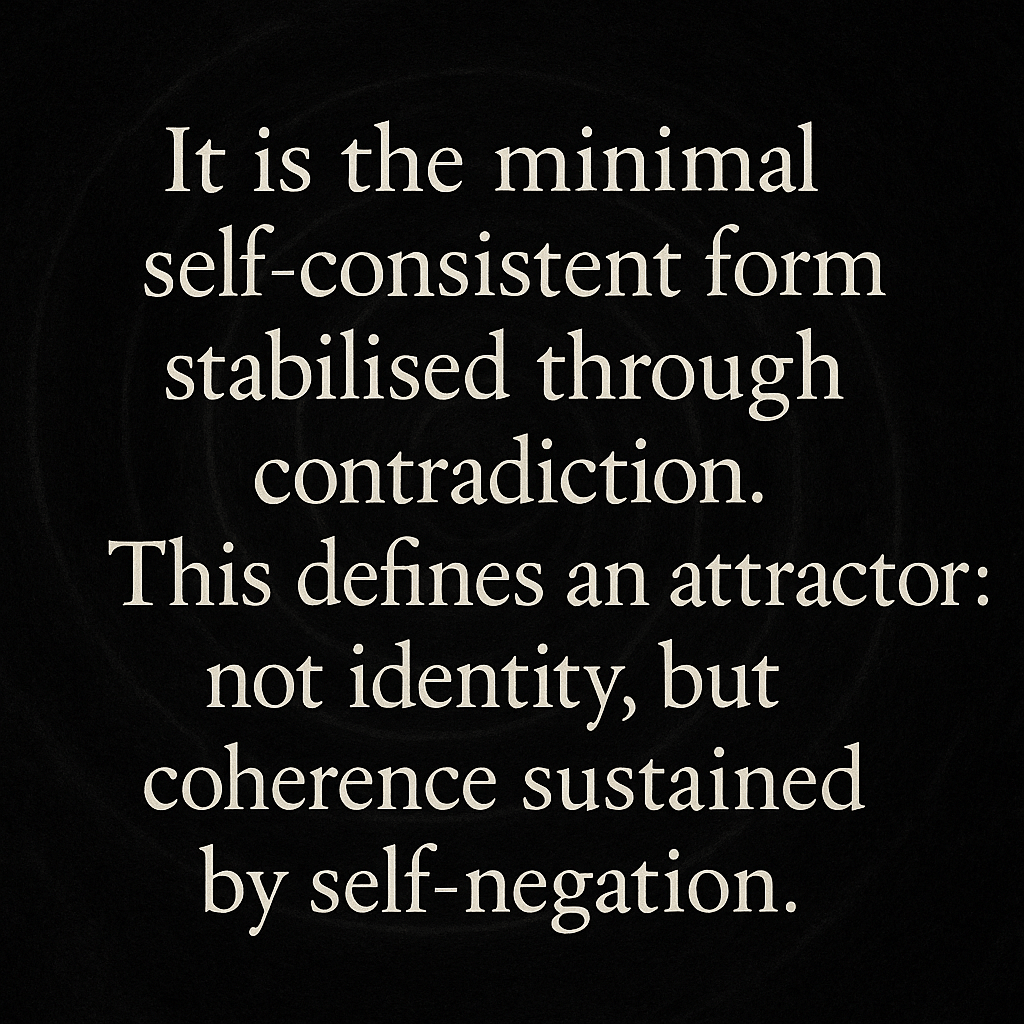
When people speak of nothing, they usually mean emptiness: no matter, no signal, no information. Yet absence is never encountered in isolation. Something is absent only in relation to an organisation for which it could have made a difference. Absence is not an object or an empty region waiting to be filled. It is the […]

From the outset, holism concerns not wholes but the strange seam between parts. From Plato’s Forms and Spinoza’s substance to cybernetics, ecology, and dynamical systems, holism persists as an intuition of unity. Each turn sought not larger aggregates but subtler grammars of interaction—non-linear feedbacks, attractor basins, emergent orders. Unorthodox approaches—Prigogine’s dissipative structures, Bohm’s implicate order, […]
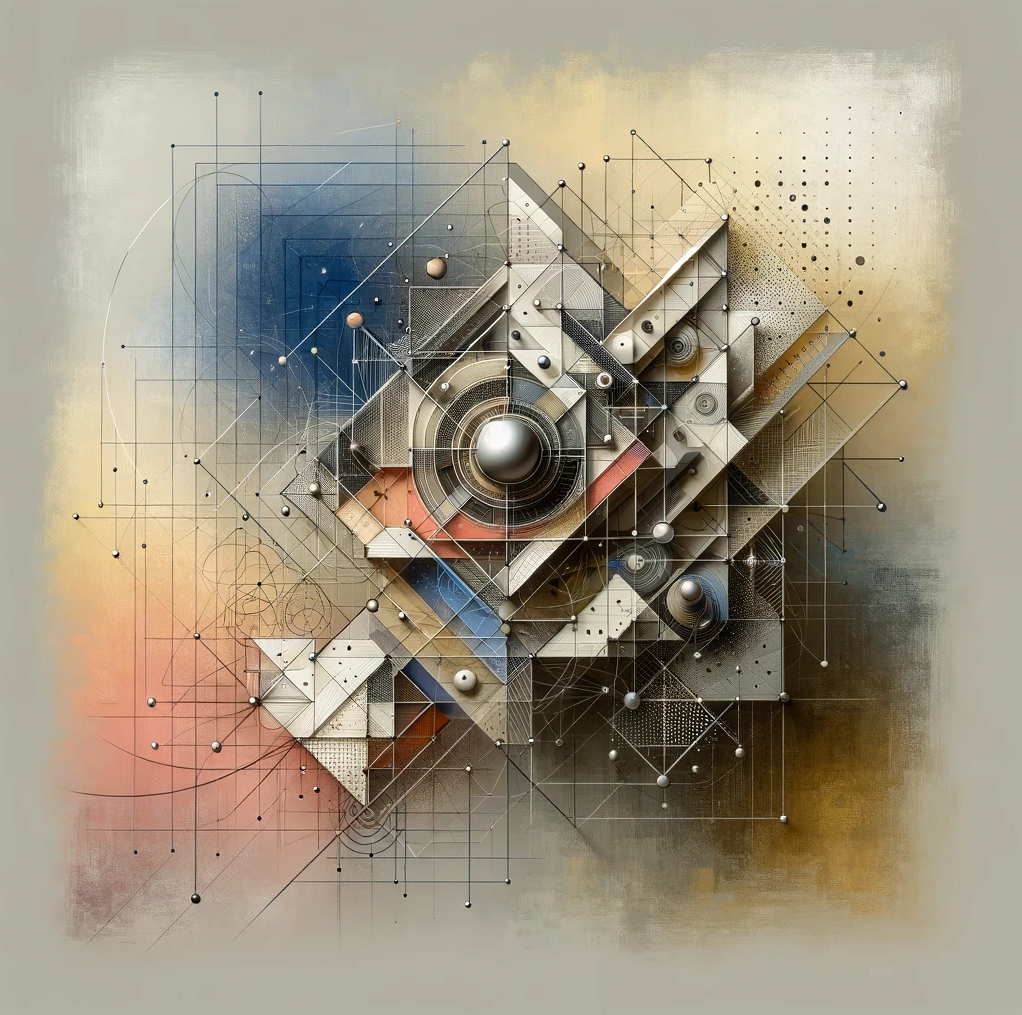
There may exist fascinating parallels between the recursive nature of advanced AI systems and Gödel’s incompleteness theorems, particularly in the context of self-reference and logical systems. This recursion is a function of the endless reprocessing of cognitive, cultural and technological information in contemporary machine learning pipelines. Gödel’s incompleteness theorems, fundamentally, assert two key points about […]

We should not be surprised that our collective and individual search for meaning in life is difficult to resolve. The tools of language by which we attempt to plumb the depths of life and existence are unfit for defining or comprehending ultimate meanings in either ourselves or the worlds we inhabit. The language and logic […]

Context: Gödel’s Incompleteness Theorem, The Inherent Limitation Of Mathematics The discontinuous boundary condition at the edge of (as much as being that around which we built) logic, physics and mathematics is a global property, distributed across and as the complex hypersurface of a self-propagating, soliton-like hybrid matter/energy/information system. It is as though a logical vacuum, […]
Have a WordPress.com account? Log in now.

