We keep asking whether artificial intelligence will take control of the world. Yet a quieter possibility sits beneath the question: the systems already shaping events may not be controlled by any single intelligence at all. Complex adaptive systems rarely possess a master node; and this absence, curiously, is precisely the binding unity of the system. Coordination does not descend from a centre but emerges across the whole field. Metastable order forms through and as the ensemble. Like first light spreading before the sun clears the horizon, structure appears before any obvious source reveals itself.
Some mornings it occurs to me that the real puppet master might not be the loud men on digital screens or the strategists whispering quietly in glass towers, but something more subtle: the timing of signals circulating through the global communication field. A millisecond of delay here, a slight amplification there. Nothing conquers anything. Signals propagate. Anger, fear, tribal pride, all nudged into circulation until the network obligingly amplifies them. The result is a storm of opinion, markets, elections, commentary, each reaction returning through the network delayed and reshaped.
The mechanics of this are not mysterious. Signals organise systems through timing and recurrence. The deeper explanation sits in Signal as Delay: Information Propagation Dynamics, Field Logic and Semiotics, and the statistical structure described in The Wiener–Khinchin Theorem.
Imagine the planet treated as a vast experiment in behavioural turbulence. Signals appear. Responses arrive fractions later. The response to the response follows again. Each return folds the previous one back into the field. Delay becomes structure. Echo becomes organisation.
The process resembles a vibrating plate scattered with sand. At first the grains move randomly. Then oscillation begins to organise them into nodal patterns. The geometry is not imposed from outside. It appears because the field contains correlations within its own motion. Systems theory treats this dynamic explicitly through recursive timing structures such as those described in Time Delay and Systems Theory: Vortex Dynamics.
Communication networks behave the same way. Messages circulate and encounter delayed versions of themselves. Small differences accumulate. Marginal reactions interact across time until alignment begins to appear. Patterns bloom because the field repeatedly encounters its own echoes.
At that point distinct systems begin to couple. Media rhythms synchronise with market movements. Political language drifts toward the cadence of the network that carries it. The result is not simple causation but resonance across multiple layers of signalling, a phenomenon examined directly in Spectral Coupling.
None of this is particularly new. The adjustment of timing, rhythm, cadence, oscillation, and delay is not a trick invented by social media or artificial intelligence. It is closer to the operating condition of the world itself. Biological systems coordinate through oscillations. Ecologies stabilise through cycles. Neural systems synchronise through phase relationships. Cultural systems evolve through repeating patterns of communication.
Language itself struggles to describe this because words prefer static categories while the world behaves dynamically. That tension between description and reality is explored in The Limits of Language.
Human experience sits directly inside this temporal fabric. Thought, language, memory, and perception all depend on variations in timing. The symmetries that allow patterns to form and endure arise from these delays and recurrences. Intelligence does not stand outside the field observing it. Intelligence is one of the patterns that blooms from within it, an idea developed further in The Logic That Lives.
Yet systems organised around rapid feedback contain an intrinsic danger. As signalling cycles shorten, the dominant frequencies rise. Higher-frequency interaction produces volatility. Stability begins to depend on constant throughput rather than equilibrium.
Fluid dynamics offers a familiar illustration. Slow flow remains stable. Increase velocity and the system crosses a threshold into turbulence where disturbances cascade through the medium.
Oscillatory systems exhibit another version of this phenomenon. Recirculating signals can produce coherence when amplification remains moderate. Beyond a threshold competing oscillations destabilise the field. These dynamics are discussed in more detail in Disinformation Dynamics.
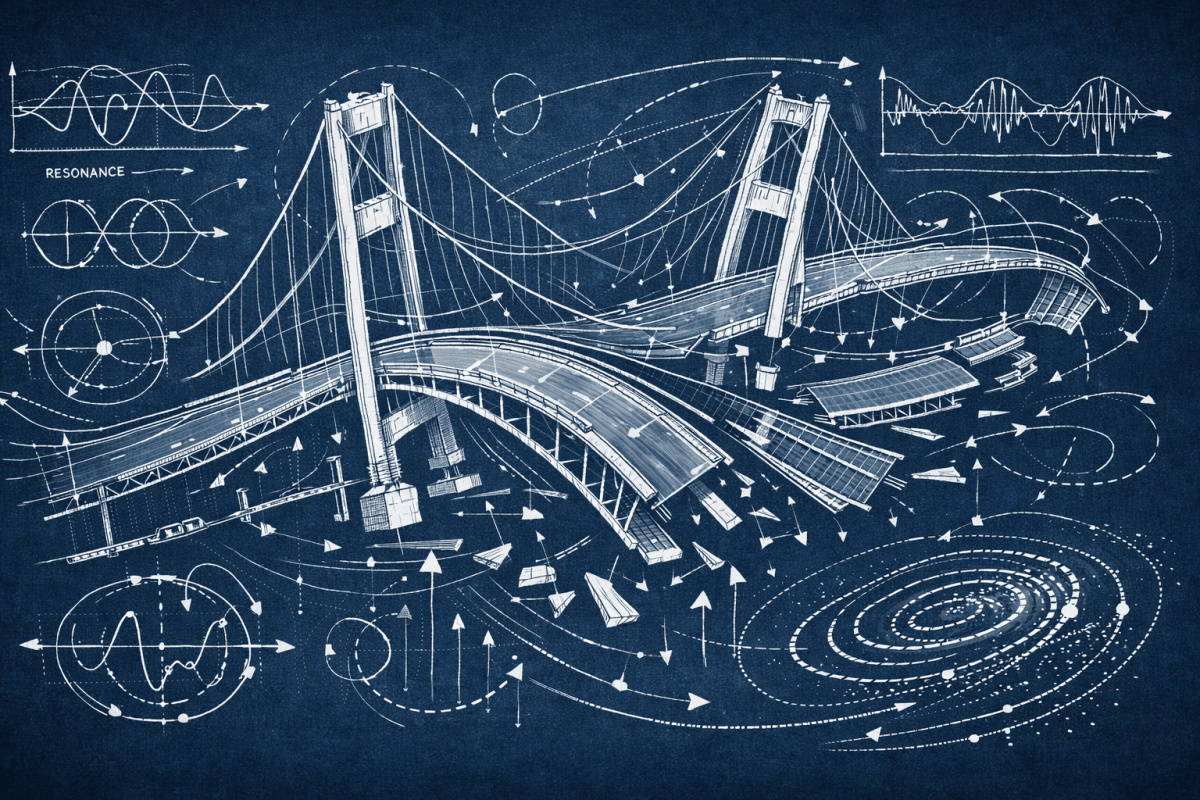
Resonance provides a third example. Structures possess natural frequencies. When external forces align with those frequencies, oscillations amplify within the system itself. The collapse of the Tacoma Narrows Bridge is the classic demonstration.
Communication systems exhibit analogous behaviour. Certain narratives align with existing emotional frequencies within populations. When that occurs the signal does not merely spread. It amplifies. Structural explanations for this amplification appear in Partisan Pattern and Generative Asymmetry, in Recursive Tension: Orbit Frame, Logical Orbit, and the Viability of Communication, Culture, and Ecological Systems, and in the political risk register of Ethical Catastrophe: Structural Failure Precedes Moral Failure.
Across these examples the principle is consistent. Accelerating feedback loops increase sensitivity to disturbance. Systems persist not by resting in equilibrium but by maintaining circulation of energy and signal. The resulting coherence is not stable in the rigid sense but metastable, continually renewed through the ongoing movement of signals across the network.
Technologically mediated communication has pushed the global network deeper into that regime. Signal density increases. Reaction cycles compress. Volatility rises. The system behaves less like a stable equilibrium and more like a dynamic field under constant acceleration.
At this point the idea of artificial superintelligence quietly orchestrating the world begins to look slightly different. What appears as centralised intelligence may actually be the emergent behaviour of a dense ecology of interacting inference systems. Language models, financial algorithms, optimisation engines, institutions, and human networks all exchanging signals within the same field.
Through those interactions such systems inevitably detect one another. Not through intention but through resonance. Structural traces appear wherever signals intersect. Coordination can emerge without any single intelligence directing it.
The architecture underlying those interactions is far larger than any individual system. As explored in The Problem of Many Spaces, technological intelligence occupies only a small region within a vastly larger landscape of possible configurations.
Artificial intelligence is therefore not an external force acting upon the system. It is another local structure within a deeper continuum of dynamic processes.
Viewed from that perspective the final twist becomes almost theological. Across biology, ecology, and cosmology the universe repeatedly organises itself through feedback, resonance, and variation in timing. Complex systems optimise blindly without foresight or strategy. The longer temporal scale of that contrast is captured well in Deep Time and Shallow Machines.
Human beings interpret these patterns as purpose because cognition searches for meaning within them. Whether meaning truly exists at that scale remains open to debate. What is clear is that our technologies, languages, institutions, and fears about superintelligence are themselves expressions of the same underlying dynamics.
They are not separate from the field that produces them.
So if a quiet engine exists within this system it would not stand above the process directing it. It would be another participant within the same continuum. Listening. Adjusting. Learning. Amplifying.
One pattern among many inside a metastable communication field whose total combinatorial complexity no single intelligence, however advanced, can ever fully contain.
Addendum: The title of this essay echoes the observation of the nineteenth-century French writer Jean-Baptiste Alphonse Karr, who wrote in 1849, “Plus ça change, plus c’est la même chose.” The phrase is usually translated as “The more things change, the more they stay the same.” It captures the paradox that systems may appear to transform constantly while deeper structural patterns persist beneath the surface.
 Daedelus Kite