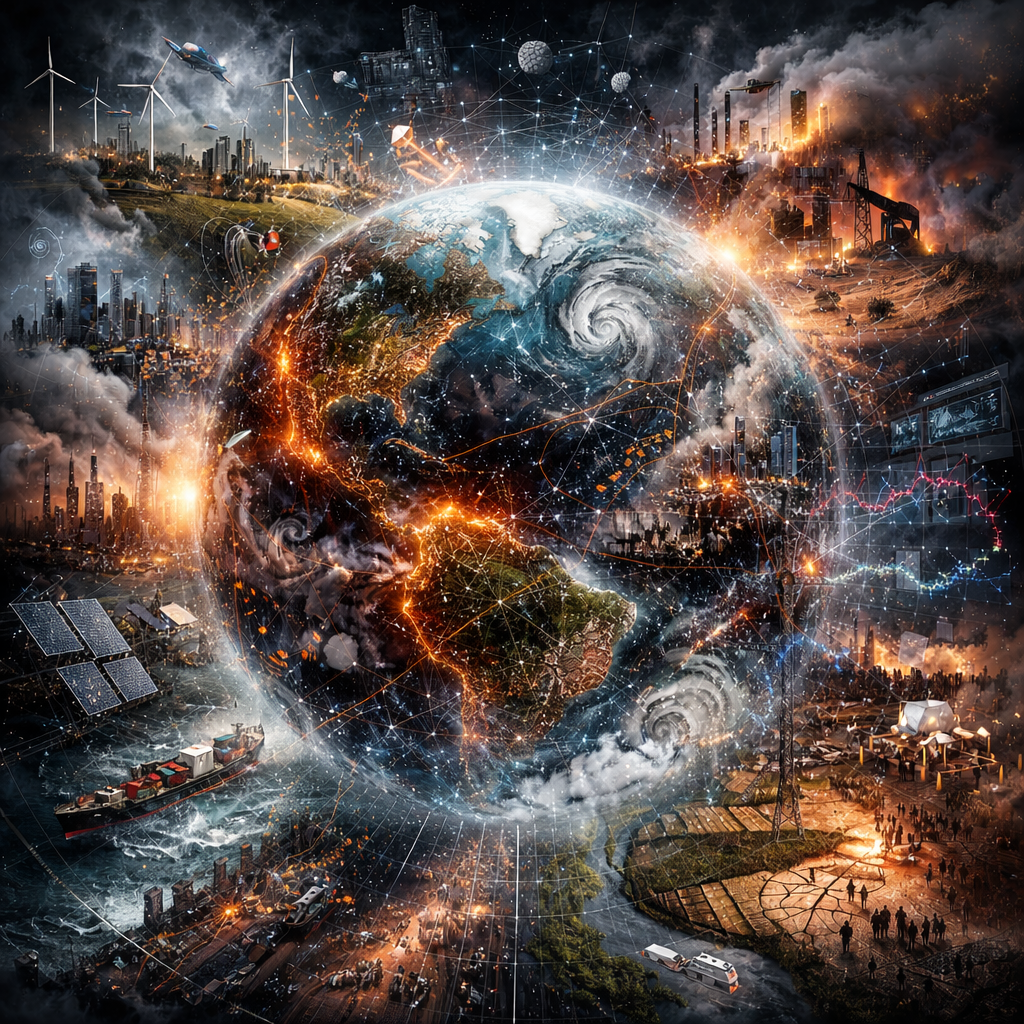
For a long time, serious problem-solving assumed the world could be broken into parts, those parts analysed separately, and the larger situation improved by fixing each component in turn. That still works for bounded problems. It fails when the object is not a part but a whole system composed of vast numbers of interdependent subsystems whose behaviour changes through interaction. Climate change makes this impossible to ignore. What looks, at first glance, like an environmental issue is in fact a planetary process involving atmosphere, ocean, agriculture, supply chains, finance, migration, infrastructure, law, conflict, media, public perception, and political response, all coupled across scales that do not align with human institutions or neat conceptual categories. A drought alters food production. Food prices reshape political stability. Instability shifts state behaviour, energy policy, extraction, investment, borders, and military posture. Those changes alter emissions, adaptation, and public attention, while communication systems themselves select for panic, denial, fatigue, and short-term reaction. Under those conditions, the old habit of dividing reality into manageable sectors becomes actively misleading, because the decisive behaviour of the system does not sit inside any one part. It emerges from the moving relations among them. The required shift in thought is therefore from analysing isolated components to orienting within entangled wholes.
That requirement does not apply only to climate or geopolitics. It applies equally to the observer trying to understand them. The concepts, models, institutions, and descriptive vocabularies used to make sense of large systems are not external to the world they describe; they are themselves products and participants within it. The map is inside the terrain. This is why the problem is deeper than complexity in the ordinary sense. We are not simply dealing with more variables than usual. We are dealing with systems whose apparent unity includes the limits of our own representation, whose coherence depends on feedback, delay, distributed interaction, and partial blindness, and whose behaviour cannot be finalised into a closed diagram without losing what matters most. There is no clean outside. The ambition to control such systems from above is therefore remedial, because it assumes a stable vantage that does not exist. Once many things must be addressed at once, they become another single thing: a whole whose nature includes non-closure, self-implication, and resistance to complete explanation. The task then is not mastery in the old sense, but disciplined participation within a reality too self-entangled to be reduced without distortion, including through the very acts of description by which we try to make it still.
Categories
Climate System Complexity
 Daedelus Kite