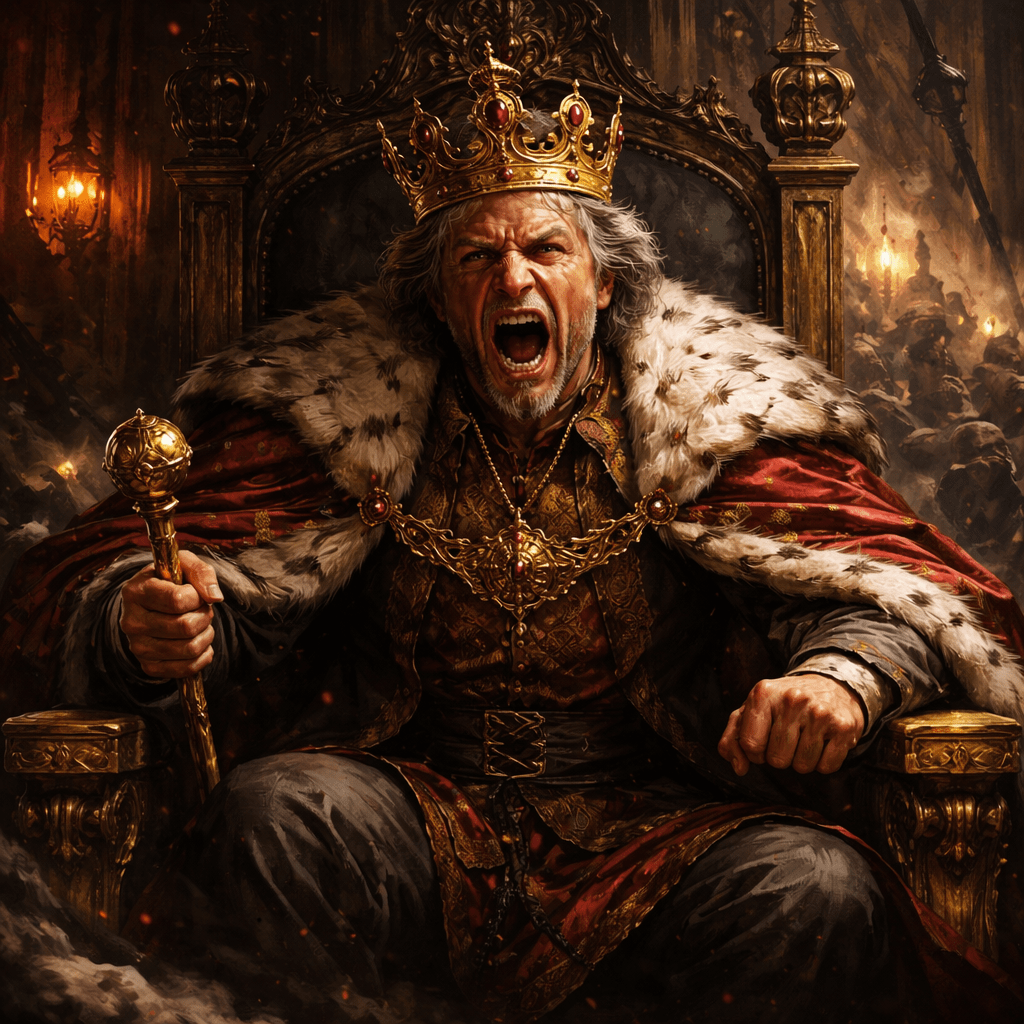
The Mad King is usually treated as a personality problem. History supplies familiar figures. Erratic rulers, impulsive leaders, volatile decision makers whose behaviour appears to bend events. Yet this framing may be backwards. Instability at the top of power hierarchies may emerge not from individual psychology but from the structure of complex social systems themselves, inflected through and as the individuals who appear to lead them.
Large societies organise through distinction. Inside and outside. Self and other. Security and threat. These boundaries do not merely separate. They generate cohesion. A group stabilises itself through difference. Identity becomes meaningful because it is contrasted with what lies beyond it. This tension is productive. It creates coherence, belonging, and orientation. But the same generative difference also produces insecurity. The boundary must be maintained. The outside must be interpreted. The system quietly becomes tuned to vulnerability as a condition of stability, and leadership emerges from within this tension rather than above it.
This makes identity-based narratives unusually powerful. They operate at minimal cognitive cost while activating deep emotional structure. Us and them. Belonging and exclusion. Safety and danger. These signals propagate rapidly, especially in technologically mediated environments where communication outruns reflection. Once activated, they generate feedback. Suspicion encourages defensive behaviour. Defensive behaviour appears to confirm suspicion. The narrative begins reproducing the conditions that validate it, and leaders increasingly act within that recursive frame.
Historical memory reinforces the pattern. Conflict leaves stronger institutional and psychological traces than cooperation. Wars shape institutions. Threats shape governance. Crisis shapes expectation. Over time, societies develop interpretive biases. Ambiguity is read as risk. Difference is read as danger. The past becomes a tuning mechanism for present perception. What begins as adaptation becomes reflex. Leadership behaviour is then shaped by inherited expectations as much as present realities.
Commerce, technology, and power intensify these dynamics. Conflict attracts attention. Attention drives economic and political reward. Media systems amplify signals that sustain engagement. Political structures metabolise insecurity into authority. Technological mediation accelerates the entire process. The result is a communication field biased toward volatility. Not because individuals consciously seek conflict, but because system-level incentives quietly favour it. Leaders emerge and act within this field, shaped by its pressures and feedback.
Within this environment, leadership begins to reflect systemic instability. Decision makers operate within distributed cognition. Intelligence becomes extended across institutions, analytics, media, and feedback loops. When this cognitive field fragments, leadership appears erratic. Administrative incompetence emerges as misalignment within extended cognition. The leader becomes the visible oscillation of deeper structural tensions, a node within a wider dynamical pattern.
This dynamic is not limited to politics. Biological systems exhibit similar patterns. Organisms maintain identity through boundaries. They exchange information and energy with their environment while preserving difference. Remove the boundary and the organism dissolves. Harden it excessively and adaptation fails. Stability emerges from tension between inside and outside. Complex societies operate under comparable constraints, and their leadership reflects these same structural dynamics.
The Mad King then becomes less an anomaly and more a signal. Conflict sustains identity. Identity sustains cohesion. Yet excessive conflict destabilises the very structures that depend on it. Civilisations drift within this tension, rarely questioning whether conflict has become habitual rather than necessary. The instability appears personal, but the logic is systemic, inflected through and as leadership itself.
In this sense, the Mad King may be the civilisational gift wrapping around a deeper dilemma. Commerce, technology, identity, and power become entangled in recursive feedback. Insecurity generates cohesion. Cohesion generates exclusion. Exclusion generates further insecurity. The cycle sustains itself. The leader becomes the condensation point where these tensions become visible, and perhaps unavoidable.
The novelty of the present lies in scale and speed. Technologically mediated cognition amplifies boundary signals and accelerates feedback. What once unfolded slowly now oscillates rapidly. The Mad King appears more frequently, not because individuals have changed, but because the system has intensified its own generative tensions. Unity depends on difference. Difference produces instability. Civilisations evolve within that unresolved logic, inflected through and as those who appear to govern them.
 Daedelus Kite