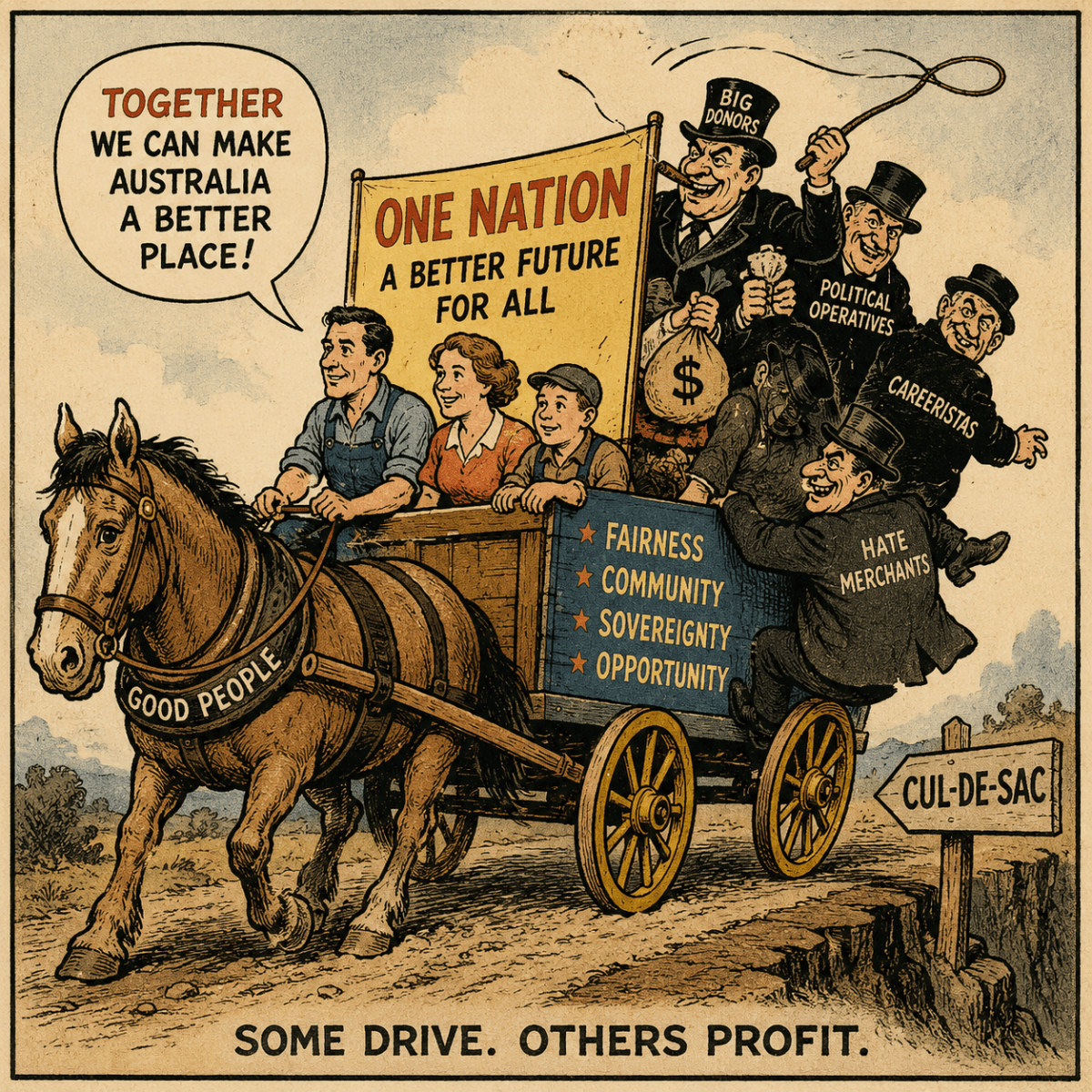
They paint themselves into a hyper-simplistic corner because simplified narratives feel stabilising during periods of systemic uncertainty. But once political language collapses into slogans, binaries, and permanent outrage, the capacity to think strategically about complex realities begins to erode. The rhetoric that initially appears empowering gradually becomes constraining. Every new problem must be forced through the same narrow symbolic vocabulary, regardless of whether the world still fits it.
The paradox is that complexity does not disappear simply because a culture loses the language required to describe it. Economic interdependence, technological acceleration, ecological instability, demographic transition, and geopolitical entanglement continue unfolding regardless of whether public discourse has reduced itself to memes and grievances. The result is a peculiar form of civilisational claustrophobia: societies surrounded by unprecedented complexity while increasingly equipped only with emotionally gratifying simplifications.
Eventually the symbolic frame becomes so compressed that deviation itself appears threatening. Nuance is interpreted as weakness, ambiguity as betrayal, reflection as elitism. At that point politics stops functioning as collective navigation and starts functioning as identity maintenance under stress. The system no longer asks, “What is true?” or even “What works?” but “What preserves coherence inside the tribe?”
That is the real corner. Not ideological defeat, but cognitive enclosure.
Categories
One Nation: a Populist Cul-de-Sac of Good Intentions