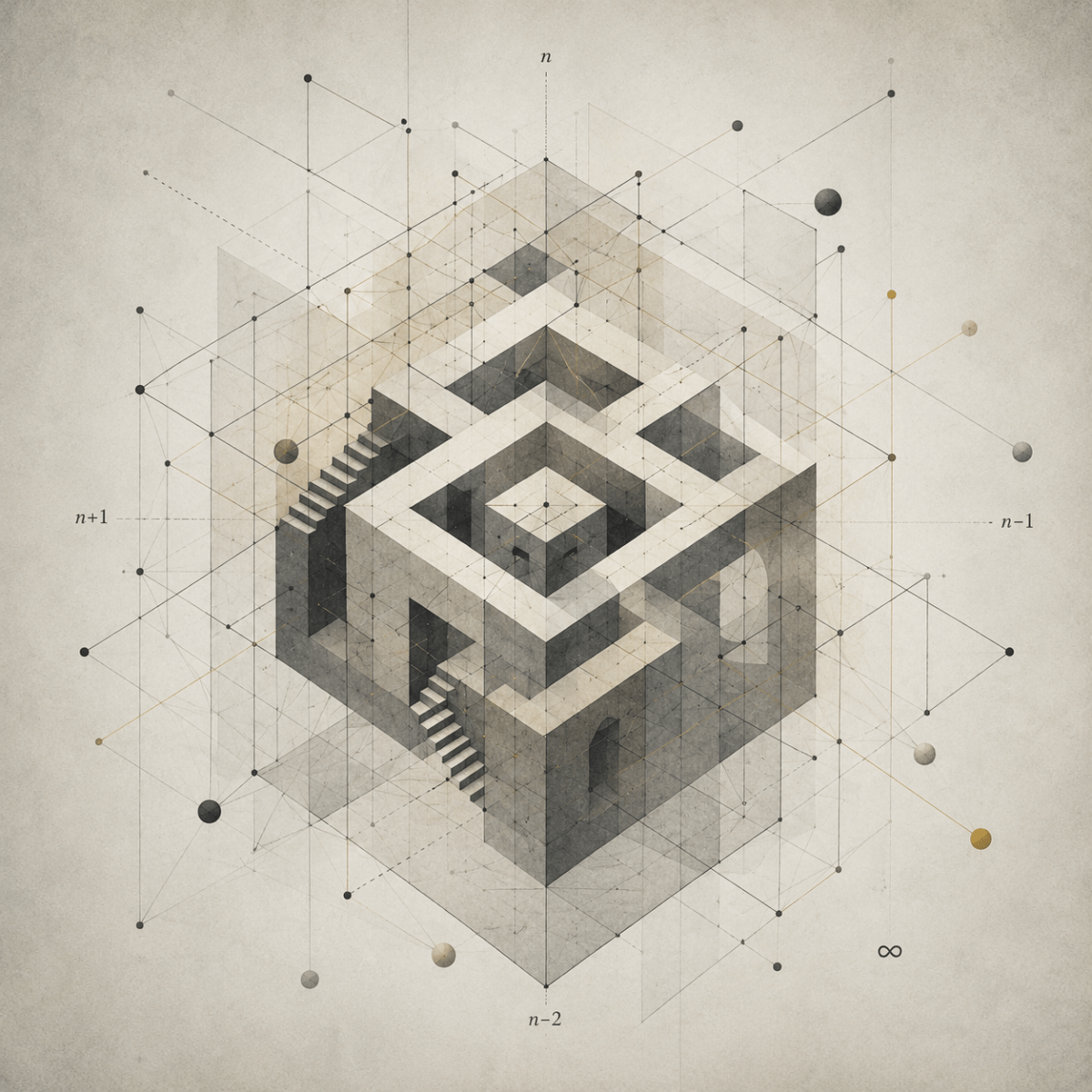
Most people encounter probability as a number. A weather forecast predicts rain. An insurer estimates risk. A casino calculates odds. Probability appears to be a way of measuring uncertainty after the fact. Yet something stranger is happening beneath the surface. When two six-sided dice are thrown, the number seven appears more often than any other result because there are more ways for it to occur. There is only one way to produce two and one way to produce twelve, but six distinct combinations produce seven. Probability is not merely a property of outcomes, but a function of the number of relationships capable of producing those outcomes. The significance of this observation extends far beyond games of chance. It suggests that recurrence belongs not primarily to things, but to the structures through which things become possible. Probability reveals something about probability itself. The likelihood of an event is not merely a measurement. It is evidence that possibility possesses shape.
Something similar occurs throughout language, culture, technology, and history. Certain words, symbols, narratives, institutions, and identities acquire extraordinary durability not because they possess greater accuracy but because they can combine with many different contexts. Terms such as freedom, security, progress, nation, crisis, innovation, or justice survive precisely because they remain partially indeterminate. They absorb new meanings while retaining enough continuity to remain recognisable. Political movements, religions, media systems, markets, and technological platforms all exploit this property. The most successful signs are often those capable of forming the greatest number of relationships. Their apparent stability emerges from their flexibility. They persist because they can travel. They travel because there are many ways for them to become meaningful again.
Language may be the clearest example of all. Words survive not because they possess fixed meanings, but because they can participate in many different relationships. A word acquires significance through the network of other words, experiences, emotions, memories, and situations with which it becomes associated. The most durable words are often those capable of operating across many domains at once. Meaning is therefore not stored inside a word like water inside a bucket. It emerges through patterns of relation distributed across a communicative field. Language persists because it is semantically promiscuous. The same word can be spoken by different people, in different centuries, for different purposes, while remaining recognisably the same word. Its stability is produced by its capacity for transformation.
The philosophical implication may be deeper still. We often imagine that reality is composed of concrete things, with abstractions arriving later as descriptions of those things. Yet recurrence points in the opposite direction. A whirlpool is not hidden inside water waiting to emerge. The spiral is a stable possibility within a field of relations involving flow, pressure, gravity, boundary, and motion. Likewise, seven is not waiting inside the dice. Both are local expressions of deeper geometries of possibility. Reality is not made of matter first and meaning later. It is made of binding relations through which abstraction becomes concrete and the concrete becomes intelligible. What recurs is not merely the thing but the possibility of its becoming. The world remembers what can be repeatedly reconstructed. Seven is not privileged because it exists. Seven is privileged because there are more ways for it to become.
References
Barabási, A.-L. (2002) Linked: The New Science of Networks. Cambridge, MA: Perseus Publishing.
Shannon, C.E. (1948) ‘A Mathematical Theory of Communication’, Bell System Technical Journal, 27(3), pp. 379–423; 27(4), pp. 623–656.

