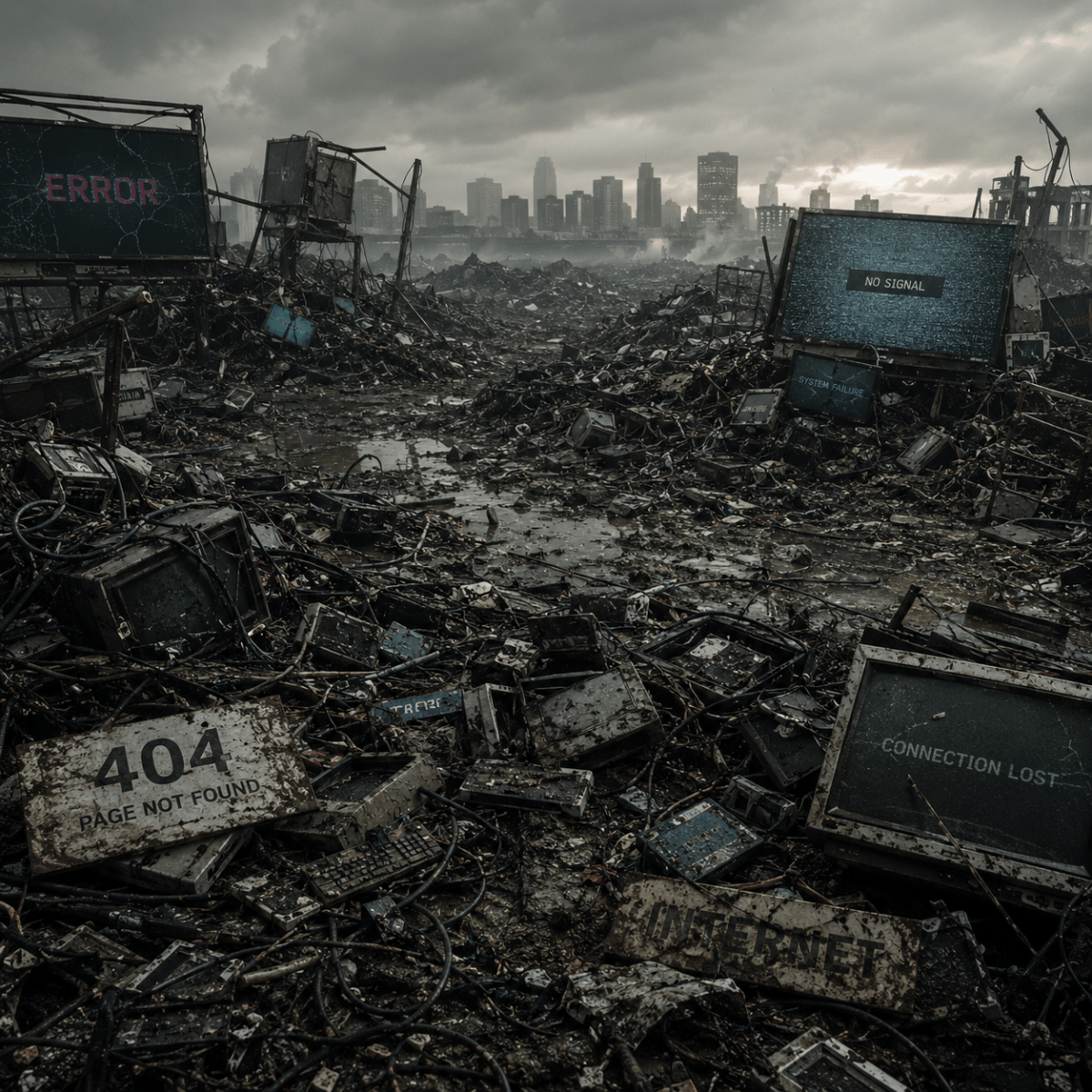
The internet used to be a junkyard. At least junkyards have provenance. A bent axle once belonged to a truck. A rusted door once opened somewhere. The modern network is something stranger: a continent-sized landfill manufacturing fresh landfill from the fumes rising off older landfill. The machines scrape the ruins, digest the ruins, and excrete statistically optimised replicas of the ruins. Then they return to feed again. The cycle repeats because repetition itself has become the product.
Nobody is steering this thing. There is no cabal in a bunker polishing a master plan beneath fluorescent lights. There are only incentives, millions of them, quietly converging. Platforms require attention. Attention requires novelty. Novelty requires volume. Volume requires automation. Automation requires training data. The training data increasingly consists of automation. Somewhere inside that loop, the distinction between signal and residue begins to erode. The map is copied from another map. The photocopy is copied again. Eventually the landscape disappears beneath its own documentation.
The infotainment tesseract does not care. It cannot care. Its metabolism is throughput. Every outrage, every opinion, every synthetic photograph, every article generated for no audience beyond another algorithm is merely fuel passing through a larger digestive tract. The old promise was universal access to knowledge. The realised form is closer to an automated weather system of recurring symbols. Vast storms of language circle the globe searching for somewhere to land, only to discover they were generated by previous storms.
The tragedy is not that artificial intelligence may replace human thought. The tragedy is that human thought risks becoming increasingly difficult to locate amidst the sediment. Experience takes time. Observation takes time. Craft takes time. Revision takes time. The machine can generate a million approximations before breakfast, each one convincing enough to survive a glance and hollow enough to collapse under inspection. Quantity acquires the appearance of reality simply by occupying all available space.
And so the wasteland grows. Not with a bang, nor even with a whimper, but with an endless low electrical hum. Server farms teaching server farms what previous server farms thought people might have meant. Mountains of synthetic artefacts accumulating beneath a darkening sky of their own manufacture. Somewhere beyond the glow of the screens, reality remains stubbornly present. Mud. Blood. Love. Hunger. Death. Wind moving through trees. The old things. Increasingly distant from the machinery that claims to describe them, yet ultimately the only things from which meaning ever came.
Categories
infinite machine: junkyard automation
The internet did not die; it was embalmed alive, taught to imitate its own pulse, and released back into the world as an infinite machine for converting human meaning into synthetic residue.