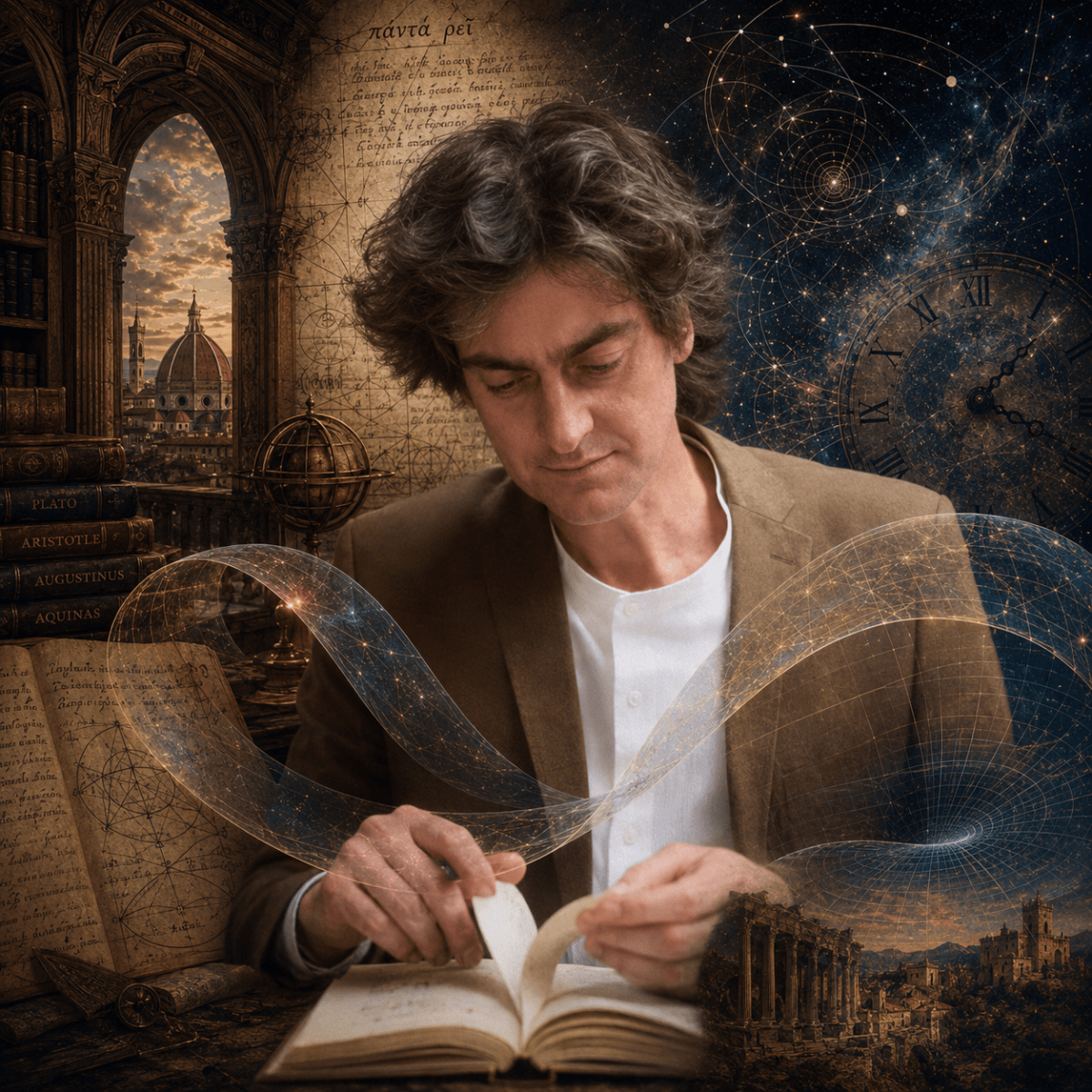
This morning I found myself watching a thoughtful discussion by Johannes A. Niederhauser on Christopher Nolan, time, and Homer. Niederhauser strikes me as something of a champion of the “European spirit”, in the better sense: not as a slogan of identity, but as a demanding inheritance of philosophy, art, language, history and disciplined thought. It is refreshing to encounter someone who is clearly trying to think philosophically rather than merely commenting on culture. His criticism of Nolan is constructive rather than dismissive. Nolan’s achievement as a filmmaker is not the issue. The question is whether his treatment of time remains bound to a modern technical imagination, where time becomes measurable, manipulable and containable. It is precisely because Nolan takes the question seriously that the philosophical difference becomes worth examining.
I was equally impressed by another of Niederhauser’s recent reflections, this time examining Jordan Peterson’s (ie commercial, political) interpretation of Friedrich Nietzsche. Niederhauser does not merely dismiss Peterson’s Nietzsche; he demonstrates the problem with care. Philosophical claims are measured against texts, historical context, and disciplined interpretation rather than reputation, popularity or public performance. The contrast matters. Peterson has increasingly attached his public authority to the most corruptible instincts of contemporary American politics and business. Interpretation is never innocent once it becomes public influence. A thinker who claims to interpret Nietzsche while aligning himself so closely with power, spectacle and political identity risks allowing those commitments to shape the interpretation itself.
Taken together, those discussions returned me to a question that has followed me since I first became interested in astronomy and physics as a teenager. Time has never felt like one problem among many. It has sat near the centre of almost every serious question I have had about reality, observation and meaning. The more closely I have looked at it, the less it has resembled a simple container through which events pass.
Time and meaning appear to share a relational structure. Neither is adequately understood as an isolated object waiting to be measured or interpreted from nowhere. Both involve relation, sequence, orientation, delay and finite access. Interpretation is locally situated. Every perspective reveals something while concealing something else. Understanding is never independent of the position from which it becomes possible.
It is for that reason that my own experiences in academia came back to mind. My criticisms of universities are grounded in those experiences, but the issue is not merely personal. Institutions must construct frameworks for teaching, researching and evaluating knowledge, yet there is always the risk that the framework gradually becomes mistaken for the inquiry itself. I encountered something of that in cybernetics. The more seriously I studied it, the less it appeared to be a body of knowledge that could simply be mastered, packaged and accredited. It felt more like an expanding horizon, where every answer reorganised the questions that followed.
That is why I found parts of academia frustrating. Universities have to organise knowledge; without structure they could not function. The difficulty comes when organisational requirements begin to govern what can be thought, said, funded, supervised or recognised. My experience was that there were thoughtful, capable people throughout the institution, yet they often worked within structures that rewarded administration, performance and institutional reproduction more reliably than open-ended exploration. Curiosity survives in such places, but it often has to work against the grain of the organisation that claims to support it.
Christopher Nolan’s Tenet has fascinated me for years because it gives cinematic form to multiple temporal orientations cutting through the same world. Forward and backward movement are not merely technical devices; they expose the instability of any single temporal frame. What interests me most is not the inversion itself, but the way each observer inhabits a local orientation while remaining coupled to others whose histories are organised differently. No participant occupies the whole field. Every perspective is partial, delayed and relational. The paradoxes arise because each local frame is sufficient to act within, yet never sufficient to exhaust the organisation from which it emerges.
That points towards a broader problem extending well beyond cinema, philosophy or universities. We are living through an era in which intellectual authority is increasingly rewarded for certainty, performance and political alignment rather than disciplined inquiry. Once ideas become instruments of identity, they cease to function primarily as ideas. They become signals of belonging. Public intellectuals who attach themselves too closely to political movements inevitably risk becoming constrained by them, defending positions they might once have questioned because the movement itself has become the frame within which every question is asked.
Perhaps that is the enduring lesson I took from Niederhauser’s discussions. The challenge is not simply to accumulate better explanations, but to remain aware that every explanation is itself an orientation upon the world. We need interpretive frames; without them thought would be impossible. The difficulty begins when we mistake those frames for reality itself. That seems to me to be as much a philosophical problem as an institutional one, and perhaps one of the oldest questions we continue to rediscover each time we ask what time, meaning, or understanding actually are.
Categories
a philosophical odyssey: niederhauser, nolan, and the meaning of time
The way we think about time quietly shapes the way we think about everything else.
 Daedelus Kite